Showing posts with label brits. Show all posts

Biography Showdown Pt 1: Evelyn Waugh

My biography reading can be divided into categories of "Never heard of 'em, should be interesting" and "I like them, and I want to know more." The former describes my extremely enjoyable foray into the world of the Mitford sisters years ago. Through the Mitfords I became more interested in Evelyn Waugh, whom I've heard of, of course, but had never read. So I picked up a copy of Brideshead the next time I saw it, and it was easily the best thing I read that year. A year or so ago, I picked up Mad World: Evelyn Waugh and the Secrets of Brideshead from the wonderfully anglophilic Nicolas Hoare. It languished rather long on my To be Read pile until the Toronto Public Library strike forced my hand.  

Mad World sets out to do a couple things differently than previous Waugh biographies. First, author Paula Byrne proposes to look not just at Waugh, but closely at the family that inspired Brideshead (and so much other writing), the Lygons. The title, Mad World, is a description of the way of life at Madresfield, a home left entirely to the young-adult children during the furiously fun 1920s. Waugh first came to know Hugh Lygon (the inspiration for Brideshead's Sebastian Flyte) while at Oxford. Waugh's first two terms were rather quiet, but soon after he fell into a group of friends from a rather different social circle: pedigreed boys from Eton, going to Oxford on expectation rather than want. Membership to the Hypocrites' Club (an informal group, bonded more through drinking than anything else) was predicated on wit, beauty, connections, or a combination thereof. Waugh had charm to spare, and was welcomed into the fold. His life would thereafter move in hard-partying, aristocratic circles. Hugh Lygon, unlike Sebastian Flyte to Waugh's Brideshead alter Charles Ryder, would be less of an influence and friend to Waugh than his sisters, most notably the youngest, Coote*. The lives of the Lygon family are followed in close detail, from school-days to death, mirroring the story told of Evelyn Waugh (though the writer remains the main focus).

Paula Byrne also ensures that formerly too-salacious details are left in, in order to create a complete portrait of Waugh, his friends and contemporaries, and the times they lived in. Colin Firth's stuttering King George gives no hint of the womanizing, drug-taking, and homosexual liaisons he was apparently known for.
Prince George, known to his friends as Babe, was bisexual. In 1923 he began a nineteen-year affair with Noel Coward. The threat of scandal was ever present. On one occasion, the royal household had to pay a substantial sum of blackmail money to a Parisian boy to whom Babe had written compromising letters.
It's suggested that Lygon patriarch Lord Beauchamp's exile was in part facilitated by the Royal family's worry that Babe and Beauchamp would be connected. "If the stories of the earl and his footmen reached the press, in however veiled a form, the consequences could be catastrophic. One imagines the King's advisers having nightmares about newspaper headlines along the lines of: 'Royal Princes in Immoral Country House Parties.'" Lord Beauchamp (fictionalised as Lord Marchmain in Brideshead) is forced to leave England in disrepute when his jealous brother-in-law outs him, and recounts Beauchamp's serial exploits with male members of his staff to Beauchamp's wife and law enforcement officials. Despite theses sorts of  very real consequences of being found out, the homosocial/sexual  bonds of a certain set of English young men are presented as expected, normal, and somewhat fashionable for the time. (There's quite a lot about this in Sexual Anarchy as well.)
Homosexuality was considered by many to be a passing phase, which young men would grow out of once they had left Oxford and began to meet young women. In those days it was chic to be ‘queer’ in the same way that it was chic to have a taste for atonal music and Cubist painting. Even old Arthur Waugh acknowledged as much: ‘Alec called on me the other day with a new friend of his, a sodomite, but Alec tella me it is the coming thing.
Of course, this depended a lot on the sorts of circles one moved in.  I suspect the middle and working-classes didn't see it the same way.  The Hypocrites Club at Oxford was "the epicentre of what would now be called the university's gay scene."  What struck me about this aspect of the book, was the ease of (certain) men in their bisexuality.**   Moreover, these affairs aren't simply sexual experimentation; Byrne notes that "there were real love affairs" at Oxford, and that Evelyn later teased a friend for "not having a homosexual phase, saying he had missed out on something special." The difference is striking in that expected and accepted bisexuality is simply not an option today; for men you're either gay or straight, and there's little room in the middle of the spectrum. This led me to a discussion in which it was proposed (by my more learned friend) that homosexuality in general has moved from "a behaviour to an identity." This is not to say that the book examines only, or mostly, this aspect of Waugh's circle, but it was what was most notable to me as a societal comparison.

It is odd, given the examination of Waugh's relationships, sexual and otherwise, that little mention is made of his second wife and mother of all his children, Laura. She's described in teasing — almost unflattering — terms in Waugh's letters before they are married
'She is thin and silent, long nose, no literary ambitions, temperate but not very industrious. I think she will suit me ok and I am very keen on her.'
and then rarely afterwards. Even his first short and ill-advised marriage to "she-Evelyn" gets more time and attention. Byrne is a fine researcher and talented story teller, and the lack of Laura in the narrative leads me to believe that Byrne simply had little to go on. By the time Waugh marries (again), his interest is possibly elsewhere, and as in the above letter, Laura will simply be enough for a wife.  Waugh's loyalty and thoughts — not for nothing — were with the Lygons. Laura is mentioned after marriage almost always in the context of having children (she would have seven), usually while Waugh is away somewhere writing. Raising these children mostly on her own through WWII, Laura perhaps proved to be industrious after all.  When Brideshead was published, "the response of the Lygon girls was what he most wanted and feared," not just because the book contained composite characters of them (and other society ladies), but because it was their opinion that mattered most to him.

*Previous to his close relationship with the Lygon girls, Waugh had a very close — though not romantic — relationship with Diana Guinness, née Mitford (later Mosley). He even lived with her and her husband in London during an indigent period early in his career.  
**And of course it's just not that way for women, who are expected to perform bisexuality, regardless of their actual sexual orientation, for the viewing pleasure of men. Among other issues, this erases any real sexual agency of women who love women.

Ain't I a Woman?

I first heard of Caitlin Moran's How to be a Woman reading British papers online; it was probably The Guardian tipped me off first. At some point I realised she's the woman who wrote that amazing Lady Gaga article (you can’t get to it on The Times unfortunately: pay-wall). The accolades and press for How to be a Woman began mounting, overseas. Yet North America seemed to take no notice. It wasn't even listed on any of the usual online shopping sites, the library didn't show any record either. Finally, I just gave up. In conversation with a friend last month, however, I learned that the Toronto Public Library had come through. (You can't buy a copy in Canada until May, apparently. Score one for the TPL!).

What you need to know about the mood and message of How to be a Woman is summed up pretty well in this quote:
In the same way that you can tell if some sexism is happening to you by asking the question 'Is this polite, or not?', you can tell whether some misogynistic societal pressure is being exerted on women by calmly inquiring, 'And are the men doing this, as well?'
If they aren't chances are you're dealing with what we strident feminists refer to as 'some total fucking bullshit.'
Moran's not shy about being a feminist, she’s a smart, talented writer, and she's funny as hell.
Frankly, more books need to exist that fall under this designation.


If you've spent more than one semester in a Women's Studies class, you won't find anything new or mind-blowing here. And if that's the case, you should approach this book as I did, more like a funny biography of an interesting character — a bit like Bossypants, but far more explicit about its pro-feminist agenda. And there certainly is an agenda here.
What I AM going to urge you to do, however, is say 'I am a feminist.' For preference, I would like you to stand on a chair and shout 'I AM A FEMINIST' — but this is simply because I believe everything is more exciting if you stand on a chair to do it
Moran wants the reader to know that feminism isn't scary, strident is a good word, and that all the shit that society proscribes for women is actually very, very difficult for most to figure out, let alone attain.

I certainly don't agree with everything Moran says, but not in a “this makes me angry” sort of way. More that I can respect and appreciate her approach, but I can’t reconcile it with my life or experience. For the most part, however, she's certainly willing to be more radical and second-wave-y than your average humorist or memoirist, and I really like that. For one, she really, really likes Germaine Greer (I was never able to make it a third of a way through The Female Eunuch though I should try again, probably). By way of another example, she's able to make the distinction between the empowering aspects of burlesque and pole-dancing classes, and strip-clubs which are decidedly the opposite.
But what are strip clubs if not 'light entertainment' versions of the entire history of misogyny?*

At some point I thought we were going to get into a bad area, when I read the chapter entitled "Why You Should Have Children," but Moran smartly follows this with "Why You Shouldn't Have Children." After all this talk of children, Moran bravely recounts her abortion. I say "bravely" because, as Moran notes, a lot of women won't admit to having had one. After writing about it in The Times, Moran received
a wonderful letter from a well-known feminist columnist who said that, although she had written about abortion many, many times, she had never mentioned her own termination.
'I always feared what would happen if I did. I presumed no one would forgive me. I thought it would — somehow — invalidate my argument.'
Moran's abortion was not done when she was a teenager, or a rape-victim, or any of those "acceptable" reasons for having an abortion, but as a mother of two already (mothers being a demographic I suspect are likely a surprising percentage of those seeking abortions).
A raped teenage girl seeking an abortion — or a mother whose life is endangered by the pregnancy is having a 'good' abortion. She still won't discuss it publicly, or expect her friends to be happy for her, but these women get away with barely any stigmatisation. [I suppose that depends on the company you keep.]
She makes no apologies for her decision and doesn't sugar-coat the experience. It's important she do this, she says, because it's the silence around abortion that lets others create the agenda for us, turn it into a "debate" instead of a real, common event that happens to real people. I actually had short email conversation with Katha Pollitt (!) about this once, how incredibly important it is that we be honest about our abortions, how the women who have had them need to speak up, and say that it's not the end of the world, that many of us have no regrets. Moran, too, has never once doubted that she did the right thing.

Finally, Moran talks about aging. The woman on the cover of How to be a Woman is, I suspect, a woman who said "no" to having all her wrinkles Photoshopped away. There are lines on that face, lines befitting a 35-year-old woman; no more no less. Being a down-to-earth saucy feminist, she is pretty much against — and somewhat confused by — plastic surgery (as she is against high-heels and other seemingly strange feminine frippery). In theory, of course, I agree with her. But she's also got a husband who, after one miscarriage, two kids, and one abortion, said to her "It seems wildly unfair that, for us to reproduce, you have to go through all this ... shit." (Did you swoon a little bit? Because I did when I read it.) I mean, for all she rightly rails against the Princess myth, hasn't she got a Prince Charming right there? For those of us who feel more insecure about relationships, or our ability to sustain them (as a child-free person, I always have a small patch of anxiety that says he'll leave me for a younger, bouncier breeder one day**), aging is fucking terrifying. It's all well and good in theory to say that "[l]ines are your weapons against idiots. Lines are your 'KEEP AWAY FROM THE WISE INTOLERANT WOMAN' sign." But for a good many of us, having anything on our face that says "Keep Away" can lead to a scary life alone. Or maybe that's just me. (I don't think it's just me.) This final chapter is really a show of how confident Caitlin Moran is, in her relationship and her life in general. No, she says, she doesn't have everything figured out, she's not perfect, but she's come a long way, and exists in an emotional place that is worth fighting for. This, of course, is what feminism should be doing for us; giving us the nerve to go with the wrinkles, to have control over our reproductive destiny, and to stand on the chair and say "I'm a feminist." For all that, I still want my Restylane.

*I have always felt uneasy when female friends have gone to strip clubs targeted at men, feeling like they're inherently supporting the objectification we're trying to get away from. I struggle with my thoughts about sex work a lot, but I usually boil it down to: I am pro sex-worker, but I can't be pro sex-work. It's always going to feel like commodified misogyny to me. While there are women, lots of women, who "willingly" enter into sex work, I always wonder if there were other options available, ones that paid as well or better, how many would still choose it? As Moran says
Recently, it has behooved modish magazines to print interviews with young women, who explain that their career as strippers is paying their way through university... If women are having to strip to get an education — in a way that male teenage students are really notably not — then that's a gigantic political issue, not a reason to keep strip clubs going
Having never been in the sex-work industry, I could be totally talking out my ass here, and I don't presume to speak for any sex-worker. I absolutely welcome opinions more formed and educated than mine on this matter.

**Trust me, I get that thinking is just as crap as the people who think I'll regret getting my tubes tied "one day." It's irrational and insecure and I cop to that. Doesn't mean it doesn't live in my head like a low-grade hum.

Missed in '11: Jamrach's Menagerie

The original point of Missed in '11 was to write a lot of small posts about books I read in 2011 and wanted to write about, but for some reason or another never did. The last post in this series was 1800 words. A lot of those words were quotations, but still! I underestimated... something. So, as I begin this post I'm going to hope it's a small one*!

I bought Jamrach's Menagerie in Paris at Shakespeare and Company. This store was very high on my Need to Do list, and it's conveniently located right across the Seine from Notre Dame. Checkcheck! I'm a bookstore supporter, and I didn't just want to go and be a tourist there; I wanted to give them some money. However, as an actual tourist, I didn't want to wander around with a bunch of heavy books all day. They had a mass market of Jamrach's Menagerie which is a perfect size for touristing. It sounded super interesting from the jacket copy and it was on the Booker short-list so I was going to read it anyway. Sold!


Hoo boy. I hadn't read anything about Jamrach's Menagerie other than it was on the shortlist, and that jacket copy. What attracted me to the novel that day was the time period and by the sounds of it there would be just the faintest hint of magical realism. Good reading for Paris! It begins this way: Jaffy Brown is kind of a Dickensian child, living not in horrific squalor, but on (to the modern, removed reader) picturesque hard-scrabble London streets. He's self-sufficient to a degree, he works odd jobs, brings home that small extra money to his single-mum. The action begins when he runs into an escaped tiger, and engages physically with that tiger in a way that shocks bystanders, one of whom is the tiger's owner, the titular Jamrach. Jaffy's life changes completely at that moment and afterwards he is employed by Jamrach. Working in the menagerie, Jaffy meets Tim, and his sister, Ishbel. The London part of this book is great, totally engaging and transportive. I could easily have read 300 pages of Jaffy's adventures in London. However, when Jaffy gets a little older he outgrows the menagerie and his London confines. Jaffy wants something, and in pursuit of the unknown something he gets on a boat.
"So much for Jaffy the child. He didn't last long, did he?"
62 pages, so much for part one.

Jaffy, Tim, and Jamrach's main exotic animal acquirer Dan Rymer, are on the hunt for a Komomdo dragon. The animal at this point in time is only legendary. Capturing and bringing one back to London — alive — will make everyone's fortune. The rest of the novel changes drastically in mood and feel. Everything becomes... I'm not going to mince words here, it gets pretty horrible. No detail of life on board a sailing vessel is missed. They find and capture a Komodo dragon, but not without horrible scenes of how these animals behave. The fate of the ship and its crew gets worse, so so much worse, and I don't want to spoil it but it's a ship, so you can probably guess. I finished the novel, but it was seriously difficult going. Sitting here with the book in my hand, I can't believe it's only 300 pages because at the time it felt like so much more. It's not that I'm squeamish or that everything I read has to be sunny and happy (and if you know me, you'll know that's not really my style anyway). Just, holy shit, this book is seriously grim.

I'm sure that first part of the book is so different from the second to make the contrast more startling, and that works. This is an incredibly well-written book, with strong characters and super-real descriptions (maybe too real). I think the problem is that it's really two books, and they don't mesh well together. If the novel began with everyone getting on the boat, with some flashback exposition, it would have worked better. Unfortunately, the reader is given one book to begin with and then has to completely change gears to understand the second. If my proposal had happened I may not have finished the book because I'd have known right away it was so very much not for me. Sneaky, perhaps, of Birch to get someone like me invested enough in pages one through 61 to hang on for the rest of the ride. Like the sailors, the reader is basically stuck going through it all. In that case, I'm a bit resentful too. I'd have been happier not reading most of this book, to be honest. It's not bad, nor offensive, but the action... ugh. Yes, that's my literary criticism: "ugh."

I'm sending Jamrach's Menagerie to my Dad, because he loves books about big ships, and those that work them. Given that, I'm sure he's read some pretty bleak things, so I'll be interested to hear his take on this book. As for me, I'm actually kind of amazed I finished it.

*Oh, hey, 800ish. I have seriously lost the brevity thread.

Missed in '11: Sense of an Ending

There are pretty major spoilers in here, if you care about that sort of thing. You have been warned!


I'm sitting in my kitchen listening to Carol Off talk to Julian Barnes about The Sense of an Ending on the CBC. I didn't initially fall in love with this book, so sometimes it's good to hear the author talk about things and shed some light on the motivations, because my first reading, as you'll see below, could pretty much be summed up with: “bwah!?” Everyone loved this book on first read, and all I could think about was these streams of wicked, strange, or stupid women that populate the novel. One of the things Barnes said in this interview, is that Tony — the narrator of The Sense of an Ending — isn't a bad guy, he doesn't hate women, he's just confused by them. This really, really shows. Stephen Hawking was interviewed recently, and when asked “What do you think most about during the day?” he replied “Women. They are a complete mystery.”* This tidbit is what made all the headlines, but why was anyone surprised? Freud famously didn't know what women wanted (and he told them what to want instead, didn't he?). Not understanding women is the cheeky default of a certain kind of man who would rather make the joke than try. Tony, according to Barnes-on-the-radio, has mostly lived a life unexamined, and that leads to a terrible characterization of the other half of the population. I suppose I just have to take Barnes on his word that Tony is clueless, not “bad.” Tony is not to be admired, not even in the end. Tony is not redeemed. Tony remains clueless and he's probably too old to care, or to change.**
Does character develop over time? In novels, of course it does: otherwise there wouldn't be much of a story. But in life? I sometimes wonder. Our attitudes and opinions change, we develop new habits and eccentricities; but that's something different, more like decoration. Perhaps character resembles intelligence, except that character peaks a little later: between twenty and thirty, say. And after that, we're just stuck with what we've got. We're on our own. If so, that would explain a lot of lives, wouldn't it? and also — if this isn't too grand a word — our tragedy.

I can't help but notice when men put things onto women that aren't really a thing. (See also "magical sperm phallacy") After Tony has a sexual encounter with ex-girlfriend Veronica, the following conversation takes place:
'You selfish bastard,' she said, the next time we met.
'Yes, well, there it is.'
'That practically makes it rape'
This is after she removed her own “knickers,” handed him a condom from her own stash, and put the thing on him. As one would expect, the word "rape" sticks to Tony. Later, when she gets together with his old school chum, Adrian, Tony is
[i]magining what Veronica might have said to Adrian about me ('He took my virginity and then immediately dumped me. So really, the whole thing felt like rape, do you see?')
This is a pretty weird piece of the narrative, thinking that women are so quick to call "rape" when most of the time we can't call it rape when it really does happen to us. So what's happening here? Is Barnes as clueless about women as Tony? It's this some sort of false memory? Note the second quoted passage: Tony imagines Veronica calling it rape. Is this some sort of fear-based wish-fulfillment? Tony's afraid she's saying these things to other people, so he decides that yes, she actually has said this, and to him. One can't be sure whether it's Tony or Barnes, but it's worth pondering. Tony also subscribes to that the old virgin/whore dichotomy. I have no qualm with this in context of characterization. It works, because Tony is the Everybloke, to every degree.
And did you think her a virgin when she was rolling a condom on to your cock? In a strange way, you know, I did. I thought it might be one of those intuitive female skills I inevitably lacked. Well, perhaps it was.

I know it's possible for men to write really believable women; many succeed. So when shit like this happens, especially in a book that's big award-winner, I wonder what's up. (And of course, I don't notice when women do the same to men, because I am not a man, and I'd happily accept examples where men found women's writing to be very weird and wrong. On the flip-side, there has been universal acclaim for Lynn Coady getting it right in The Antagonist.) As soon as I start wondering, I start looking at the rest of the female characters. Tony's mother is presented as stupid (though all young people feel this way about their parents at some point). Interestingly, Barnes said in the interview I heard today that his father was “wiser” than his mother, so there's something of Barnes in Tony here. His daughter, Susie, is slightly self-absorbed, and distant.
She's practical about emotions, Susie is. Gets that from her mother. So my emotions as they actually are don't concern her.
She spends more time with his ex-wife, who cuckolded him. This is okay though, because she gets what she deserves:
Margaret's second husband turned out to be not quite peaceable enough: he took off with someone who looked rather like her, but was that crucial ten years younger
She and Tony have a "good" relationship, but one gets the sense he feels slightly controlled by her. It's amusing how Margaret and Tony talk of the mysterious woman, how one is or is not that woman, but all women are basically a mystery to him.
Margaret used to say that there were two sorts of women: those with clear edges to them, and those who implied mystery.
This reductionist categorization seems more in line with how Tony looks at women. Again, I wonder if Tony is putting words in someone's mouth (though women do make judgements about other women all the time, but I'm thinking of how this particular book works). Veronica is dubbed "the fruitcake" later by Margaret, and Tony agrees. Meeting up after 40-odd years, Tony finds the same old, cold Veronica, who gives him the female stereotypical “If you don't know why I'm angry I'm not going to tell you” line so many times. Maybe it's repeated so often, because Barnes knows it's a cliché.
'You just don't get it, do you? But then you never did.'
'You still don't get it. You never did, and you never will. So stop even trying.'
'If you need to ask the question, then the answer is no.'
The only woman in The Sense of an Ending who seems at all nice or caring winds up — spoiler alert — seducing Adrian and baring his child. The child likely has Down's Syndrome:"'The Mother' — at a dangerously late age. A child damaged as a result." A result of the mother's age, a result of her scheming to take the boyfriend away from her daughter. (Is this why she was so nice to Tony when he visited the family home?) The sins of the mother visited on the child, and Veronica is tasked of caring for him after her mother dies.

With Veronica I moved from blaming her for having failed to save Adrian to pitying her.
Adrian kills himself, young, while — as far as Tony knows — still with Veronica.
The bitch, I thought. If there was one woman in the entire world a man could fall in love with and still think life worth refusing, it was Veronica
Unlike the ladies of The Sense of an Ending, Adrian is the shining light of the narrative. He is the stand-out, is interesting in ways good and bad, which are all things that Tony will never be. If Adrian is the only thing that gave an ordinary life a narrative, Veronica is the villain of that narrative for taking the novel-worthy away from him.
I did, eventually, find myself thinking straight. That's to say, understanding Adrian's reasons, respecting them, and admiring him.
And that's early on in the novel, before the reflections of age. Later:
I don't envy Adrian his death, but I envy him the clarity of his life.
Adrian remains a shining star for Tony, possibly because he didn't live long enough to be tarnished. He's Tony's dead rock star.

The Sense of an Ending is chock-a-block with ruminate wisdom. Part of me wanted to quote everything, but I had to stop myself from transcribing half the book. When Tony talks about ageing, about the things he's learned, about what it's like to be average and how infernally dull it is to be completely normal, I rather liked the book. These parts certainly speak to a person like me, who feels pretty average in all ways. I wish that would have been more of the content, instead of the paean to male friendship, and how women are just so weird (though isn't Adrian weird, isn't his suicide, and his affair with Veronica's mother very, very weird?). I suppose, though, that would cut an already slim book down to an essay. Like last year's winner The Finkler Question, we have a mild-mannered, white middle-class middle-aged man telling his story in a calm and characteristically English funny way. I laughed out loud at both books, I really liked Finkler and felt that was the right choice that year for the Booker. But following that with The Sense of an Ending seemed a bit... not predictable, but sigh-worthy. Really? Another one of these? Some people feel frustrated about historical fiction taking prizes (I've heard the term "Giller Bait" bandied about, referring to historical fiction in Canada), and this is how I feel about the middle-aged, middle-class white English guy wondering just what it all means. It's a bit, just a little bit, tired. Not enough, yet, to annoy me, but we'll see what happens next year.
You get towards the end of life — no, not life itself, but of something else: the end of any likelihood of change in that life. [...] I thought of what I couldn't know or understand now, of all that couldn't ever be known or understood. [...] There is accumulation. There is responsibility. And beyond these, there is unrest. There is a great unrest.


*My twitter-snark response: “This from a guy who left his wife for his nurse.” ETA: Ouch. Then there's this: For years there have been shocking rumours of violence and abuse against the vulnerable scientist.
**”I will not change and I will not be nice.”

The Female of the Species is More Deadlier Than the Male

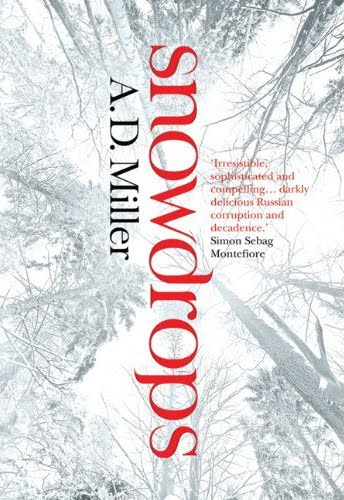
I know I just said that I'm not hard on fiction. I guess what I mean, is that it takes a lot for me to call something a "bad book" or to say that I've wasted my time reading a novel. I finish almost everything I start, and there have been only two exceptions in the past couple years. However, most of the things I'm about to say about Snowdrops are complaints. It's nominated for the Booker, so I don't have to be rhapsodic about its merits, of which there are many. It's a caper book, that's made clear from the start. There is a sense of fun when speeding through, knowing there's a scam, wondering how it will unfold. Snowdrops has a bit of a pulp thriller feel to it, though written in a more high-minded style, more thoughtful than throwing a cliff-hanger at the end of every chapter.

I enjoyed reading Snowdrops while I was reading it, but something nagged at me. About a week after I finished, I finally realised: I am sick of the honey-trap. I'm tired of the nebbishy guy seduced by the "bad" girl. I felt like I'd read Girl Crazy all over again, but set in Russia. Our protagonist, Nick, is a lawyer just moved to Moscow. He's a mediocre sort of fellow, without much in the way of personality, not much success with women, not much of a looker. Nick will be defined by the events around him, pulled along with the flow of cynical Russians, all on the take. Nick does not act, he reacts. Nick wants, but lets others take. Like Russell Smith's protagonist in Girl Crazy, Nick first encounters the conveniently slutty love interest while she's in distress. In this case, he foils a purse snatching. And Masha, after an accelerated courtship, gives him her body (and for extra kink, her “sister” watches). She continues to string Nick along for months, to ensure his help in the caper. (I'm not giving anything away here. Again, this is all foreshadowed in the telling.)
'In Russia,' Steve said, 'there are no business stories. And there are no politics stories. There are no love stories. There are only crime stories.'
Nick falls in love anyway. He thinks of marrying Masha, even though he knows nothing about her, and admits as much to himself in the narrative —constructed as a letter to his now fiancée (like in Girl Crazy there's a dull, dependable girl at the end, to act as foil to the wild girl of yore).
That's what I learned when my last Russian winter thawed. The lesson wasn't about Russia. It never is, I don't think, when a relationship ends. It isn't your lover that you learn about. You learn about yourself.
Caper accomplished, Masha conveniently disappears so that Nick can get onto being whatever it is he's learned to be. He can go back to England having had the Great Adventure, settle down with his predictable boring late-life wife.

One is supposed to separate the work from the writer. I understand that this is crucial in literary critique. But there are seriously unprofessional parts of me that wonder about A.D. Miller (and since I'm not getting paid for this, being unprofessional now and then is probably inevitable). A BBC piece on Miller says: "Miller's own experiences in Russia were 'slightly more uneventful' than those of his fictional creation". It makes me wonder if he wishes that all this had happened to him. If he saw all the strip clubs and easy sex, the women he writes about as desperate to find a non-Russian husband, and wanted so much to have them for himself. Would it have mattered if those women had ripped him off, had hurt him, if he'd gotten to fulfill that Mata Hari dream? In the end, this girl is always a fiction. It feels like Miller is writing a fantasy for himself, a Booker nominated Penthouse Forum letter. “I can’t believe it happened to me. I was working in Russia…” While it is well written, at times clever, Snowdrops winds up existing in sexual cliché territory, and for me that's a bit tired and not the least challenging.

ETA: In the comments, I just proposed the idea that the letter Nick writes to his fiancée is in itself a fiction. That he's the dullest dude ever, and so he makes up this elaborate story to tell his girlfriend, so she'll find him more interesting. And if that's the case, if the book is that self-aware? Then it's fucking brilliant. And I'm willing, totally willing, to believe that's the case, if there's any evidence for it. I'd prefer fiction be good, after all

Looking In

When Pigeon English was released early this year, we didn't know what would happen in London in August...

The narrative revolves around Harrison — Harri — an 11-year old boy, newly arrived to England from Ghana. He lives with his mother and older sister, while his father and baby sister have stayed behind. Harrison's family, like so many immigrant families, lives in a bad neighbourhood (in London), defined by crime and violence. Through the first-person narrative, Harrison retains an innocence and sense of wonder that seems to belong to someone several years younger. This is at times not exactly plausible, as when he seems to have absolutely no knowledge of human sexual activity. I remember being 11. I wasn't participating in anything, but I certainly knew some of the mechanics (and I can't just blame Jean M. Auel for that). Then again, perhaps the avenues which kids in Europe and North America learn about sex just didn't exist in Ghana; I can't claim to know anything about it. In other ways, the exaggerated innocence seems appropriate, as his class-mates are portrayed socially similar. The games and they way they play them sometimes seem, again, something younger kids would be interested in. (I should note, though, that by "innocent" I don't mean "simple.") The comparison has been made, favorably for Pigeon English, to Emma Donoghue's Room, with Harri judged an easier child narrator to read and accept. Readers often found Room's Jack both too precocious and annoying (I don't agree). Harri remains likeable and for the most part, age-appropriate (as above, if anything, he skews slightly young for his age). The Guardian review says
Kelman has already been much praised for his ability to write from an 11-year-old's perspective, but here, as often in the first half of the novel, Harri's voice feels laboured and faux-naïf.
I think most of this, aside from my issues with innocence, can be chalked up to Harri's difficulty using language in his new context. I think Stephen Kelman's writing is pretty clear on that.

While it's not explicit, one assumes that Harri's family is (in waves) moving to England for a "better life," but his flashbacks to time spent in his home country show that he is now much worse off. (Though this may be some of the troubling white framing of black experience as seen in The Help, or evoking a "noble savage" type.) Comparatively, London is dirty, violent, and crowded. People are selfish, preferring to harm rather than help others. The never-easing class divide in England cuts across colour and and country of origin, keeping a poisonous river between the have-nots and the have-too-much. The origins of the August 2011 London riots, it's been said, erupted from a feeling of absolute hopelessness, from the societal group of which Harri is now a member. Unlike the prevailing "You can be anything" message that American kids grow up with (erroneous or not), England likes to keep its classes separate. Given the historically abysmal record in the way England treats the poor, upward mobility isn't even considered; it's just assumed getting out is not possible. Near the end of the novel, the seniors in Harri's school write goodbye messages on each other's school shirts. Two pages are devoted just to these messages, and they illuminate the matter-of-fact acceptance of the fate of those without means. It doesn't even seem sad or angry, it just is. The messages read like any year-book: some are just names, some are jokes or bawdy quips. They begin*:
GOOD LUCK KEEP IT REAL     spud
NORTHWELL MANOR TILL I DIE        TYRONE
TAKE IT EASY GET RICH OR DIE TRYIN naomi
DFC [the initials of a local gang]FUCK SCHOOL LEWSEY HILL R. PUSSIES
Then others start, interspersed with the sort above, with a new theme:
JUST ENOUGH EDUCATION TO PERFORM
repeat after me: DO YOU WANT FRIES WITH THAT?
DON'T PAY TAX, SELL DRUGS INSTEAD
SEE YOU AT THE JOB CENTRE
Be warned: the future doesn't need you![emphasis mine]
It feels almost prescient that mere months before the London Riots this novel would be published, capturing the soon-to-be-violent malaise of a demographic group so strongly. Harri, while a newcomer, shares a lot with his peers, and neighbours. Like him, most of the people in Pigeon English are essentially, easily good. For example, Terry Takeaway is a thief and a drunk, owner of a pitbull (hallmark of a "bad guy" in many places), but he's also on the lookout for Harri, willing to defend him from older kids for no other reason than it's intrinsically right. (The pitbull, Asbo, is revealed to be a loveable pup, and Harri enjoys playing with him immensely.) There are only a couple essentially bad characters in Pigeon English, and Kelman is careful to make them different as possible, to show that the hard, evil criminals of legend aren't the majority. When things go bad on a large scale, as in the August riots, it's often not because people have substandard ethics or upbringing (fuck you very much, David Cameron), but because they're pulled along, never having been allowed to know another way to be.

There's a load of films being made where filmmakers go to a council estate and 90 percent of the people there are functional—getting their kids ready for school, paying their taxes, working. And 10 percent are dysfunctional—and they go, "That's what we're going to make a film about."*


*I've attempted to replicate the changes in type on these pages of the novel, which indicate that there are different people writing each message.
**Actor Eddie Marsan, interviewed by Jonathan Romney in The Independent, May 2, 2010. As quoted in Jon Ronson's The Pyschopath Test (210).
***Also, I think I've figured out — for myself anyway — the "talking" pigeon character that seems to have caused so many readers so much trouble. He's supposed to be for Harri, as Harri is for the neighbourhood; an outsider looking in, with a perspective that illuminates the situation. I agree, though, it doesn't really work.

Wild Abandon

My first experience with the work of Joe Dunthorne was watching the movie adaptation of Submarine. The movie is a bit off-kilter, slightly trippy, and seemingly coloured by remembrance. It’s also a bit uneven, and I was left not terrifically impressed. It was, then, with an open mind but a small amount of trepidation I began to read Dunthorne’s new novel, Wild Abandon. What I got was the usual outcome of the book vs movie duel: something much, much better on the page than on the screen.*

Wild Abandon follows the lives of commune, or their preferred term “community,” members in Wales. Don and Freya are a middle-aged married couple, and half of the creating force behind the community. Janet, their school chum, and Patrick, former landlord and provider of startup capital, round out the founders. The community is in decline, after a decade or so or humming along. New members are hard to find, there aren’t many children.

Don, with his degree in film studies, is ever the actor reciting lines. He’s described as often seeming to have rehearsed things is his head, many times, before speaking. “Don preferred himself in front of the lens. In the same way that a miserable holiday, when viewed through its photographs, becomes a stream of joyful moments.” In a flashback sequence, he is away from the community and gets the call his wife is giving birth to their first child, Kate. He relishes the role of the immediately expectant father, racing back, practicing what he’ll say, dramatically, to the cop that pulls him over for speeding (and is saddened when it doesn’t happen). That he doesn’t make it in time to see Kate born is representative of his character. Freya is responsible in birth, as well as in death; she’s been dubbed the community’s “abattoir,” because she’s the only one who can actually kill and butcher animals. The sexual politics between Freya and Don are interesting: it’s the woman who works hard, and gets down to what has to be done, because there’s little choice; the man lives in the mind, making speeches and directing, while doing very little himself. This relationship isn’t atypical in literature or life; I’m thinking of the Great Male Author trope, with his long-suffering wife behind him, making financial and household arrangements while the artist needs his think-time.

Kate has her sights set on going to University elsewhere in the next year, and 11-year old son Albert is too smart yet not socialized enough. Kate escapes the community to the home of her boyfriend’s parents. Like most teenagers, she wants only what she doesn’t have while living with her parents (and this is echoed by boyfriend Geraint moving to the community later on). She seeks what she thinks will be a more interesting sort of discord.
Considering that Kate had never spent any time in a suburban home before, she had a highly developed understanding of what to expect; during her upbringing, her father had encouraged her to make the most of his film collection, which had a lot to say on that subject, including The Graduate, Edward Scissorhands, American Beauty, and The Ice Storm. One of the community's well-told stories was of Kate, aged ten, setting an alarm for herself to wake at 3 a.m. so that she could come downstairs and watch Poltergiest, the definitive suburban horror film.
In fact, what she finds is that life is pretty much humdrum no matter where you run to.
The disappointing news from her time in Three Crosses was that, where she had hoped to find suburbia's dark and seething underbelly, she had found its potbelly of contented boredom.
( In this way, Dunthorne reads a bit like a gentler, less satirically-minded Tom Perrota.)

Everyone in Wild Abandon is a bit like Kate, moving and shifting, enjoying the new but eventually searching for a new place that might be just a bit better: Kate eventually gets into Cambridge; her parents leaving London squats for the wilds of Wales; Patrick leaves the commune to once again work a full-time job and have an apartment; Freya wanting to leave Don and get Albert into regular school; Geraint joining the community. It’s reminiscent of the constant ebb and flow of city/suburban populations. Albert, not having the possibility of self-determined mobility at his age, turns to an Apocalypse scenario centered on a black hole for comfort. It’s child’s logic; if he never leaves his known world, the only possible change is for the world to end. Kate is the embodiment of that black hole—as her sphere increases (going to school outside the community, then leaving for the Three Crosses suburb, then going to college) the more Albert feels his world is ending.


Dunthorne has just the right descriptive simile or metaphor handy at all times. This isn’t as easy to pull off as you might think; the descriptor has to be contextual, so much so that it gives the reader a perfect idea of the scene at hand, without distraction. Dunthorne has this down to an art, and it’s an integral part of his style. This might be annoying in the hands of a lesser writer, but I only noticed the comparatives so often because of how perfect they were. Early on in the novel, one of the founding members of the community, Patrick, has a paranoid episode after ingesting both marijuana and mushrooms. Fleeing the community on a cold night in just underwear, he tears through the brush, coming out into a suburban street in an empty new development. As he succumbs to hypothermia he falls onto the “road shaped like a thermometer -- a turning circle at one end.” Not only is this an accurate visual, it’s loaded with symbolism. The thermometer, of course, speaks of temperature and Patrick’s loss of body heat. The choice of a cul-de-sac, though, also represents an ending, the bottom of the bag, or in Intervention speak, rock bottom. Patrick quits the community, and gets clean (after a last hurrah of enjoying hospital sponsored morphine drips). Later, Kate takes her university qualifying exams:
There was something enjoyable about the tarot of turning over an exam paper: a whole gymnasium full of people reading their fortunes.
Again, this is perfect on a couple levels. Exam results do tell the future, but on a smaller and more physical level, the turning of the papers is indeed very like turning over tarot cards. It makes the moment slower than I remember when I took my exams, and more lovely. Wild Abandon is like that sometimes, making the reader stop sometimes, over the small moments, looking at the small parts of life in a new way. That’s what good literature does.

Kate’s first memory of cartoons is watching “Steamboat Willie.” She’s struck by the pile of potatoes Willie is tasked to peel, a pile that never seems to end or get any smaller. It gives her nightmares. The petite-bourgeois lives in Wild Abandon are similar in that, not getting ahead, just making lateral movements. (The commune, while at times hardscrabble and always ad-hoc still falls into this category, having been created by a property owner and three holders of liberal arts degrees). Comfortable survival is the same on the commune as in the suburbs. The novel’s title, perhaps, relates to those small moments which stand outside just-living, like the two rave parties depicted (an accidental one in the past, a party for Kate’s birthday that got out of hand, and the one that climaxes the book, which is engineered to generate interest in the community). Perhaps, though, the title is sarcastic, because no matter the location, being middle-class has conformity clauses.

Reviewed from advanced reading copy, courtesy Penguin Books Canada.
*Yeah, I get that they’re different works. **
** And I’m glad I haven’t read Submarine, actually. The Guardian review did that thing that The G&M review did with The O’Briens, talking about how the first book was much better. Sometimes, it’s good to start with the second book?

Easy Reads

This week, the Booker Shortlist and the Giller Longlist were announced. Thus, my library queue got crazy again, and there's going to be a whole lot of Literature up in here pretty soon. It seems appropriate, then, that I just polished off a total snack-book, Emma Forrest's Cherries in the Snow*.

Having read Forrest's memoir, Your Voice in my Head just recently, I was a bit distracted by knowing which details of Cherries were "write what you know," and unavoidably making conjecture as to which other details were true. Forrest's personality is evident in Cherries, which is smart, funny, and just slightly raunchy. The main character, Sadie, is a young, hip English Jewish girl living in New York (as is Forrest). As the novel begins she's in a relationship with an older man, a journalist. I believe Forrest mentioned a long-time relationship with an older playwright in Your Voice. I began to wonder how much of the stilted sex life in the first part of the book was fiction, and how the older man (men?) in her life felt about that.
The novel is a chick-lit romp through makeup and love, with a feisty eight-year old thrown in. No startling new territory here. Kate Carraway's The Globe & Mail review of Your Voice in My Head says of Forrest's earlier fiction
I and other twentysomething disaffecteds read half-sunk in lukewarm bathwater, searching for instruction and connection with her characters, all of them good bad girls, messy and wanting.
This intrigued me, but I probably would have enjoyed this book a lot more in my teens and 20s. For me, it was possible to believe in those years that a man like the love-interest Marley was on the horizon. Marley is a prince-charming composite, perfect for Emma Forrest, BEST LOVAH EVER (really? at 24 you get this? really?) with a dark distant-past, enough cash to go around, who falls in love with our protagonist almost instantly, but not slavishly. Ten years ago I could easily dream that I too would one day have a glamourous job at a cosmetics company in the big city... oh, shit; I do have a job a cosmetics company in the big city. Anyway, what I mean is, this is all delightful fantasy stuff but at this point in my life Cherries is the sort of thing that entertains only while I'm reading it. To really care about a book like this one probably needs to be able to feel like they could put themselves into the main character and I was wholly unable to do so. I really, really loved Forrest's memoir, and I look forward to any forthcoming work. I suspect it will speak to me more than Cherries in the Snow.

Something I never, ever stop loving is a big old multi-generational epic. Peter Behrens' The O'Briens is a good choice if you're in the mood for such. The reviews I've seen mention his first (and, they say, better) novel The Law of Dreams, which won the Governor General's award. Since I haven't read that one I haven't any comparative complaints. The O'Briens begins before WWI and ends in the 1960s, following the fortunes of Joe O'Brien and his extended family. Again, from The Globe and Mail:
We see no consequence more dire than his wife being angry with him, but even then we’re not sure whether she wants to leave him because of his drinking binges or because she has fallen in love with J. Krishnamurti.
That's valid, but I didn't really mind the lack of big drama. Some bad things happen, but everyone's pretty much okay in the end, and I don't have a particular issue with that treatment. The O'Briens is a story, not an opera.
I read a lot of Judith Krantz and Barbara Taylor Bradford novels years ago, and the way The O'Briens deals mostly with the lives of the privileged felt similar. Some might take that comparison as an insult, I don't know, but it's certainly not meant that way. Those books, as with The O'Briens, were easy and engaging, over 500 pages and 50-plus fictional years.
As for quibbles, I do have a couple. The O'Briens is most interesting in its early going, usually when focusing on the matriarch, Iseult, and it does suffer sometimes from possible behavioral anachronisms (for example, I'm not sure how easy it would be for a woman to leave her husband and flee the country with her children in 1931, or if many women would even think of the possibility). As well, there was a stand-out magical sperm phallacy (I coined it that day, yes the "ph" is intentional) early on that had quite a few of my Twitter pals giggling**. Otherwise, it's a fine read, and sometimes just "fine" is exactly what I want.

Okay, awardies and fall lists. Let's do this. *rolls up sleeves*

*That review is a random Google find, and a lovely little review it is!
**My tweet: "Her firm white belly loaded with mystery." Oh bugger off, it's JIZZ not the Arc of the Covenant.

Stronger Voice

This is yet another Lainey recommendation, but it's likely I would have picked it up anyway: putting Millais' Ophelia on the cover is a good way to get my attention*. And it's not just an allegory. Emma Forrest talks about Ophelia in her introduction to Your Voice in My Head. She was obsessed by the painting as a teen, riding her bike to the Tate to see it every weekend. It's clear early on that Forrest is my kind of gal.
   

There's something about a story of mental illness that draws me, though I'm often left frustrated and disappointed. Such memoirs often feel congratulatory (about the illness, not the recovery), and indulgent. I suppose it's easy for me to say, because I've comparatively not suffered much from bad brain chemistry, but I'm often left with the feeling that the illness is held up as the redeeming feature of the author's personality. The illness makes them "special," the illness is why we should pay attention, or the illness is why they're an artist in the first place. And maybe all of that's true, but it's also annoying. Not everyone with a mental illness is an artist (though I suppose there's the argument that many artists are mentally ill). Some people with mental illness are just as dull as anyone else. That's another reason I really like Emma Forrest. This book is about a particularly dark time in her life, but it's always extremely self-aware. Forrest is smart, talented, and funny first. It's a neat trick, too, because the book really is about her relationship to mental illness: her cutting, bulimia, mania, and depression. These traits, however, don't define Emma; her bipolar status is simply another part of her, not the sum total of her. This is a hopeful and important message, I think, to anyone struggling through diagnosis and treatment: your illness is not the entirety of you. Other memoirs might fail in this, making the illness the star, and the writer simply the host organism. (To be fair, I'm sure that in the middle of any mental illness it feels—more, probably is—all-consuming.)

Your Voice in My Head has gotten a lot of attention, because Forrest goes into great detail about her relationship with Colin Farrell (whom she does not name, but the world knows). I don't need to say much on that score, other than this is just one more thing that makes Forrest's experience very relateable: we haven't all dated movie stars, but a lot of us dated That Guy†. That Guy comes on very strong, feels every emotion full-force, and then one day it's just done. And as all this is happening, Forrest's much treasured therapist, Dr. R, unexpectedly dies.

In a Turkish museum, Forrest has an hallucinogenic/imaginary conversation with the deceased Dr R, about his death, and the death of her relationship. "Losing you both was only the practice pain, wasn't it? For my mum and dad..." Her mind's Dr. R agrees. It's from this conversation the book takes its title. It's appropriate, as it's the most poignant moment, in a memoir full of honesty, intelligence, big emotion, and all-encompassing humour (which never feels out of place, even in the depths of emotional despair).
'When it happens,' he asks me, 'what will get you through?'
'Friends who love me.'
'And if your friends weren't there?'
'Music through headphones.'
'And if the music stopped?'
'A sermon by Rabbi Wolpe.'
'If there was no religion?'
'The mountains and the sky.'
'If you leave California?'
'Numbered streets to keep me walking.'
'If New York falls into the ocean?'
Your voice in my head.


*The Canadian edition has Ophelia on the cover. Other editions don't seem to. Shame. It's a great image, and an important one to the author, that is not only the topic of the introduction, but a totem that Forrest carries through her life and references several times.
**While I haven't mentioned it, this post is tagged "Jewish" because her religion is an important part of Emma Forrest's life, and she does talk about it in Your Voice in My Head. If you've got any inclination in that direction, the description of Rabbi Wolpe's sermon that comprises the entirety of Chapter 36 is a lovely and moving moment.
†Or, I suppose, That Girl. Though given cultural norms, a dude who will feel is supposed to be compelling, while a girl that feels is needy, and to be avoided. YMMV, as always.

The Little Lady Pt 2: Elizabeth Siddal

I was first introduced to the Pre-Raphaelite Brotherhood in a second year English lit course called "Victorian Sexuality in Poetry and Painting." It was taught by an elderly Brit who looked like he'd been there, and had decided to tell us the tale. Despite his sometimes meandering lectures (I remember he'd often veer off into talking about Marlene Dietrich), he had such amazing knowledge of the subject, and a real obvious love for the era. It was infectious. Soon, we were all in thrall with Tennyson, William Morris, Waterhouse, Burne-Jones*, and Dante Rossetti. Especially Rossetti, because he had that fantastic macabre tale attached to him: when his wife died, he buried his unpublished poems with her, then exhumed her years later to get the poems back. It is said that when Elizabeth Siddal's casket was opened it was discovered that her hair had continued to grow after death, filling the casket with red-gold. We saw slides of Beata Beatrix** in that class, we looked at some of Siddal's sketches and self-portraits, and we read as many of her poems as were available (few exist and are rarely anthologized). It was impossible for me not to fall for Elizabeth Siddal's tragic, romantic legend.

It's the stories and myths surrounding Siddal, and the way she's portrayed visually by male artists that draws people in. In The Legend of Elizabeth Siddal Jan Marsh does an admirable job attempting to fleece out the verifiable details of Siddal's life, of which there are surprisingly few. However, the book is less a strict biography, and more a study of the way in which biography is influenced by the times. Marsh looks at the renditions of the legend, from Pre-Raphaelite contemporaries, to modern scholarship (including her own first forays into Siddal's story). The Legend of Elizabeth Siddal is able to piece together facts about Siddal while illuminating biases that went into earlier biographies (and biographical sketches, since early on Siddal was rarely given much space or attention at all, other than references to her relationship with D.G. Rossetti). It's a bit disappointing to realise that we'll never know much, comparatively, about Siddal, and Marsh is extremely clever to take on that lack of knowledge, and how others filled the spaces, as the basis for her book, rather than attempting another biography filled with guesswork.

This is not to say that there aren't any facts to be had. One does learn a great deal about Elizabeth Siddal, reading The Legend. There aren't many books devoted to Siddal specifically, and even more modern explorations of the PRB, like Desperate Romantics, relegate Siddal to little more than girlfriend/wife. In fact, Siddal studied and produced art in her own right, as well as being muse for Rossetti, and model for Millais' famous Ophelia† (below). The common idea that Siddal committed suicide is disputed, and her life before "discovery" by Walter Deverell is examined as much as possible. Indeed, any "fact" of Siddal's life (including the spelling of her last name!) has at least two published versions, and Marsh examines all possibilities, keeping in mind the circumstances under which they appear.

The Legend of Elizabeth Siddal is excellent reading not only for those interested in the PRB, or Siddal specifically, but as a very interesting look on how biography —especially biography of women—is created within a societal context‡. Says Marsh in her Postscript:
The quest for the 'real Elizabeth Siddal' reveals more about the changing ideological context, and the uses to which the legend is put in the redefinitions and negotiations in the realms of gender and art. [...] [B]iography is not reincarnation, but a form of exhumation.


*My favourite PRB work: Burne-Jones' The Depths of the Sea.
**I saw a Beata Beatrix in Chicago a couple years ago and almost wept. I suppose this sounds dramatic, but I did get a great lump in my throat and tears in my eyes. Art, AMIRITE?
†The painting of Ophelia, prior to her taking up with Rossetti, gave rise to another often told story about Siddal, who was painted while floating in a bathtub of freezing water, while Millais painted her. "As it was now winter, he placed oil lamps under the tub to warm the water, but was so intent on his work that he allowed them to go out. As a result, Siddal caught a severe cold, and her father later sent Millais a letter demanding £50 for medical expenses. According to Millais' son, he eventually accepted a lower sum"
‡And now I feel like I need to re-read The Biographer's Tale.

One Day


My taste in most things seems to run to Brits. Depeche Mode, The Smiths, Radiohead. Quality Street, Sherbet, Jellybabies. A.S. Byatt, Thomas Hardy, Angela Carter. So One Day was an easy sell for me. It's a rock-'n'-roll candy-bag of a book, with an essential easy Englishness. While One Day deals with some more serious topics (death, divorce, alcoholism, life paths), it feels like reading Bridget Jones's Diary. This is a complementary comparison; One Day is filled with likeable, relateable characters, who are often very funny. These are people I'd have over for dinner, and Drunken YellingTM.

Spoiler-y things happen after here!

One Day's narrative trick is to relate the events of July 15th, starting in 1988. This is the day we find Emma and Dexter in bed, though not post-coitus. We are led through the next 20-odd years of their life, through the ups and downs of a vibrant and wonderful friendship, reminiscent of When Harry Met Sally. In fact, Emma's later boyfriend, Ian, actually alludes to that film, though derisively. I found myself tearing through the first 3/4ths of the book, just enjoying the ride. Unfortunately, no one can ever just let men and women be friends, and the thing I dreaded most happened: Emma and Dexter get together. Moreover, they get married. Emma, to this point, had been rather unconventional, with a wandering career path and a "not-for-me" attitude towards marriage and children. In fact, she resents the intrusion of children into the lives of all her friends. When she marries Dexter, however, she comes to realise she does want a child. I'm not sure if this is supposed to be a show of maturity for Emma, or an easy narrative out. Either way, seeing Emma become those things she fought against being was a let down. And then, Emma dies.

By this part of the book, I'd checked out a bit. I just didn't like them together any more. Maybe Nicholls didn't either, and had to kill Emma off to make things interesting. Emma dies suddenly, riding her bike in the rain, struck by a car. The passage itself is supposed to be startling:
Then Emma Mayhew dies, and everything that she thought or felt vanishes and is gone forever
I was reminded of another startling death scene I read a couple years ago, from a breakout French bestseller (this is probably spoiler-y too, but I'm trying not to be). Same sort of premise: quick death, struck by car. Yet that time, I wept from it. I didn't see it coming, and I cared so much, that I was brought to tears*. When Emma died, I thought "Oh, that was easy."

One Day remains an excellent read, though I resented the conventionality it stumbles into near the end, and the odd way Nicholl's tries to make up for it. One Day was yet another Lainey Liu recommendation (she's a hell of a reviewer and reader, whatever you think about the celebrity gossip biz), and I wouldn't say the less-than-great ending quarter of One Day would make me trust her taste in books any less. She nailed Room, and got me to read Furious Love, so I'll keep heeding her suggestions.

*I almost never cry at movies, but Hardy (for example) can make me bawl for days. I'm more invested in the word, I suppose