Showing posts with label calgary. Show all posts

Fables of Elbow Drive

When I was 23, I had a weekly, weeknight DJ gig in an alternative bar in Calgary. Well, the alternative bar in Calgary, not by dint of being the best but the only. I was a regular there, had been for years, so I knew most of the patrons. Weeknights in a dance club were for students (as I was), people without office jobs ("industry workers" as they were called), the underemployed, the artists and musicians, and the gainfully employed who really like to drink. The weekday crowd was less boisterous, more friendly, more willing to be silly, more likely to request a lesser-heard track. There was no pressure to pack the dance floor — it wasn't possible with a quarter-full bar — so I'd happily oblige with a flurry of odd songs. It was on one of these nights a fellow DJ friend wandered up to the booth. "I've taken six hits of acid," he said. He was probably exaggerating, but he was definitely tripping balls. "My friends have all left. Can we hang out?" (Acid, by the way, is one of those drugs you don't have to be on to find hilarious. People on acid are hilarious on their own.)

When the club closed for the night, my friend wanted to go through Mount Royal to where Elbow Drive follows the curve of the Elbow River. He told me he'd grown up around there. So we drove south and east from the club, to the outskirts of downtown. I'd never spent much time in this part of the city. It was relatively old, and far away from my parents' house in the north. Unlike the rocky banks of the fast-moving Bow, the Elbow River was bordered by flat and manicured grass, parks, and stately homes.* I could just barely hear the water moving along in the moonlight. He told me stories of being a kid around the area, where he used to play, the place where he kissed his first girlfriend. 3 a.m. on a summer Wednesday night is a pretty great time to discover a place in a city you've lived in all your life.

It was a picture of that night that entered — and stayed in — my mind reading "Home for Good" in Katherine Govier's Fables of Brunswick Avenue. I picked up the collection after it was mentioned a couple times by friends, one of whom quoted the axiom "Everyone lives on Brunswick Avenue sooner or later." I was apartment hunting at the time, and my library request for the collection came in the same day as a viewing of an apartment on Brunswick. A good omen, I thought. I didn't get the apartment, and I didn't exactly get what I was expecting from Fables either. The title of the collection is a bit misleading; very few of the stories take place in Toronto at all. However, a couple take place in Alberta, one of those in Calgary.

"Home for Good" begins with my nightmare scenario: a woman, Suzanne, returns to Calgary after many years of living in Toronto. While the job she has secured in Calgary is a step up and the ostensible reason for her move, the truth is that her life in Toronto was in utter shambles.
She walked over to the dormer window which made an alcove in her living room. She was a tenant in the attic of the kind of old house she had grown up in. The house had been painted and papered and divided into “heritage” apartments, although only fifteen years had passed since she left. Surely things happened too quickly in this town. Everything was a mistake, including the apartment. It had reminded her of a Toronto apartment, that was why she had taken it. But in Calgary it didn’t seem so choice; it made her feel as if she couldn’t afford anything better.
(I live in one of those third-floor Toronto apartments currently, by the way.) Suzanne visits friends who live by the Elbow, "From the window [of her apartment] she could see over to the riverside park." Suzanne remembers sneaking out to that park at 2 a.m. as a kid. I probably sat in that same park at 3 a.m. Govier captures exactly how it would feel to have to go back, to have to stare that feeling of failure in the face, to have to relive every moment everyone back home failed you, and the ways they've changed in your absence to fail you now.

It's true, things happen really quickly in Calgary. It's a city that really likes to knock things down and build new things as fast as it can. Yet when Govier's character remembers her 1968 student apartment near the university (probably still called an outpost of the U of A back then), I can picture the whole neighbourhood perfectly. The LRT I took to that same university cut through Motel Village. That Denny's saw late-night milkshakes in high-school. The bar I got into underage was right there. It's the same city. Some things never change.

I was kind of spooked by "Home for Good." I've still got my Norton anthologies as Suzanne does; they go where I go. I know I'm not the only one who takes all her school books with her through every move, but I could so perfectly see everything in "Home for Good," understood Suzanne's want for "a book somewhere that said how you were supposed to feel when you were no longer young, but you were not yet dead." There was a moment a year into living in Toronto when I almost went back, when everything seemed too hard and too expensive. I always fear I'll be forced to go back, that some misfortune will drive me there... When I picked up Fables of Brunswick Avenue I expected a fictional primer on my new stomping-ground. I didn't move to Brunswick Avenue; I was moved — thankfully, in time only — back home.

*Image found through Google; click on it for the site it came from. I suppose it being broad daylight in that photo takes away from the image I'm going for there, but so be it.

Someone Wrote a Book About Calgary*

A couple months ago, I was reading Shawn Micallef's tweets about his time in Calgary with a critical and cynical eye. I thought he got it right, most of the time, and though I could be nitpicky about some details in the tweets, I won't. I've always said that Calgary can be fun if you're a visitor.

Of course, I know Calgary in a different way. I lived there for the first 26 years of my life and I return every 1-2 years to visit my Dad, my cat, the house I grew up in, and take the drive to Banff to see my ailing Mother. I went back in early June this year, to a place I recognize less and less. Maybe it's from living in Toronto so long, I've forgotten just how incredibly aggressive the whole vibe is in Calgary. For the first time, I felt uneasy in my hometown. Walking down 17th Ave, on a sunny Sunday afternoon, I felt menaced. The quiet at my Dad's house, in an early 70s suburb backed by Nose Hill Park (at right**), was eerie more than comforting. I looked over my shoulder a lot. Driving, as Micallef put it, is "no fun. No fun." I saw some cyclists attempt to ride on these hostile streets, and my hats off to them. If all of those complaining about the lack of bicycle infrastructure in Toronto could see what these bold Calgarians deal with, they'd be amazed at how good we have it.

I did take a bit of issue with the Spacing post that went up later, only in that I felt the reach could have been a bit broader. I lived in one of the neighbourhoods just out of downtown, after moving out of my parents' house. And yes, they can be lovely. In fact, I returned to that neighbourhood several times during my last trip. Micallef mentions Crescent Heights, which was the aspirational housing of kids from the north-western suburbs. Mount Royal was where we wandered, after-bar, Elbow River in the moonlight. But go a little further and things change. Each neighbourhood homogeneously proclaims its decade as you move further away from the core, "mixed" architecture being an anathema. The ability to walk to much of anything is gone. My parents' house is 2km from the nearest grocery store. Try that with a bag-full of canned goods. It's not that the Calgarian suburbs are a nutritional desert; there isn't a convenience store any closer. It's just house, after house, after house. I'd like to see what Micallef would make out of this wasteland. The 'burbs are mandated to look uniform.

It's this sort of environment in which Monoceros takes place. The pressure for uniformity in the Calgary suburbs extends, too, to the people who live there. Calgary is hyper-masculine, and to step out of line is to become extremely vulnerable. There's little support for those who won't fall into place.

What I love about Monoceros, is how Suzette Mayr set a book in Calgary, without using any overt cowboy tropes. Mayr, interestingly, has most of the narrative take place in February. You'd think it would be difficult to write about a prairie winter, or perhaps monotonous to read about one, but Mayr's lucky to have Calgary to work with, with its ever-changing temperature. The Chinooks that roll in and out through Monoceros affect the moods and actions of the characters, like the Santa Ana winds do in a Raymond Chandler story.

If the weather in Calgary is totally unpredictable, the prejudices that run through the populous are easy to call. This is why Max and Walter hide their relationship (which is a marriage in everything but name, right down to the boredom of familiarity) for over a decade, to the point of maintaining separate residences in name only, lest they be fired from their shared Catholic high-school workplace. When Patrick Furey kills himself, it's partially due to the knowledge that navigating this world, when his classmates have begun to clue into his sexuality, will be too difficult. The boy he loves, Ginger, has gone cold, after conducting a secret affair. Ginger, too, knows the risks are too great. Calgary is a city infused with testosterone, and enforces a strict code of conduct. This isn't to say there aren't out people there, but to be out is sometimes a luxury that some can't afford. It's still this way; tall, thin, black-wearing friends of mine still get "fag-rolled" simply for looking like something other.

Monoceros is solidly a book about Calgary, even if it is rarely explicit about it. Mayr understands very well the hetero-normative crush of the suburbs, which take up more than 90-percent of Calgary's area, and at least as much of its collective consciousness.

*See, also: "No One Writes Books About Calgary."
**That photo, by the way, was taken at 8:30 pm in early June. When you leave for a while, it becomes wonderful and confusing how late the light stays.
What Calgary does have, is a lot of off-road trails, which are more recreational in intent, though I suspect some do get used for commutes out of the suburbs.

The School Visit

I have lingering flu weird head space. So forgive some wandering in this post. I've been living on Green Juice for days.

When I was in the 10th grade we had a Real! Live! Author! come give a talk to the budding writers among us. It was totally optional to go, and there were probably about 20 students collected in the library to hear her talk. I'd just handed in a short story that had received an unusually high mark (and I've probably not written any fiction as good since), and was told that I should go as well. So there I was.

The author was Elona Malterre. You might not have heard of her. Certainly the other students hadn't. But by some weird twist, I had. My Dad had bought and read her book, The Celts*. Since I was constantly raiding my Dad's library, I'd read it too. This was my encounter with a Real! Live! Author!, and I still remember thinking "Well if I'd have known it was her, I'd have brought the book for her to sign!" I was actually pretty thrilled to meet someone whose work I'd read. I'm still that way, and I'm totally in awe that people I call friends are Real! Live! Authors! It seems like a sort of magic to me, to be able to create a whole book.

Since this was 20 years ago, I don't remember terribly much. However, Malterre said one thing that has always stuck with me. She told us that every book has a time in your life. Even if you start a book and can't finish it, set it aside and pick it up again next year. Or the year after. As you grow and change, your perspective will be different, and that book will mean something new. She told us never to force yourself to finish a book, just wait until the time is right for you and that book. This was powerful advice. There have been a few books in my life (some Great Literature, some not) that haven't thrilled me on first, second, or third try, but when the time was right, I'd tear through them. The best example from my own life is The Crystal Cave, which I tried to read about five times between the 7th grade and University. Maybe it was all the Arthurian revival stuff I was reading in my Victorian poetry class, but things finally clicked, I spent a thrilling couple days with the book in 1996.

Sadly, I don't read like I used to. I finish almost** every book I start, owing mostly to my extensive use of the Toronto Public Library system, and the books don't have time to match my mood, or life path, or whatever. It no longer happens that I have no next-book scheduled and instead must peruse my shelves (or box of mass markets) for that book I didn't finish, but wouldn't give away (and there are still of few of those sitting there, so sadly neglected). I keep buying, too, and that pile just grows and grows. I still value what Elona Malterre said, though. It's great advice. I pass it on to others, when I can.

This post was sparked by an author who also does school visits, Jill Murray, and her post today on Bookmadam about how authors pay the bills. I don't know how common school visits are; I only ever remember having that one (my distant foggy elementary school past thinks we might have had one there too, but it was Calgary, and we didn't have a lot of local published talent). I think it's a great idea though, and something that really benefits the kids who get to participate. I didn't realise it was something authors did to supplement their income, but people need to be paid for their time, and to my mind, it's money well spent.

*I don't know where he came across it, and if it was just some freaky coincidence that she happened to be a local author. He and I both did most of our book shopping, at the time, in used bookstores, so the mass market paperback copy we had probably came from there. Sorry, Elona!
**Picoult is just really that bad.

When She Takes a Walk

Missing woman dies after exposed to extreme cold.

My Mom hadn't been working for a while. Before we'd admit anything to ourselves she'd been let go from her job, unable to learn new computer systems. So she'd been spending her days indoors, wandering from room to room, wiping down counters and dusting bookshelves. Every day she'd clean the catbox then walk to the end of our street where there was a "poop and scoop" deposit bin for the surrounding off-leash park. The walk was a good idea; it got her out of the house every day, into the fresh air.

When her diagnosis finally came I went home as soon as I could. I arrived on Boxing Day. It was a relief to my Dad to have someone in the house. He'd been leaving her alone, going to work. He couldn't afford not to. Still can't. On returning he'd often find the oven or the taps on. It's what we expected to happen, eventually. So having me there was one whole week without the stress. I would turn off the taps and the stove, if needed. I'd make her eat. And every day she went for that walk.

I joke that cold weather follows me: when I moved to Toronto at the end of February the temperature suddenly dropped; I went to LA this Christmas and was met with rain and 10 degree temperatures; that December, leading into January, Calgary denied me a Chinook, and instead greeted me with snow and minus 30. Still, every day my Mom bundled up, walked a little over five minutes each way, and deposited the catbox refuse. One morning, half-asleep in the basement bedroom, I heard the back doorbell ring. Initially I ignored it. It wasn't my house anymore, the caller wouldn't be there to see me. The doorbell kept ringing. Then I realised my mother had gone for her walk. It was my mother at the door, outside, in minus 30 degree weather. I raced up the stairs to let her in.

She'd lost her keys somewhere along the way. She insisted we go back out and look for them, in the howling wind, on every lawn, in any disturbed snowbank. We never did find her keys. I was completely shaken. This event, more than the diagnosis, made her disease real to me.

It was minus 30 and 9am. My Dad wouldn't return home until 4. This morning, when I heard the story of the woman who died, all I could think of was that cold day my Mom locked herself out.

I told her that she had to suspend these walks, at least for the winter, trying somehow to reconcile the fact that this was both my mother and a person I had to make rules for. Sounding like a mother myself, I said "You could have frozen to death out there!" I was so thankful she'd remembered, somehow, that I was there. She had enough in her to ring that doorbell. Though maybe she'd have rung it anyway, all day, waiting. It hurts to think about.

I didn't show my Mom how upset I was. I tried to be calm, but I was so young, and so unprepared for this to happen. That was a real taste of the times we'd have moving forward. All the changes for her life.

I read Tangles on Christmas day this year. It was painful to read, and after the bit about how Sarah Leavitt's Mom got lost the first time, I had to put the book down because I was crying too hard to see.
Before my visit I asked Mom if she would let me videotape her talking about having Alzheimer’s. She though that would be a good idea[…] She said she had made some notes about the day she got lost. This is that story without all the pauses:
"I knew I had to walk down Smythe Street to our house. Part way down, I got lost. I mean, I could see where I had to go, but I couldn’t figure out how to get there. It seemed so far away. I ended up outside Harvey’s, where you used to go, remember? So I went inside. A nice young man […] called me a cab and I told the driver what happened. 'I got lost because I have Alzheimer’s.' 'Alzheimer’s . Phew. That’s rough. My Dad had it, used to go out to the bar in the middle of the night.' People here are so kind. They really care. I’m so lucky.
[…]
This is my new bracelet. It’s from the police in case I get lost. But I’ll never go out again by myself.
After my Mom lost her keys that day, my Dad didn't replace them. He'd just lock the back door when he left, and hoped she didn't decide to go out the front door (which has a knob deadbolt, not one you'd need a key for). I don't know why it didn't occur to either of us just to change the lock. None of us were in our right minds. Thankfully, using the front door was something my family never did, and she'd never got the habit of leaving that way. At that stage, she was relying a lot on rote. Later that year, in the summer, she did leave by the front door once, and wound up deep into a different suburban neighbourhood. From what my Dad told me, a nice older lady -- older, for my mother wasn't even 60 yet -- managed to get my Mom talking enough to piece together where she lived, and got her home. They waited there for my Dad to get home from work. Mom got the bracelet then, though Dad also changed the locks. She never needed to use the bracelet; she would never go anywhere unattended for the rest of her life.

Random Nostalgia

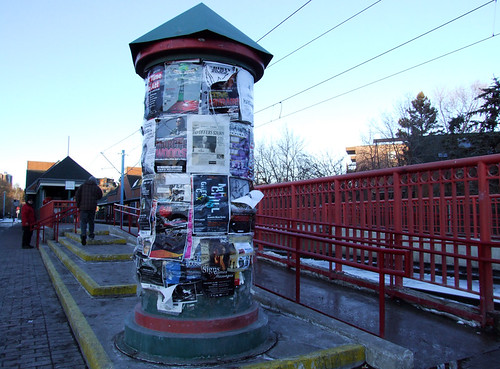
Spacing Montreal has a post on legal postering spaces in Montreal, and a comparison with Calgary's spaces. Interesting stuff, but the part that caught me was the last photo: it's my old C-Train station!

To class, and back home. Downtown. Crossing those tracks to go to the Safeway, or Second Cup, or on my way home from hanging out with that odd little Goth guy at 3 a.m. That photo sent a little shockwave of homesickness through me. Everyday I spend in Toronto -- and every sad trip back to a place that's turning more into everything I ran from -- fills the holes that my past carved in my chest, when I left. Yet there are still things, like random photos of a place that was part of my everyday life, found while link-jumping, that tear those wounds open again. Smaller every time. Some day, it won't hurt at all.

A Tale of Second-Hand Book Shops

I went back to the homeland a couple weeks ago, and tore through some reading material. Vacation, to me, is lazing around reading in my parents' backyard, and yes, that's just about perfect. Perfect, other than the day I left here (32°C), and landed there (2°C and snow). Anyway, here's the lowdown from my trip to Cowtown.

Nobody Passes: Rejecting the Rules of Gender and Conformity, came with a recommendation from Busy Hands. Normally anthologies are a bit tough to get through, since the quality of writing varies widely. However, I loved this one, from start to finish. Nobody Passes should be the primer of third-wave thought. Nowhere else have I found such amazing examples of how sex, gender, race, class, ability, and a whole host of other markers of "otherness" all play a role in defining the experience of each person's life. Not one essay in Nobody Passes repeats a feeling, an experience, or viewpoint, from any other essay. Every piece is fresh, individual, and ultimately educational. Even the ones I identified with gave me new ideas. Cheers to the editor, Mattilda, for a job extremely well done. An early version of the introduction is up on hir site, if you're curious.

I hit my second favourite used bookstore while I was out and about (my favourite having been closed down and turned into a tanning salon, or some other nonsense. And the people at Bookninja are trying to tell me that Calgary's not the evil yuppie nonsense scene that I know it to be. Puh-leeze). While there I picked up a random Anne Tyler book, having remembered another Femjay recommendation. I was not pleased. Ladder of Years is predictable in the extreme, and reads a bit like the romance novels the main character is addicted to... without the romance. Requisite happy ending, after specious empowerment journey. Hey, I'm down with low-lit, and "beach reads" and all that, but this one was just meh. Since I was not pleased, you don't get a picture for this one.

On my last day, needing something for the plane, I popped into the only remaining used book store in Kensington, and grabbed Midnight in the Garden of Good and Evil. I've been intrigued by this book for a long time, but never managed to pick it up. I do like a good Southern Gothic, and this had all the elements. Often non-fiction reads a bit too much like a dry newspaper article. Midnight reads like literary fiction, and that's a high compliment coming from me. I got home to the shock high humidity, and a book about Savannah was an excellent accompaniment. Now I want to see the film. I think it's important for you to know that I never see movies. Can't be bothered. So actually wanting to seek one out is pretty rare.

I've had 1984 on my bookshelf for years now, and never got around to reading it. Being without any new reading material, I finally cracked it open. Good timing, as The Guardian just did a little article on it being voted as "the definitive book of the 20th century" by its readers. I have this crazy idea to read some Joyce next (filling up all those "classics" I never did in high-school or Uni). I'm just not sure I really want to tackle something like Ulysses with my head being so scattered. Though it may make for good distraction. I'll likely buy a used copy, hopefully with someone else's notes in it, and see where that takes me. One of the things I have always loved about used books, is the anonymous thoughts you sometimes find in the margins. I always get out my pencil and respond.