Showing posts with label non-fiction. Show all posts

Alone

There's a scene from Sex and the City where Miranda chokes on some Chinese food in her (super huge) bachelorette pad.  This gives rise to her fear of living, and dying, alone.  Of course, everything turns out just fine for Miranda, arguably the most independent of all the gals.  And by "fine" I mean she gets a man and a baby and a house in Brooklyn so, yay, nuclear family ending!  There was always ambivalence about the whole situation in her character though, and I get that.  I live alone too, and I don't think about it much.  I'm still young enough to feel like being frail is a long way away.  I like my space, I don't want kids, etc etc. 

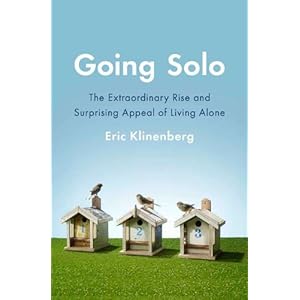
Going Solo seemed like one of those books I'd read to shore myself up, have someone preach to my choir.  The sunny sounding subtitle: "The Extraordinary Rise and Surprising Appeal of Living Alone" makes it sound like the kind of book where I'd find stories like mine, get some interesting statistics, learn about why people my age(ish) choose singledom.  That's all there, but it's in short supply.  Author Eric Klinenberg interviews the creator of Quirkyalone, talks to some divorcees, and is — thankfully — aware that the experience of, and the journey to, living alone can be very different depending on one's gender. There is also a thoughtful analysis of how and why the nuclear family structure common in the mid-20th century has changed (mothers got to work outside the house, and this move is treated as the radical change it was) and interesting thoughts about community planning for the future.  A lot of the singles in these sections are happy, having chosen to live alone. "Most people who live alone are financially secure, not poor, and those who purposely use their domestic space as an oasis from their busy, stressful work lives report that it is a regenerative, not an isolating experience."

However, more of the book talks about the elderly, and the challenges they face as they age.  Most of those profiled are widowed, so they are alone not by choice. Several are poor, or finding it difficult to get by, while not wanting to go into a nursing home where care is often substandard (and getting worse, as corporations increasingly look to the bottom line and nothing else). Klinenberg also talks to the indigent, mostly men, who populate New York's Single Room Occupancy buildings.  The main thrust of the book is more that
[t]he extraordinary rise of living alone is not in itself a social problem.  But it is a dramatic social change that's already exacerbating serious problems for which there are no easy solutions: Social isolation for the elderly and frail. Reclusiveness for the poor and vulnerable.  Self-doubt for those who worry that going solo will leave them childless, or unhappy, or alone.
There's not a lot of feel-good going on here. And what was worse for me, the only person in the book who resembles me shows up only as a corpse.  "Mary Ann" dies at 79 without any family, and Klinenberg accompanies the state worker who is charged with trying to find someone to lay claim to Mary Ann's meagre estate.  There's some weird language used about the older people in Going Solo: for example, an older woman who bemoans her lack of companionship is described as being sad that she had no one to complain to.  That felt pretty unfair.  Another profiled senior is noted as making racist jokes, though this has nothing to do with the topic at hand (unless the implication is that his racist jokes made him an outcast?).  Klinenberg also talks about his grandmother, who lost her second husband as Parkinson's Disease began to take hold of her.  Fortunately, she had children who would chip in for the very best of care.  This is not to say the experience in an assisted living home is perfect, but she's lucky she had help. Perhaps "lucky" is the wrong word, since most of the elderly alones in the book have some sort of family support system.  (The same can't be said for the men of the SROs though.)

I often read motherhood narratives because they reinforce my choice to be child-free.  Perhaps parents will want to read this book and be glad they had those kids.  I will never have children, I will not marry* and I have no siblings.  When it goes wrong for me, in my old — or possibly not so old — age, it's going to go very, very wrong.  The old joke about dying and being eaten by one's cats before anyone notices?  This guy.  Before I read Going Solo I honestly didn't mind my lack of family too much, but thanks to this dreary and scary book, I'm terrified.
 
*"I will live my life as I, will undoubtedly die: alone."

The Social Determinants of Crank

In 2005, Newsweek printed an article called, “America’s Most Dangerous Drug.” Newsweek's coverage followed an Oregonian series called "Unnecessary Epidemic." Media outlets across the United States began reporting on the spread of what the United Nations drug control agency declared "the most abused hard drug on earth": methamphetamine. Early 2005 also saw Nick Reding begin to investigate the effects of meth on small-town America. Four years of interviews and investigation produced Methland:The Death and Life of an American Small Town.

Reding begins with a good overview of what meth is chemically and historically: first synthesized in Japan in 1898, desomethamphetamine made its way to the US in the 1930s. There, in the last year of that decade, it began to be marketed as Benzedrine.
Methamphetamine in 1939 was prescribed as a treatment for thirty-three illnesses, including schizophrenia, depression, anxiety, the common cold, hyperactivity, impotence, fatigue, and alcoholism. In a world in which the winners were defined by the speed with which they could industrialize. meth suppressed the need for sleep, food, and hydration, all the while keeping workers "peppy."
The Nazis used meth to keep their soldiers marching through a Russian winter. Into the 1980s, meth was still being prescribed as a diet aid in the US. And above all this, it made users feel better than they had before taking the drug.
In biochemical terms, methamphetamine is what is called an indirect catecholamine agonist, meaning that it blocks the reuptake of neurotransmiters.
Essentially, meth makes you feel very good, and keeps you feeling good, until it wears off. The problem, of course, is the side-effects (several of which meth was supposed to cure): paranoia, sleeplessness, psychosis, anxiety, memory loss, and rather quickly, total addiction. The drug hijacks the brain's usual neurotransmitter cycle and very soon "the only thing that does feel good is more meth."


"In truth, all drug epidemics are only in part about the drugs. Meth is indeed uniquely suited to Middle America, though this is only tangentially related to the idea that it can be made in the sink. The rise of the meth epidemic was built largely on economic policies, political decision, and the recent development of American cultural history. Meth's basic components lie equally in the action of government lobbyists, long-term trends in the agricultural and pharmaceutical industries, and the effects of globalization and free trade. Along the way, meth charts the fears that people have and the vulnerabilities they feel, both as individual and as communities. The truly singular aspect of meth's attractiveness is that since its first wide-scale abuse — among soldiers during World War II — meth has been associated with hard work. For seventy years, the drug more commonly referred to as crank had been the choice of the American working class."


The condition Reding found most salient in the rise of meth abuse in central small-town America was the loss of good-paying agricultural jobs, as farms and processing plants were swallowed up by huge corporations. Companies like Tyson and Cargill busted unions and drastically reduced both pay and staff. People now how to work twice or three times as long to make the same wage as before, if they can find a job that is. Many residents of small towns were left in poverty and misery. Moreover, they felt usurped from the few jobs available by illegal immigrants, usually Mexicans, who will work for even less pay, in more unsafe conditions. (Illegal immigrants are the perfect workforce for a profit-first company, because they have absolutely no recourse when treated unfairly.)
But there's also a more subtle connection between meth, immigration, and the food industry. That relationship is driven by the conceit that drugs, like viruses, attack weak hosts. Or, to put it another way, narcotics and poverty — along with the loss of hope and place[...] — mutually reinforce one another.


Meth isn't simply a kitchen-sink, home-made issue. When the Combat Meth Act went into effect in 2006, there was a measurable decrease in small time makers and dealers (calculated by the number of meth labs busted by police). However, this just let Mexican drug trafficking organizations (DTOs) take over production and distribution, and they now supply "95-100 percent of the meth now consumed in the United States." Unlike cocaine and heroin, the DTOs can control every step of the meth supply chain.
Unfortunately, the same American immigration policy that provides a low-wage workforce ideal for the food industry is what keeps the DTOs in business. [...] [T]he interests of the DTOs are aligned with those of the likes of Cargill and ADM.


It's not just big agribusiness that's helping meth take over. Both pharmaceutical and retail giants have a hand in keeping a main ingredient in meth, pseudoephedrine (usually found in cold pills like Sudafed), easy to get. Neither want stricter controls; change forced from the outside generally means expenditure. Reding also notes that systems put in place to track who is buying cold pills are extremely easy to circumvent: since the bigger retail chains like Target and CVS don't pay their employees much, it's pretty easy to bribe them to look the other way while cold pills disappear from the shelves.

Methland's narrative unfolds through limited biography. Most of those profiled are residents of Oelwein, Iowa, including its mayor, police chief, and a second-generation doctor. A good portion of the book shows the steps residents take in trying to fight the decline of Oelwein, of which meth is only a symptom. However, I couldn't get the story of one of the addicts out of my head. Roland Jarvis, high on his own supply, sets his mother's house on fire while making meth. He goes in and out of the house, feeling no pain high on crank and adrenaline, trying to save possessions, and put the fire out with buckets of water.
Following one of his trips outside, Jarvis looked down and saw what he thought was egg white on his bare arms. It was not egg white; it was the viscous state of his skin now that the water had boiled out of it. Jarvis flung it off himself, and then he saw that where the egg white had been he could now see roasting muscle. He looked as hid legs and hid abdomen. His skin was dripping off his body in sheets. [...] He'd have pulled the melting skeins of skin from himself in bigger, more efficient sections, but for the fact that his fingers had burned off his hands.
Reding meets Jarvis five years later, and notes how he is able to light foils of meth with the stumps of his fingers.

America prefers to see drug addiction as "a psychological rather than a sociological" problem. In keeping with the American bootstrap mythology, meth addiction is an individual's problem, even though that same drug enabled people to work longer and harder in decades past. (This approach is also seen in shows like Intervention which put the onus of addiction solely on the individual, or the family, rather than the wider societal conditions.)
[M]uch of meth's danger lies in the drug's long history of usefulness to the sociocultural and socioeconomic concepts American society holds dear, many of which stem from the pursuit of wealth through hard work.
Having read Methland I'd say that the pursuit of wealth at all costs also contributes to meth addiction; not by the wealthy, of course, but those the corporate overlords have crushed along the way.

Phil Price, a state investigator working in Georgia, puts the meth problem succinctly: "[N]one of this is about a drug. It's about a system of government and an economy." Reding illuminates the many causes behind the popularity of meth for a certain subset of Americans, by showing how corporate lobbies and drug cartels control the conditions of people so many thousands of miles away. Methland is an important book, not just about drug addiction and manufacture, but about how the decisions made for people, far away from them, can tear individual lives and whole communities apart. The collateral damage of greed lines the streets of places like Oelwein.

Personalities

When I was a kid, I remember watching a lot of TV movies with my Mom that dealt with mental illness. I'm not sure if she was drawn to them in a masochistic way — they scared her, and she let me know — or if that was just the flavour of things at the time. It's probable I saw Sybil; I definitely remember seeing When Rabbit Howls*. What I remember most about these movies, was that the "patients," those in therapy or strapped to tables getting electro-shock therapy, were always women.

Debbie Nathan, in Sybil Exposed hypothesises that particular mental illness narratives, specifically Multiple Personality Disorder, can tell us about the cultural pressures facing women at the time.
The Sybil craze erupted during a fractured moment in history, when women pushed to go forward, even as the culture pulled back in fear. Sybil, with her brilliant and traumatized multiplicity, became a language of our conflict, our idiom of distress.
Of course, women and madness have always been conflated. Elaine Showalter's The Female Malady, should you be interested, is an excellent resource on the topic of not only women and madness, but how women personify madness. A year before Sybil came out, Phyllis Chesler published a study called Women and Madness. Chesler, as quoted by Showalter,
maintains that the women confined to American mental institutions are failed but heroic rebels against the constraints of a narrow femininity, pilgrims "on a doomed search for potency," whose insanity is a label applying to gender norms and violations, a penalty for "being 'female'" as well as for desiring or daring not to be."
Nathan places not only Sybil but her doctor and her biographer**, as women caught in this junction of what femininity was supposed to be, and how each actually expressed themselves as women.

In a middle passage of Sybil Exposed, Nathan talks about Truman Capote's In Cold Blood, and how the invention of the "non-fiction novel" had an impact on the author of Sybil, Flora Schreiber. Nathan, too, takes a narrative approach to unveiling the real Sybil, Shirley Mason, and how Mason became (pseudonymously) famous for her dysfunction. Nathan follows Schreiber, Mason, and Mason's doctor, Connie Wilbur, from their childhoods through their respective deaths. It's a well-researched tour through the lives of three very different women, each interesting (or at least written in an interesting manner) in her own right. Sybil Exposed does suffer from time to time for being a bit too focused on readability. There are some awkward moments when Nathan tries to write like a novelist, and instead turns a very strange phrase. For example (and I'm sorry this made me laugh out loud): "For Flora and her contemporaries in the 1940s, Madison Avenue was the Wall Street of advertising." As well, there are scenes in which Nathan supposes to know what Flora Schreiber is thinking. Normally, this sort of conjecture wouldn't be much of a problem, but coming off a scene in which Schreiber is shown to falsify scenes in the name of sensation or narrative cohesion, this suddenly rings false.

Of course, the main "fiction" of Sybil Exposed is Shirley Mason's MPD diagnosis. It is truly shocking how Connie Wilbur extracted narratives of systemic abuse from Mason, most of which proved to be false. Under Wilbur's care, Shirley Mason became extremely addicted to several strong medications, derailing her promising scholastic career. Wilbur broke almost all the rules and ethics governing psychiatric care when dealing with Mason, growing too close to her, overdosing her, paying her bills, suggesting narratives, over-riding confessions of fakery, for her own fame. Despite the incredibly serious and permanent harm done to Mason, Wilbur isn't purely evil; since the reader has seen these characters grow up, they know nothing is so easily categorized. It is more that Wilbur's ambition gets the better of her. Nathan makes clear that Wilbur — and Mason and Schreiber — were operating at a time when ambitious women were mostly thwarted, where childless women were unnatural, and bad mothering was becoming the cause of most mental disorders.

Because Shirley Mason is dead, and many of Connie Wilbur's records were destroyed upon her death, there will always be missing pieces of the puzzle. Nathan supposes that pernicious anemia (a condition Mason really did have) was the main cause of most of Shirley Mason's original complaints, the symptoms of which were not fully understood when Mason was a young person. She was diagnosed as a hysteric instead.
Soon, Shirley would not know the difference between the bad feelings in her mind and the malfunctions in her body. All would combine, into a performance that eventually would become one of the most dramatic productions in the world[.]
Mason's life is a real study in tragedy, and not only in the fictionalised account initiated by her psychiatrist and propagated by her (first) biographer. Nathan smartly focuses on the personalities behind Sybil instead of the personalities that were ostensibly the symptoms of her illness.

Wilbur didn't just influence her patient; her work was to inform multitudes of other psychiatrists, and the hunt for ritual abuse reached epidemic and — in hindsight — very strange proportions. The media, owing to the sensation, happily jumped on board. As a child I just accepted that there were Satanists meeting in wooded areas, killing babies for their nefarious rituals. Remember, this wasn't a religious Dungeons & Dragons panic, these were medical practitioners who saw this as the cause of MPD, and they coaxed their patients into false memories of terrifyingly abusive parents, evil daycares, and cannibalistic branches of the KKK. After reading Sybil Exposed and The Psychopath Test I wonder what stage the psychiatric community is in now, and if we'll ever reach a point when we can stop getting it pretty amazingly wrong. We have to trust what's happening in the field now is correct, because there are a lot of people who need help, but it's scary to think about what will be Exposed in another 20 years.


I first came across mention of Sybil Exposed from Jessa Crispin's article on The Smart Set.

*And would thereafter, and forever more, assume John Updike novels are about MPD.
**On such a continuum, Plath's schizophrenic Ester Greenwood is not just a thinly-veiled portrait of the author, but representative of many women of the day.
She enters a depressive spiral in which non of the alternatives available to educated women seems satisfactory. Career women, like her editor-in-chief or the professors at her college, seem sexless and even freakish. Housewives [...] seem defeated and servile. (Showalter, 216)
Neither Flora (who like Ester was writing in New York in the 50s [and beyond]) nor Shirley ever married and none of the three ever had children.

Whatever You Say I Am

I was saying to a friend, recently, that I'm a lot harder on non-fiction than fiction. Even when I don't wholly enjoy a novel or short-story collection I don't tend to judge it too harshly. I like to talk fiction, move around inside it, make connections. With non-fiction, there's often a thesis in the setup (memoir isn't wholly excluded from this), and that invites critical inquisition of the text, even if the thesis as a whole is solid (see my unhappiness with Barbara Ehrenreich's Bright Sided). That's my theory on how I read, anyway.

The Psychopath Test danced right through all my argumentative tendencies, and stands as a solidly interesting read. Jon Ronson is an extremely talented writer and pure investigator. The Psychopath Test doesn't come from a single thesis, but rather the coalescing of several incidents and interviews that he'd done, which all seemed to make sense together in hindsight. For example, Ronson had interviewed "Tony" in Broadmoor psychiatric hospital for This American Life. Tony was living among serial killers and sex offenders as a consequence of claiming madness to get out of a jail sentence for aggravated assault. The psychiatrists at the time of his sentencing believed the quotes Tony had pulled from violent movies to be his own thoughts, and declared him insane. The NPR interview seemed pretty open and shut when I'd heard it years ago. Stupid kid does something stupid, and follows with stupid plot to Get Out of Jail Free. When he seems sane, the hospital thinks his treatment is working, and says they need to keep him. If he plays insane, he clearly needs to stay as well. Tony is stuck.

The Psychopath Test however, goes a bit further with Tony's story.
Seems Tony's doctors know very well that he faked his way into Broadmoor.
"Tony[...] did get here by faking mental illness because he thought it would be preferable to prison." [...]It was now the consensus. Tony's delusions --the ones he'd presented when he had been on remand in jail-- just, in retrospect, didn't ring true. [...]"Oh!" I thought, pleasantly surprised. "Good! That's great!" I had liked Tony when I met him but found myself feeling warier of him those past days so it was nice to have his story verified by an expert
However, the action of making up those stories in an attempt to escape prison, as well as many other indications have Tony diagnosed as a psychopath, according to the Hare Checklist.
But then I read Professor Maden's next line: "Most psychiatrists who have assessed him, and there have been a lot, have considered he is not mentally ill, but suffers from psychopathy."[...]Faking mental illness to get out of a prison sentence, he explained, is exactly the kind of deceitful and manipulative act you'd expect of a psychopath. Tony faking his brain going wrong was a sign that his brain had gone wrong.

The genesis and applications of the Hare Checklist, named after and created by pioneering psychologist Bob Hare, are ostensibly the main focus of the book. Ronson gives a thorough introduction to the history of the treatment and diagnosis of psychopaths, with pertinent peripheral information about psychiatry/psychology — and its opponents — in general (there's a very interesting chapter on the history of the DSM, which is going into its fifth edition). Ronson then takes the checklist on the road and investigates whether psychopaths are disproportionately represented in the top ranks of corporate executives. The Psychopath Test refuses to have a central thesis, rather Ronson simply and entertainingly reports the facts as he can find them, and the events as they happen. Both Scientologists and psychiatrists are treated with fairness, and neither escape scrutiny. Ronson gives enough of himself, though, to keep the book engaging and avoid being dry recantation of names and dates. This is simply an excellent, well-researched non-partisan look at a specific subset of psychiatric definitions.

When I was in University I took a first-year psychology course as an option. One of the things our professor told us was that we would wind up diagnosing ourselves with all sorts of mental disorders when reading the text book. We were told to ignore this phenomenon (is there a name for it? I never knew), and do our best not to be concerned when we checked off symptoms of depression, bipolar disorder, or food related disorders. We were asked to leave naming of our psychoses and neuroses to the professionals. An interesting subtext of The Psychopath Test is how Jon Ronson begins to do just this, as he becomes more knowledgeable. No, he doesn't think he's a psychopath, but he discovers — he thinks — that he's in whatever the exact opposite category is. He's too anxious, too interested in other people, he feels fear more physically*. At the same time, he begins diagnosing random people with psychopathy, after taking one class with Bob Hare. That, if anything, is one of the lingering and more important messages in The Psychopath Test: A little learning is a very dangerous thing.

*It's theorized that psychopaths had a low or non-functioning amygdala. Once Ronson hears about this, he feels his go in to overdrive rather too often.

Catfight

     Kelly Valen was compelled to write Twisted Sisterhood: Unraveling the Dark Legacy of Female Friendships after she published a New York Times article about the extremely poor treatment she received from her sorority sisters after she had been date-raped in college. The reaction to that article (much of it critical of Valen herself), and the communication she received afterwards, made her want to investigate dysfunctional relationships further.
Intentionally or not, I'd found myself scratching the surface of something significant. The notion that women of all ages and backgrounds were writing to me not so much about the date rape or the Greek system but to share their own hidden hurts and discomfort with other females really floored me

     She was also surprised at how many people asked her to look more deeply into the patriarchal causes of girl-on-girl hate. In Twisted Sisterhood she prefers to put these concerns aside, stating that she's out of her depth looking into feminist theory too deeply. In fact, the book ultimately suffers from this attitude, as Valen is unwilling to look into much of anything too deeply, beginning too many thoughts with "Well, I'm not saying x but maybe y?" As if she's afraid to offend, again. Instead, she spends most of the text quoting from her over 3000 survey respondents, but refuses to come to any conclusions, or even put forth any theories, other than "women must just be different somehow."

     I'm not sure what I was hoping to get out of Twisted Sisterhood. Perhaps some insight into my own actions: I too fear friendship with women due to past hurts, yet unlike most I instantly open up and share too much, too fast. I also become annoyed pretty easily, and I'm not shy about kvetching. Twisted Sisterhood made me feel ashamed of the latter, but didn't even try to give me strategies or alternatives. Instead, Valen tosses around a lot of nebulous ideas and buzzwords like "personal responsibility" and "co-operation" without really engaging with any of the negativity that the book is essentially about.
     Never once does Valen acknowledge that it's okay to be pissed off when people are shitty. Regardless of gender, I feel that I have every right to talk about being hurt or pissed off when people are shitty. It's not a "girl thing" it's a people thing. I shouldn't have to take shitty behaviour from anyone, man or woman. What Twisted Sisterhood had a real opportunity to do, and failed to address completely, is put forth better and more constructive ways to deal with these situations.

     Here's my own personal theory on mean girls, and I certainly don't expect you to agree. In fact, I'm not even sure how valid it is, but it's honestly the best thing I've been able to come up with. (Other ideas are, of course, what the comment section is for. Have at it!)
     Yes, women are worse to each other than men are to other men. At some point* we had to compete with other women, and other women only, for resources. Those resources being men. Without a man the world was a dangerous and unfairly difficult place for a woman. Valen is correct when she relates that women now feel that they're not competing for anything; for the most part, women are just competing. However, to me this seems like a hangover from the bad old days, which didn't end that long ago.
     My cohort's mothers would definitely have learned it from their mothers. Our grandmothers might have had the vote, but didn't have many opportunities outside the home. Even those of us lucky enough to have grown up in a more feminist household still encountered the larger majority of kids who didn't, and who learned those lessons of female competition from their mothers. And so on down. I think, I hope, that this might lessen through successive generations, as we women realise that the behavior we've learned isn't getting us anywhere, and is an antiquated reaction to conditions that, for the most part, don't exist anymore.**
     We've lost what we were fighting for and now we just fight. This can be especially evident at work, as it is a place where there is tangible reward for "winning." Valen does report that in her survey, many woman did not like working for a female boss, or that they feel a lot of tension in the workplace between females. Though, it's possible too, that women have to work harder, and overcompensate in being seen as less emotional and tougher than the men (think the Anna Wintour boogeyman), if they are to be taken seriously enough to rise to executive levels. (Depends on the workplace of course, but ask your nearest female CEO about her experience. Oh, never mind. Maybe there's a VP handy?)
     There's still a patriarchal element at work of course. Valen is also correct when she says that many women lash out because they are insecure in themselves (our Moms were right about that). Insecurity is also very, very good for business. Valen knows that "we can, to some extent, be counted on to [...]compete, compete, compete" which serves to "drive our purchasing decisions." Again, she lays this at the feet of women, who "notice, evaluate, and one-up each other" without examining where this behaviour might come from. Since men are still over-represented in owners and executive branches across these — and most — businesses and corporations, when we buy to improve our self-esteem, we make those men richer. My feeling is that it's not a direct "How can we screw women over?" ploy, but women feeling bad about themselves is a well-known revenue stream, one I'm sure corporations won't be giving up any time soon. And given how ingrained the current capitalist method is, I don't think this would change if women were in charge. Women CEOs will be just as responsible for the bottom line as male ones. Again, cultural hangover.

     The overriding message in Twisted Sisterhood is that women are ultimately responsible for the way they treat each other. While I think on an individual level this is true, and that as individuals we have a responsibility to think and do better, there's more at play on a societal level. Women are not mean just because they're women. Something has made us so, and it would be helpful if we had more insight into what that is; fighting an invisible and unacknowledged opponent will only be an exercise in futility.
     Valen's thesis, if there can be said to be one, can be drawn from a quote in the last chapter, called "Betting on the Power of Females and 'Sisterhood'." She quotes a man† who says "Women are mean to each other because they're slaves to their overblown insecurities. It's in your nature and it's your greatest weakness." (Emphasis mine.) Valen sees nothing wrong with this analysis, that women are simply weak and insecure, not bothering to question who benefits from this condition (which I absolutely refuse to believe is innate). "This kind of in-your-face diagnosis of our female culture might rub you the wrong way," she says, "but it's hard to disagree with this fellow, really." Maybe it's hard for Valen to disagree, but that's in keeping with her inability to show any strength at all, even in a chapter with "Power of Females" in the title. If women follow Valen's trend of shying away from firm opinion and action out of fear of causing offense, then we will continue to be weak and insecure. The answer to female aggression is not knee-jerk passivity.


*I admit this point in time is pretty tough to pin down: when did we lose property rights, if we ever had them? When did we become chattel, if we ever weren't? When did we become regarded more for our bodies than brains?
**Though our rights are still under backlash-y attack. Not to mention those places in which women are still second-class citizens.
†This is extremely frustrating, because while Valen refuses to place any blame on the way women have been treated at the hands of men, she is, in the end, really concerned with how "our brothers, husbands, bosses[!], and fathers of girls are feeling about the females in their lives."
Mind Unchanged


As an avowed grump, I looked forward to reading Bright-Sided: How Positive Thinking Is Undermining America.

The first chapter on cancer, and the relentless positivity patients are expected to embrace, is the most convincing. In fact, Ehrenreich has some very interesting things to say about cancer, and her own experience as a patient. She writes that
the rebel cells that have realized that the genome they carry, the genetic essence of me in whatever deranged form has no further chance of normal reproduction in the postmenopausal body we share, so why not just start multiplying like bunnies and hope for a chance to break out?
Ehrenreich goes on to write of studies that show a correlation between positive attitudes and immune system health. However, the Journal of Clinical Oncology notes "the immune system does not appear to recognize cancers within an individual as foreign, because they are actually part of the self." It's an interesting and factual take on cancer, lacking in sensationalistic scare tactics. Cancer is so often seen as something that can be wholly prevented if one just tries hard enough, cutting risk factors, being born with the "right" genes, and even thought away, as Ehrenreich reports. However, to think of a cancer as an organic part of the self is almost a radical approach, though scientifically it's a bit of a no-brainer.

The next chapters, however, are less convincing. Ehrenreich comes out against positive thinking methods involving the rubber band trick (in which you snap a rubber band against your skin when you have a negative thought), and positive thinking and list making to reprogram negative attitudes. While she doesn't mention it by name, Cognitive Behavioral Therapy employs these tactics, and is often successful in treating illnesses like depression. I find Ehrenreich's dismissal of these techniques (and later her supposition that the pharmaceutical industry prompted psychologists to prove their worth with these and other thought exercises) to be a bit heavy-handed. There's a lot of research out there that says we're way, way over-medicated for depression, and I expected some critical analysis of this. Instead, she glosses over medications, and indeed, there's some tacit approval of them.

Ehrenreich also makes some pretty tenuous connections. For example, she seems to be hinting that Positive Thinking practitioners had a part, however small, in the layoffs and corporate restructuring of the 80s and 90s. Seems to me it's more likely that entrepreneurs were taking advantage of a new market. This would actually have seemed more sinister and proved the point that motivational speakers and the like were really just wanting to cash in on a social phenomenon at the expense of people in a difficult situation, rather than having a part in creating hardship.

In her chapter on the rise of positive thinking megachurches that take sin and God out of the equation, Ehrenreich spends a paragraph snarking on the appearance of a couple of the new breed of (very wealthy) preachers. The female of the couple, Victoria, is just back from winning court case in which she was being sued by a stewardess she treated miserably on a flight. Ehrenreich is part of the crowd at the megachurch that day.
I look around cautiously to see how everyone else is reacting to this celebration of a millionaire's court victory over a working woman, who happened in this case the be African American. The crowd, which is about two-thirds black and Latino and appears to contain few people who have ever landed a lucrative book deal or flown first-class, applauds Victoria enthusiastically.
Instead of attempting to explain this phenomenon, which would be well within the scope of the book, Ehrenreich devotes only a couple sentences, almost a literary shake of the head, an "aren't these folks silly" sort of dismissal. There's also a weird point she makes about modern megachurches that I can't shake off: Church buildings used to be built to inspire and be seen as something outside of the mundane world. "Not so the megachurches, which seem bent on camouflaging themselves as suburban banks or school buildings." A look at church architecture in Canada (I can't speak for anywhere else) from the 60s and 70s, across denominations, shows this as a phenomenon of the 20th century, not of any one particular turn of faith, though the megachurches do indeed hold more people, and are less community/neighbourhood sized.

What I find most troubling, is Ehrenreich's "patron at the zoo" way of writing. I did notice this when I read Nickel and Dimed many years ago. Ehrenreich often treats the poor and working class in her books like caged animals, with pity and disdain, instead of understanding. As mentioned above, she looks down on the "black and Latino" congregation of a couple of rich, white preachers, instead of attempting to look at how a supposedly poor group would find solace in the message. (I say "supposedly" because Ehrenreich doesn't mention actually talking to these people, she judges them simply by looking at them.) She finds certain psychologists merely silly or annoying, and makes her personal dislike known, while skimming over facts. This will be the last Ehrenreich I read, because I really can't take her classism (and possible racism!)any longer. Ehrenreich has pretensions of journalism, but her books read like a long, and in this case poorly thought-out, letter to the editor instead.

* * *

In the "things that do not suck" portion of this post, the always amazing Kerry Clare has a great post on the Toronto Women's Bookstore, and her life with feminism over at Pickle Me This.

Visiting Lives

Early-to-mid 20th century British literature is a particular favourite of mine (The Rainbow is in my Top 10 of books). Thus, I've been meaning to read Brideshead Revisited for a long, long time now. I read this article earlier in the month, and was reminded, once again, of this glaring gap in my repertoire. So on Friday I went book shopping, picking up the latest issue of Bitch upon walking in the door, then heading over to the fiction section. Found Brideshead, then wandered a bit. Browsed the biographies, picked up, then rejected the latest Hardy bio. Looked up and saw a biography of the Mitford sisters.

The letters of the Mitfords have recently been compiled and published, and if I remember correctly The Globe and Mail reviewer was rhapsodic about the family* (the review is behind the stupid, outdated Globe paywall); I was intrigued. Since finances are a bit tight, I had to choose only one book. I've read nothing but fiction all year, so I decided to put Brideshead away, thinking that the Mitford story would at least be a change of pace. Of course, turns out two of the elder Mitford sisters were pals with Evelyn Waugh in their early years, and Brideshead is based on parts of their circle. So the next book up, should definitely be Brideshead. It's fate! Unless, of course, something in my library queue comes in.

Biographies can be really painful for me to read. They're not a genre I usually enjoy, though a well-written one is an excellent thing, so I continue trying them. The Sisters is one of those excellent biographies. I'm about 200 pages in having been reading only for a couple days. One might make the argument that it's the subject that can make or break a bio, and the Mitfords are very interesting subjects indeed. However, I once read an Ann Sexton bio and it took me almost a month of slogging to complete. Ann Sexton is beyond fascinating to me, but there was just something about the writing that didn't grab me. On the other hand, Rough Magic, a Sylvia Plath biography, was an excellent and intriguing read, and I actually dislike Plath for the most part. So for me, a good bio isn't really about the subject, it's about the skill of the writer. Mary S Lovell, author of The Sisters, is skilled at keeping things moving, and not getting too bogged down in the fine details. She's also fantastic at introducing a large cast of secondary -- and even tertiary -- characters, without losing the reader in complex family and social trees.

I likely won't go on and read the letters, however. Published letters hurt my brain more than biographies ever could. I've tried. I've read the letters of authors I love, and I never get more than 100 or so pages in, before I lose all interest.


Mitford sisters: from left, Jessica, Nancy, Diana, Unity, Pamela 1935
Image from Telegraph.co.uk.


Guardian review of The Mitfords: Letters Between Six Sisters
NYT review of The Sisters.

*There was also a blogger writing about the Mitfords recently, but I read so many blogs these days, I forget which one it was.

Reviews of Reviews pt 1


Back in September, Feministing wrote a piece on sexist book reviews, citing The New York Times review of Katha Pollit's Learning to Drive as an example of such. Jessica Valenti writes:

Sometimes it seems like women are criticized just for having the audacity to speak the truth about their own lives. I'm so over this kind of hackneyed, backlashy bullshit. It's the easy way out: Don't want to bother with writing a thoughtful review of something? Just go the "harping woman" route, it's a winner!

The Times struck again, in its review of Susan Faludi's The Terror Dream. Reviewer Michiko Kakutani accuses Faludi of "recycling arguments similar to those she made a decade and a half ago in her best-selling book Backlash: The Undeclared War Against American Women (1991)" which now "feel forced, unpersuasive and often utterly baffling." Faludi's main argument, that female voices were systematically silenced post 9/11, in favour of a more macho, cowboy ethic is considered suspect. For an example in the media, Kakutani points out that Katie Couric* was made anchor of the CBS news. Never mind the pages of statistics in which Faludi points out that the numbers of female editorials, columns, and appearances on TV were in rapid decline. Never mind the threats made to those women (Pollit included) who questioned the new mindset. Never mind the drudging of their character in the media (not just the Right Wing media either). Nope, Katie Couric was on the news, so Faludi's "thesis [...] rings false."

Kakutani comes up with two other female names of news reporters, but can't argue the statistics, so zie** ignores them. In fact, it's rather funny that Kakutani engages in just the sort of shoddy work zie ascribes to Faludi. Wherever Faludi's extensive research doesn't fit this hit-and-run review, it's ignored. And that is to say, the facts and figures are never quoted.

The strongest part of The Terror Dream, for me, focuses on the immediate aftermath of 9/11. This is where Faludi is at her best, and most comfortable. As in Backlash, her research is extensive, compelling, and the conclusions drawn are uncomfortable, and thought-provoking. Agree with her or not, the fault isn't in her writing and execution. If there is a fault in The Terror Dream, it's trying to tie post-9/11 reactions to a larger, national neurosis about invaders, and how that changes how females are treated in American society. I'm not sure I'm convinced of that at all, but I am intrigued with the notion, and at the very least, now educated in some early American history.

By calling The Terror Dream "[an] ill-conceived and poorly executed book — a book that stands as one of the more nonsensical volumes yet published about the aftermath of 9/11," Kakutani leaves the reader of the review feeling like this was more of a vendetta piece. I don't think I've ever seen a more slanted review, and ironically, it speaks to the phenomenon Faludi is writing about: silencing the voices of women who dare to speak out.

Rebecca Traister in Salon also reviewed The Terror Dream, in a far more balanced way. While Traister also had some problems with the book (the opposite ones I did, actually; she finds the last bit of the book "brilliant and exhilarating"), she doesn't just throw the whole thing on the fire. Addressing critics of Faludi's methods, Traister writes:
It's a complaint that has been lodged against Faludi before: that she's a cherry-picker, rounding up the juiciest anecdotes that suit her argument and leaving the rest to languish. On the other hand: What a bumper crop of cherries!

The impression is that Faludi's work, is worthwhile, though not without problems. To me, this seems like a very fair assessment of the work.

In any polemic, and to be sure that is what The Terror Dream is, there are spaces in which to attack. But that's fair. That's what is supposed to happen. A book like this is supposed to create thought and debate. However, anytime I see a review so obviously slanted, so eagerly derisory, as was published in The Times, I smell a rat. It's too easy to give into simple nit-picking, without even considering that Faludi, on one level or another, just might be right. The Times review didn't respect the book (or the author) enough to give any consideration to Faludi's arguments, and thus, Kakutani's piece simultaneously fails as a review, yet manages to prove at least some of Faludi's arguments through vitriol.

"This, sadly, is the sort of tendentious, self-important, sloppily reasoned book that gives feminism a bad name." No, Michiko. This is the sort of thoughtlessly reactionary, sloppy, needlessly nasty review that gives rise to books like The Terror Dream. So, well done!


*Though Couric's appointment actually speaks to Faludi's thesis as well. When she moved to CBS, there were a lot of stories on her, and most of them focused on her family life.
**I'm using gender neutral pronouns here, as I'm not sure of the gender of this reviewer.

(Over)Due


I did promise a post about Nobody's Mother to a commenter a while back, so that's where we'll go today.

Nobody's Mother is mostly written from a upper-middle class, middle-aged, white, straight perspective. There is one essay from a lesbian, and one from a Native North American. I was hoping for a few more younger voices, because a common issue that child-free women have, is not being taken seriously if they're pre-menopausal. I had the same issue in asking for a tubal ligation (which I didn't get, by the way). I was 30-years old, and still got the "you might change your mind" speech, accompanied by the "what if your partner wants children?" question. (My response? "Clearly, I'm not the partner for them, then.") The majority of the essays are women looking back on how and why the came to be child-free, by choice, happenstance, lack of opportunity, etc. There's nothing wrong with this approach, but it makes the book read more like Dropped Threads than a political work, which is something I was hoping for. To give the publisher credit, there's no hint that the book is all that political, but a girl can dream.

In fact, there is some "oh, well I'm not a feminist but..." stuff going on in there that irked me a little. Further, and I find myself doing this, I was annoyed by all the "but I like kids! really!" disclaimers. As a child-free person, I'm pretty tired of saying that. Fact is, I do like my friends' kids, but I shouldn't need to defend myself with that fact all the time. Part of the problem, is that the term "child-free" has been hijacked by a minority of people who very much dislike children, and by extension, mothers. I won't go into some of the truly awful rhetoric I've seen on child-free boards, but I will say I believe that to be anti-mama is to be anti-feminist, as much as being anti-choice is being anti-feminist. This is black and white to me, and you won't move me from that.

I bought this book looking to shore myself up against the chorus that gets ever louder as I roll through my 30s (32 in a week and a half, there's still some shopping time left). I wanted an angry, political diatribe against all the bullshit that child-free women face, both for those who chose it, and for those who did not. I wanted viewpoints I'd never heard, arguments I'd never thought of. What I did get, was 50% "Yes, I've thought/said that" and 50% "Ugh, you shouldn't have to say this!"

Which is not to say Nobody's Mother is a bad collection. In fact, it's very good to hear all these voices. As most of the contributors write and/or read for a living (journalists, professors, poets), the writing is uniformly excellent, and compelling. For an example, Lorna Crozier's essay is reprinted here. I think, though, that the book might stand better as an educational tool for parents, or future parents, to understand their child-free loved ones a bit better, and perhaps stop the misunderstanding of why some women would choose not to have children.

The best essay, for me, was Katherine Gordon's, that addressed specific questions she's (presumably) often asked. I have excerpted it here:

I'm 42 years old. I have no children. I'm very happy
But you would be so much happier if you did have a child.
Excuse me?
Children are such a joy. Having one would make you really happy.
I'm sorry. I know you mean well. But what makes you think you know what makes me happy?
You're not complete unless you have children
Ah. A person cannot be whole without kids? And therefore cannot be happy?
That's right. You don't know what you're missing
Well I can't argue with that. But I could say the same of you, of course.
You don't have to be defensive, you know. It's not too late. You have options. You have choices
I made my choice a long time ago.
What kind of person are you, not wanting to be a mom?
Someone who makes parents uncomfortable to be around, I guess -- the unhappy ones, anyway. To justify their decision to include children in their lives, parents have to judge me by their own standards and find me wanting. To dispel any discomfort they may have at being parents, they tell me what they believe I really think and feel, even when they do not know me at all.

A Tale of Second-Hand Book Shops

I went back to the homeland a couple weeks ago, and tore through some reading material. Vacation, to me, is lazing around reading in my parents' backyard, and yes, that's just about perfect. Perfect, other than the day I left here (32°C), and landed there (2°C and snow). Anyway, here's the lowdown from my trip to Cowtown.

Nobody Passes: Rejecting the Rules of Gender and Conformity, came with a recommendation from Busy Hands. Normally anthologies are a bit tough to get through, since the quality of writing varies widely. However, I loved this one, from start to finish. Nobody Passes should be the primer of third-wave thought. Nowhere else have I found such amazing examples of how sex, gender, race, class, ability, and a whole host of other markers of "otherness" all play a role in defining the experience of each person's life. Not one essay in Nobody Passes repeats a feeling, an experience, or viewpoint, from any other essay. Every piece is fresh, individual, and ultimately educational. Even the ones I identified with gave me new ideas. Cheers to the editor, Mattilda, for a job extremely well done. An early version of the introduction is up on hir site, if you're curious.

I hit my second favourite used bookstore while I was out and about (my favourite having been closed down and turned into a tanning salon, or some other nonsense. And the people at Bookninja are trying to tell me that Calgary's not the evil yuppie nonsense scene that I know it to be. Puh-leeze). While there I picked up a random Anne Tyler book, having remembered another Femjay recommendation. I was not pleased. Ladder of Years is predictable in the extreme, and reads a bit like the romance novels the main character is addicted to... without the romance. Requisite happy ending, after specious empowerment journey. Hey, I'm down with low-lit, and "beach reads" and all that, but this one was just meh. Since I was not pleased, you don't get a picture for this one.

On my last day, needing something for the plane, I popped into the only remaining used book store in Kensington, and grabbed Midnight in the Garden of Good and Evil. I've been intrigued by this book for a long time, but never managed to pick it up. I do like a good Southern Gothic, and this had all the elements. Often non-fiction reads a bit too much like a dry newspaper article. Midnight reads like literary fiction, and that's a high compliment coming from me. I got home to the shock high humidity, and a book about Savannah was an excellent accompaniment. Now I want to see the film. I think it's important for you to know that I never see movies. Can't be bothered. So actually wanting to seek one out is pretty rare.

I've had 1984 on my bookshelf for years now, and never got around to reading it. Being without any new reading material, I finally cracked it open. Good timing, as The Guardian just did a little article on it being voted as "the definitive book of the 20th century" by its readers. I have this crazy idea to read some Joyce next (filling up all those "classics" I never did in high-school or Uni). I'm just not sure I really want to tackle something like Ulysses with my head being so scattered. Though it may make for good distraction. I'll likely buy a used copy, hopefully with someone else's notes in it, and see where that takes me. One of the things I have always loved about used books, is the anonymous thoughts you sometimes find in the margins. I always get out my pencil and respond.