Showing posts with label the media. Show all posts

The Deen Crush and Kink Obfuscation

Graphic sexual content ahoy.  If you're not cool with that, read no further!
 
In my early 20s I watched porn. As a young adult I was still testing boundaries and learning how the world worked.  As weird as it sounds, porn had value.  I learned that the human body is a funny thing. Budgets are so much smaller for porn, and it's shot much more quickly, and as a result the "flaws" on a body are all present and accounted for.  Even the "perfect" porn bodies had zits and marks and wrinkles and blemishes.  Porn was the most honest expression of the human body in media.  And it was funny, at least to me.  I'd watch it with friends or lovers, making a Mystery Science Theater out of it, deducting points for bad form or lube wastage. I even wrote a paper for a Women's Studies class about how Pornogothic was a better and less offensive movie than John Carpenter's Vampires.  But I never watched it alone, and it never turned me on. Until this year; until James Deen.

I've always enjoyed written smut, but the visuals never did anything for me.  I accepted this, because porn is not marketed to women.  Erotica is, but I don't really go in for soft-focus and love-in-a-field.   Then, this year, a friend told me about James Deen. "He's amazing," she said. "He really likes to make women come."  That sounded a bit soft-focus to me, so I sort of brushed it off.  Then I saw him in a video suggested to me by another friend, and I suddenly Got It.  She didn't mean he was "making love," she meant he was really, really good at his job.  I've seen him make a professional porn star (I'm assuming she has a level of detachment that can enable her to perform as directed) lose herself in the act so completely, she screamed "I love you!"  He laughed, and It. Was. Gorgeous. 

Months later, I read the Good article "What Women Want: Porn and the Frontier of Female Sexuality." It focuses on Deen, and his seemingly incongruous teenaged female fan-base.

Deen is not supposed to be the star of his scenes—his sex partners are. But on Tumblr, a network of teenage bloggers*has emerged to turn the focus on him. The young women trade Deen videos, post candid photographs, and pluck out all the minute details that turn them on: the way he looks at a woman, touches her, stares into her eyes, whispers in her ear. “There was just something about the way he moved,” Emily says of her first exposure to Deen. He seemed to be “speaking to the girl, but not with his mouth, with his hand over the girl’s throat, and with his eyes.”
Deen’s young fans gush over the sight of him thrusting into a woman while holding her hand. They sigh over a private photo of a clothed Deen commuting by plane. They create animated GIFs of Deen’s greatest moves so they can watch him execute them again and again and again without rewinding. They pepper their Deen fantasies with Harry Potter jokes and circulate them to other girls. Several propose marriage.
Via 100 Interviews
Cue the moral panic: teenage girls are not supposed to be sexual, they're not supposed to enter the clubhouse where the boys are.  ABC's Nightline did a feature on Deen, with all the hand-wringing expected when young women decide they're into sex.  But, as usual, the people who are most concerned are the ones who aren't hearing anything the young women are saying.  When interviewed, the young women report that they like how "normal" Deen is, how his scenes border on romantic. Tumblr swoons when he kisses a girl.  All the innocence that the Concerned Adults are worried about stays firmly in place, even after viewing all that porn.  Make no mistake, there are a lot of naked-bit .gifs, but they're often accompanied by expressions of longing for the person, not the act, and when he does something that makes the girls uncomfortable they're vocal about it.  One wrote that the money shot, the one thing you can count on in porn, isn't something she'd want to do in real life.  Given how internet savvy most young people are, it's likely they'd have found an interview which he says he respects his partners' limits.  "[For example] there’s no reason to choke somebody if they don’t like getting choked," he says. "Then you’re basically being an asshole." Much is made about Deen's boy-next-door looks, but he's not superstar handsome. The important part is that he's a part of a sexual context for teenaged girls in a way that the Biebers of the world aren't. The Deen Crush validates their human nature, that being a teenager is a hormone filled hornball experience, while letting them squee about those big blue eyes.  Sex, as it turns out, doesn't ruin a damn thing.**

I'm as obsessed as the teens, for ostensibly different reasons.  The connection is that as women we can't stop watching because it's all hard to believe. Something for us? Really!? It wasn't meant that way, it wasn't pitched that way, it's not even produced that way, but that's how it ended up. I think it speaks to an idea that men and women are not very different after all. It turns out that women also like to watch.  However, unlike how porn is traditionally experienced by men, the women who are into James Deen are talking — a lot. There's ownership of interest. It's not shameful and private, it's shared and memed.
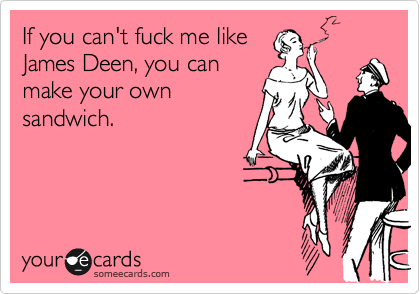

My introduction to Deen was through an S&M scene, and it's the only context I've seen him in.  So while the teenagers are watching the vanilla stuff, there's a whole other side that is almost never acknowledged in the media.  Maybe they're afraid the teenaged girls will find the kink? (Though as above, the girls who aren't into it feel they have enough agency to say so.)  The Nightline video — which you should only watch if you want to kill your ladyboner, and fast — pulls clips mostly from  TV show parody porn, probably because they want you to think the porn industry is targeting children by making cartoon spoofs.  (Who knows, but Deen in yellow paint as a porn-Moe Syzlak is not hot.) The first mention I've seen of his work in S&M was in the New York Observer's piece "The Boyfriend Experience."
“I’ve been into rough sex pretty much my whole sexual life and so I’m not, like, bad at it,” Mr. Deen told me by phone last month, on his 26th birthday. “I don’t know how to say it without being a hideous prick, but I’m pretty good at having rough sex. It got to the point where a lot of girls who aren’t into that type of sex were afraid to work with me because they thought I was going to slap them in the face or something.  But I only do that if the girl is into it."
"James Deen is gonna get me kicked out of feminism."

According to the Observer, one third of his output (hurr hurr) is in the realm of kink.  But unless you're watching it, you probably wouldn't know it exists. (I've watched it. A++.  Would porn again.)  Maybe it should be that way; kink is only kink because it's not so common.  But why the erasure?  Especially in the age of this awful Fifty Shades of Grey thing.  Is S&M only okay if it's in print? If it's so badly written as to be completely implausible and thus, safe?  I've read part of Fifty Shades, and as my friends know, I spent a good deal of time rolling my eyes and yelling "That's not a thing!"  Anastasia Steele is a reluctant virgin, which is probably an oft used porn setup in itself.  Christian Grey is into bondage because he's got a very damaged psyche.  From what I can figure, Fifty Shades of Grey is getting a cultural pass because their foray into BDSM is a phase, and what they really want is to hold hands and make love in a field or something.  (And we're back to the teenaged girls.) It's a new cultural conception, this the boy-next-door porn-star, and the world isn't quite ready for him to be into suspension,spreader bars, and fisting.  What's amazing is that we have this boy at all.  Small victories.


*They might be teenagers, but that link is absolutely NSFW.  
** Through all this, I totally acknowledge that there are teenaged girls who aren't into that at all. How could I not?  


Further reading:
 James Deen: The Tom Cruise [whaaaa? Brits are weird] of Porn 
Porn That Women Like: Why Does It Make Men So Uncomfortable?  

This Can't Be A Coincidence

Last night on Family Guy, Brian published a book with Penguin. And here's how that show portrayed a higher-up at Penguin:

This can't be a coincidence.

Open Letter to Jodi Picoult

Dear Ms Picoult,
I agree, the New York Times really, really likes white dudes from Brooklyn. I noticed a while back, and the reviewers there are not real subtle in their idol worship. Further, I'm pretty sure the reviewer of the new Franzen book, Michiko Kakutani, is predisposed to hate female authored books. All this can definitely get pretty annoying.

However, I complain as a reader. You're complaining as a writer, and I have to assume that you're complaining because your reviews have been less than positive. Here's the thing: you're a horrible writer. Your situations are cliche and contrived. Your characters are more than unlikeable, they're hateful and unbelieveable. You seem to be writing to ensure a TV movie option.

You sell a lot of books and I can't figure out why. Maybe all this is unfair of me, since I've only read about 50 pages of one of your novels. I can't remember another book I've hated so much I had to put it down and quit. There are books I don't like, having finished them, but yours was the only one that so disgusted me I had to stop and give it back to the library, lest it contaminate my house further.

So maybe I just don't know enough of your work. But have you read Franzen? He's really, really good. So is Lethem. Some of the Wonderboys the NYT loves aren't all that, but those two? They kinda are. You are not now and will never be in the same league.

I'm annoyed that you co-opted a very valid complaint for your sour grapes. You cheapen and lessen the point. It almost feels like Sarah Palin calling herself a feminist. Right words, wrong people.

Next time the NYT fawns over Tao Lin, though, feel free to lose your shit.

Sincerely,
Panic

Orange Prize Brings Out the Neanderthals... Again

Every year when the Orange Prize lists are announced (long or short), someone steps up and says that the women-only prize is "sexist" and not needed. Every. Damn. Year. Boring! Yet rage-inducing! Such ambivalence!

This year, they've trotted out my beloved A.S. Byatt to do the dirty work (it's okay, Antonia, I still love you). Bah. I'm not going to get into all the arguments (wooops, I actually do, further down), since about three people read this blog, but there's no such thing as a reverse -ism, friends, and until women are equal players in the world, things like the Orange Prize are, yes, still needed. Consider that the most recent winner of the PEN/Faulkner award, Kate Christensen, is one of only a handful of women to do so.

And the opinion pieces come out of the woodwork. Here's another one, from Telegraph, that I'm purposely not linking to (for several reasons, the hateful reader comments being but one):
Women are predominant, in terms of numbers and power, in most of the major publishing houses and agencies. They sell most of the books, into a market that largely comprises women readers.

First, I'm not sure how it is in the U.K. but in Canada, something like 80% of the workforce in publishing is female, while only 3% of the executive is.* So, tell me, where is the real power? Secondly, "they" sell most of the books do they? You mean most of the people in the pink ghetto of retail are women? Well yes, that's true. Or do you mean female authors sell more books? If that's the case, then you're going to have to be more clear in your writing, and back that up with some stats. I'd love to see them, because I'm definitely interested.

The author of this silly piece seems to think that women are a "dominant" group, like "whites" (wrong). He continually makes these sorts of comparisons between gender and race based oppressions. While -isms do work together to create layers of oppression, comparing oppressions (sexism and racism in this article), is very, very tricky business (see Hilary v Obama), and really shouldn't be done. Ever.

Then, he casts every woman he comes in contact with as unable to defend their position with logic; their only tactic is to "hit him on the head," literally or with "verbal abuse." He was called, and I quote, "a BUM." How he must suffer! Personally, if I was faced with these tired old arguments against women-only institutions, I'd be prone to violence too. Not because I'm unable to engage in "mature debate," but rather because my opponent has set the bar so low with their reactionary drivel, a hit on the head is the only logical response.

And P.S.: the patriarchy is not "a trick that men played on women for thousands of years." Leave it to a man to take millennia of world-wide, systematic oppression, abuse, and subjugation and minimize it down to something like putting a whoppie cushion on your chair. That, my friends, is what we call privilege. Additionally, with the implication that women fell for this "trick" for so long, the writer once again gets to call womankind stupid.

But yeah, we're all like totally equal and powerful and shit. *headdesk*

My ex-pat friend Axel did mention in the comments a while back, how right-wing the Telegraph is, so I guess I shouldn't be too surprised to see this sort of thing published there.

I've gotten into arguments mature debates at Bookninja about this sort of thing, and it's unhelpful that there aren't (that I know of) statistics on how many books are published by men and women each year (for the casual observer, it seems pretty even in the fiction realm), how big the advances are for men vs women, that sort of thing. This is a casual observation, but I have noticed The New York Times often gets really, really excited over quirky, clev-ah, first time male novelists, giving them pages and pages and pages of press**, yet women don't get the same treatment†. There have been studies that indicate that women are the bulk of the fiction readers, but nothing so much on the writing front. I'd be interested to know, at any rate.

The Orange Prize long list is here.
I've read:
Jennifer Egan The Keep
Anne Enright The Gathering
Heather O'Neill Lullabies for Little Criminals
Based on my small list, I'm pulling for Egan. The Keep was one of the most transporting things I've ever read.

*This is based on my memory of a Quill and Quire industry survey I read in 2005. I doubt things are 50/50 as of this writing. Call me a pessimist.
**I'm sorry, please allow me to indulge my incredibly shallow side. Look at that photo!! If I saw that guy in a coffee shop, my first thought would be "douchebag."
†Sarah Seltzer, in the latest issue of Bitch, addresses the anti-feminist bias at The NYT, that I mentioned in this post. Unsurprisingly, Seltzer writes about it far better than I did. Well worth a look.

Reviews of Reviews pt 1


Back in September, Feministing wrote a piece on sexist book reviews, citing The New York Times review of Katha Pollit's Learning to Drive as an example of such. Jessica Valenti writes:

Sometimes it seems like women are criticized just for having the audacity to speak the truth about their own lives. I'm so over this kind of hackneyed, backlashy bullshit. It's the easy way out: Don't want to bother with writing a thoughtful review of something? Just go the "harping woman" route, it's a winner!

The Times struck again, in its review of Susan Faludi's The Terror Dream. Reviewer Michiko Kakutani accuses Faludi of "recycling arguments similar to those she made a decade and a half ago in her best-selling book Backlash: The Undeclared War Against American Women (1991)" which now "feel forced, unpersuasive and often utterly baffling." Faludi's main argument, that female voices were systematically silenced post 9/11, in favour of a more macho, cowboy ethic is considered suspect. For an example in the media, Kakutani points out that Katie Couric* was made anchor of the CBS news. Never mind the pages of statistics in which Faludi points out that the numbers of female editorials, columns, and appearances on TV were in rapid decline. Never mind the threats made to those women (Pollit included) who questioned the new mindset. Never mind the drudging of their character in the media (not just the Right Wing media either). Nope, Katie Couric was on the news, so Faludi's "thesis [...] rings false."

Kakutani comes up with two other female names of news reporters, but can't argue the statistics, so zie** ignores them. In fact, it's rather funny that Kakutani engages in just the sort of shoddy work zie ascribes to Faludi. Wherever Faludi's extensive research doesn't fit this hit-and-run review, it's ignored. And that is to say, the facts and figures are never quoted.

The strongest part of The Terror Dream, for me, focuses on the immediate aftermath of 9/11. This is where Faludi is at her best, and most comfortable. As in Backlash, her research is extensive, compelling, and the conclusions drawn are uncomfortable, and thought-provoking. Agree with her or not, the fault isn't in her writing and execution. If there is a fault in The Terror Dream, it's trying to tie post-9/11 reactions to a larger, national neurosis about invaders, and how that changes how females are treated in American society. I'm not sure I'm convinced of that at all, but I am intrigued with the notion, and at the very least, now educated in some early American history.

By calling The Terror Dream "[an] ill-conceived and poorly executed book — a book that stands as one of the more nonsensical volumes yet published about the aftermath of 9/11," Kakutani leaves the reader of the review feeling like this was more of a vendetta piece. I don't think I've ever seen a more slanted review, and ironically, it speaks to the phenomenon Faludi is writing about: silencing the voices of women who dare to speak out.

Rebecca Traister in Salon also reviewed The Terror Dream, in a far more balanced way. While Traister also had some problems with the book (the opposite ones I did, actually; she finds the last bit of the book "brilliant and exhilarating"), she doesn't just throw the whole thing on the fire. Addressing critics of Faludi's methods, Traister writes:
It's a complaint that has been lodged against Faludi before: that she's a cherry-picker, rounding up the juiciest anecdotes that suit her argument and leaving the rest to languish. On the other hand: What a bumper crop of cherries!

The impression is that Faludi's work, is worthwhile, though not without problems. To me, this seems like a very fair assessment of the work.

In any polemic, and to be sure that is what The Terror Dream is, there are spaces in which to attack. But that's fair. That's what is supposed to happen. A book like this is supposed to create thought and debate. However, anytime I see a review so obviously slanted, so eagerly derisory, as was published in The Times, I smell a rat. It's too easy to give into simple nit-picking, without even considering that Faludi, on one level or another, just might be right. The Times review didn't respect the book (or the author) enough to give any consideration to Faludi's arguments, and thus, Kakutani's piece simultaneously fails as a review, yet manages to prove at least some of Faludi's arguments through vitriol.

"This, sadly, is the sort of tendentious, self-important, sloppily reasoned book that gives feminism a bad name." No, Michiko. This is the sort of thoughtlessly reactionary, sloppy, needlessly nasty review that gives rise to books like The Terror Dream. So, well done!


*Though Couric's appointment actually speaks to Faludi's thesis as well. When she moved to CBS, there were a lot of stories on her, and most of them focused on her family life.
**I'm using gender neutral pronouns here, as I'm not sure of the gender of this reviewer.

Schadenfreude Pie


I've already admitted that I'm a bit addicted to stories of domestic distress. I'm also a capital-F Feminist. The "mommy wars" is where these two things meet up, rather uncomfortably. See, while I'm child-free, a lot of very important people in my life are mothers. Many of them stay-at-home mothers. So I've become very interested in this whole "mommy war" thing, which we know now is very much a product of the media, used to sell papers and magazines. More importantly, it's a product of the patriarchy, which has always used "divide and conquer" as a means of making sure the underclasses ─ in this case, women ─ don't rise up. Who has time to fight the real enemy, when you're fighting each other, right?

A couple years ago I read The Mommy Myth, more as a backup to my child-free choice; I needed something to stablise my mind, in the midst of the "You just got married, when are you having kids?" chorus. At the time, my cohort was mostly child-free as well, but when I started meeting some mamas and their kids, I started noticing the "mommy wars" articles. That's when I got a hold of the excellently researched The Truth Behind the Mommy Wars. A couple months back, someone in a feminist forum (perhaps it was the comments section of my favourite radical Feminist, Twisty Faster) recommended Perfect Madness: Motherhood in the Age of Anxiety. Not only does this book tackle the "mommy wars," but it takes a very serious look at how mothers are expected to be superhuman, even if they're part of the "opt-out" set. There's more than a hint of the post-feminist *cough* in here. Feminism seems to get the blame for making women take on too much, since we (those of us born in the 70s) were told that we could be mothers and career people growing up, and when that doesn't work, we still channel all that super person work ethic into raising children. The concession is made a couple times, far too briefly, that if things were just equal, if men were able to be full co-parents, then perhaps mothers would get a break, get a nap for crying out loud. However, the overriding impression is a bit defeatist: you were lied to; you can't have it all. It's the impression I got anyway. Overall though, there's some really good stuff about how hyper-parenting isn't good for kids, and that mamas need to take it easier on themselves.

And here's the uncomfortable alliance, and full confession: I read, and sympathise, and disseminate, and support mothers. And yet, and yet... I read these books and I still have to breathe a sigh of relief, because I've got it so, so easy. I'm not sure if that makes me a total asshole or not. I suppose the blog world will have to tell me. At any rate, I've been wanting to share the following link forever now, and because the aforementioned sigh of relief just might be bordering on Schadenfreude, I bring you:
How to Make a Schadenfreude Pie.

The problem with all these books, is they focus on a very specific group: middle to upper-middle class (mostly) white women. They almost always miss the people who are struggling to get by, the people who don't have a choice about working, the people who don't have a choice about staying home. They miss the working poor and the single mamas. That's why I was glad to see this article the other day:
The Working Wounded.
The debate over whether mothers of young children should opt out of full-time work, and instead stay home with their kids, has important implications for all mothers, but the vast majority of those mothers are being excluded from the conversation. The vocabulary of the discussion -- opt out, choose to stay home -- reveals its bias: It assumes that all mothers can make a choice that, in actuality, very few mothers are in a position to make.
Because not everyone is Rebecca Eckler (annoying).

* * *


In the least shocking news ever, it turns out Americans don't read a lot.
One in four adults say they read no books at all in the past year, according to an Associated Press-Ipsos poll released Tuesday.[...]The typical person claimed to have read four books in the last year -- half read more and half read fewer. Excluding those who hadn't read any, the usual number read was seven.
I wouldn't mind seeing some Canadian numbers on this sort of thing. I assume they'd be higher, but I have absolutely nothing to base that on. More important than the statistics in that article, is the picture: where is this bar that I can still smoke in!? Tell me! I will go to it! Bah, it's probably a wretchedly old stock photo.

By the way, if you're curious how many books this Canadian reads per year, check out the "2006 Book List" and "2007 Book List" links on the sidebar there.

The Middle Ground and Assorted Media

I once read an issue of US magazine that a had cover shouting "Mary-Kate is too thin!" and an inside article blasting Brittney for being "too fat." I think the two women were within five pounds of each other at the time. I'm reminded of this issue because there's been talk recently, about literature, being either too "fake" or too "real."

Laura Albert, the author formerly known as JT LeRoy, was found guilty of fraud by a Manhattan jury last week. Albert's book Sarah was optioned by a film company, but when Albert was "exposed" as the real author, the work somehow lost merit. Personally, I think it's a load of crap. I haven't read the book, but it seems symptomatic of our sensationalist age the author's personality and back story are more important than the work itself. The author wasn't a young hustler, working the truck stops of Virginia; the author was a mother from Booklyn Heights, and that doesn't sell.
According to the New York Times "[a]fter the revelation, the company took the position that Ms. Albert had used the JT LeRoy “brand” — the same that had attracted them — as a celebrity magnet to draw attention to her books." See? The work isn't important, only the angles that will get media attention are. Sell, sell, sell. That's why movies are so shitty these days. Sensation, not content, is of the upmost importance.

In a drastically different story, an author was assaulted when he returned to his hometown in France, because the book he wrote was a bit too real for the villagers of Lussaud.
[I]n July 2005, when Jourde, whose previous works include unflinching and controversial portrayals of the worlds of literature and academic scholarship, arrived with his family for a summer break, six villagers appeared outside his house shouting insults. Blows were exchanged and stones thrown. A car window was smashed. Jourde's 15-month-old baby was slightly hurt and his mixed-race sons were called 'dirty Arabs'.

You can't win, folks. I'm sitting here trying to think of (popular?) books that just breeze by, and all I keep coming up with is controversy. Not that literature has ever been immune from this sort of thing. Literature has power, huge power, and because of that, there will always be crazies trying to ban Potter for fear of witchcraft, and people making poor King adaptations (and King writing poor novels, but I digress). I just found those two stories an interesting comparison, coming through the grapevine when they did.

In other media, Wil Murray is coming to my town next month, and he's bringing his tight pants with him. Check out the excellent article in Toronto Life and head on down to the Loop Gallery to see what happens when you "let the paint do what it wants.*" Now, someone just has to get Lee Henderson's butt out here, for the full Alberta posse effect.


*Actual quote, circa 1998. Love ya!