Showing posts with label fiction. Show all posts

The Dependent


There’s a story many women tell, about that time they dated a musician.  Sometimes he’s an artist or a poet, but usually it’s a musician in this story.  Our heroine is responsible and hard-working (if only in comparison), while he’s aimless, entitled, or lazy.   It falls on the shoulders of the girl, likely for the only time in her life, to support this man entirely.  In “Wings,” Lorrie Moore supposes that the relationship lasts almost to a girl’s 40s, when she’s not so girlish anymore.   “She'd been given something perfect – youth! – and done imperfect things with it.”
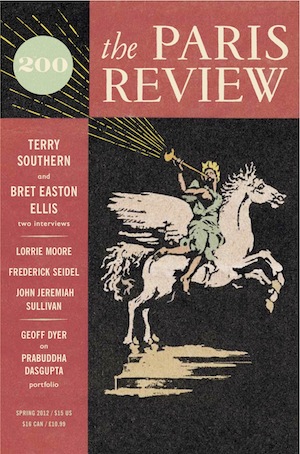
In the landmark 200th issue of The Paris Review, Bret Easton Ellis says Lorrie Moore is "maybe the best short-story writer of my generation."* “Wings” is in that same issue, and  is illustrative of this pronouncement. It is the story of KC and Dench, lovers and bandmates. They've come to a significant roadblock in their lives, unable to make a living from music, unable to do much of anything else. They've come to a small town to sublet a house from a friend in a neighbourhood better than they're used to; here they try to regroup. One morning, on her usual walk with the dog (to get Dench's coffee), KC meets the resident of a large house she admires. Reluctantly, KC is drawn into old-man-Milt's lonely world of microwaved store-bought muffins, and unheated rooms. As time goes on she helps him with his doctor's appointments and errands, like a dutiful daughter or younger wife.

Part of Moore's skill is being able to economically write a novel's worth of backstory into many fewer pages. We learn how KC and Dench met, how their parents died, how Milt married for the fist time at 60.   The character of Dench emerges as one of those men that will always have a woman around to pick up his life (or coffee) for him. Early on, KC wonders:
How did Dench pay his bills?
"It's one big magic trick," he said.
Dench, probably unconsciously, preys on the soft spot women seem to have for the mysterious bad boy (though he's also smart and funny; there is much to love in Dench but he's difficult to live with because he's essentially lazy and unbothered by that).  KC is the driver behind most decisions in the relationship.  By the time they arrive in the sublet town, the pattern is completely entrenched.
She loved Dench. She was helpless before the whole emotional project of him. ... Romantic hope: From where did women get it? Certainly not from men, who were walking caveat emptors. No, women got it from other women, because in the end women would rather be rid of one another than have to endure themselves on a daily basis. So they urged each other into relationships. "He loves you! You can see it in his eyes!" they lied.
However, her relationship with Milt begins to make Dench’s inability to fend for himself more clear, and more annoying.  Dench whines that he had to spend all day alone with their dog, while KC was out all day with Milt.  Further, Dench asks KC to get as close to Milt as possible, in order to be put into his will.  It's the only time the drive to not work seems conscious and planned.  He suggests to KC that if she was nice to the old man "then the end result might be, well.. .we'd all be a little happier." "He's probably loaded. And gonna keel soon. And..." It’s enough to make KC want turn her back on Milt, though (initially) not Dench.

It’s worth nothing that Milt, too, is something of a Dench.  The big house he lives in was his wife’s originally, and he was a bachelor for many, many years before.  "Wings" begins with an epigraph by Henry James from The Wings of the Dove: “Should he find he couldn't work it there would still be time enough.”  Time, in this case, to find another woman to pick up the pieces. It’s as if he too moved from woman to woman and the last left standing – in this case KC – would be the one to get the reward: namely, the house.  KC is later accused of being a gold-digger by one of Milt's stepdaughters. This hits particularly hard, as Milt has just changed his will to leave KC the house. But the truth is that it's really the men in "Wings" who need the women to prop them up.

The day KC met Dench, he auditioned for her band.
But she remembered she had wondered whether it would be good to love him, and then she had gone broodingly to the window to look out at the street while he was singing and she had seen a very young woman waiting for him in his beat-up car. ... The young woman had clearly driven him there--would she be tossed away? bequeathed?
It's the question KC has to turn on herself, but she realises that it doesn't matter if she sticks around to be replaced, or if she cuts lose.  Dench, like Milt, will always have "time."  KC chooses a more solitary path.  

In “Wings,” KC winds up without the man, but still in the position of helping others.  She turns the house into a hostel for the families of sick children being treated in a nearby hospital.  She is tethered by the house and the narrative that her position in life is to be relied upon.  We assume Dench has flown to yet another sturdy female who could fix him.


*Though he also goes on to say that "The Corrections and Freedom are the two best novels that came out of my generation, so man up and deal with it, guys." So, perhaps his opinion is slightly suspect.

In the Telling

Open City feels like a collection of vignettes, rather than a novel. Narrator Julius wanders New York and Brussels and while doing so is given the stories of those he meets. These interactions are not limited to people you’d think would share stories: those you have a relationship with, the guests at your dinner table, your family finally telling you their secrets. To make this concept work, complete strangers are somehow compelled to tell Julius intimate details and life-stories. It makes for wonderful reading — new points of view and fresh narratives abound — though it strains credulity a bit. Further, Julius never seems comfortable with all this telling. For all that this book is set up as almost micro-fictions, told by the characters he meets, Julius often tries to avoid hearing their stories, or at least seems unhappily resigned that he is (unusually) someone people feel compelled to talk at, for lengthy periods of time. Julius doesn't usually say much in response, and seems so interior of a person. I can picture his face not being scowling or openly condescending, but not particularly friendly; not someone I would approach and tell my life story. Perhaps though, it is his profession. Julius is a psychiatrist; he is paid to hear people talk, and perhaps there is something in this that he carries outside, so that people everywhere talk to him.


Each person, must, on some level, take himself as the calibration point for normalcy.
Cole forces the reader to examine how they approach stories and the biases they bring along with them. For example, there were several instances in which I assumed a character was white. First, a friend of Julius outlines his family’s situation: His father is "out there in South Caroline somewhere right this minute, looking to score blow. That's what he lives for"; Mom had "six children from five different men"; he has an older brother "who's doing time for dealing"; and his Uncle Raymond "was a mechanic in the Atlanta area. He had a wife and three kids. [...] He went into the backyard and shot his brains out." For whatever reason, I had a white-trash hillbilly family in mind, but another in the group, Moji, says to The Friend Not Named "black* people [...] like you, who have been here for generations." A similar thing happened a little bit later when Julius is with a patient, and it's only when the patient says "Doctor, I just want to tell you how proud I am to come here and see a young black man like yourself in that white coat, because things haven't ever been easy for us" that I realise the patient is black. I feel this is deliberate on Cole's part. He knows that whoever is reading this book will default somewhere, and he lets them. For some readers, their biases will be totally wrong. Moji later wonders if Julius is asking her leading questions about her relationship in order to ascertain if her boyfriend is black; Julius carries bias as well. I don't think this unconscious assuming is just me, but it does make me wonder how other people would default with these pieces of the text. Without information otherwise, do we all default to what we are, because it is the most comfortable and familiar? Julius, as a kind of Mischling (with a German mother and African father, he grew up in Nigeria and seems to identify as black for the most part [and this reminds me of the erroneous notion that Africa is a country, that North Americans often have]), lives every day knowing difference, never quite fitting one category or another. He recoils at the notion of instant brotherhood based on nothing but religion or skin-colour, knowing that the inbuilt bias can lead to surprising revelation later; he’d rather just avoid getting close. (Julius is also set upon by black youth, beaten and robbed. The ties that bind us to race or religion vanish easily in the face of violence.)


Following the idea of bias and prejudice, there is a subtle yet real examination of xenophobia here. It’s not just in the obvious conversations people have about people from other nations, but in the way people speak everyday about their environment. I began to notice that the invasive "Chinese" species of trees and insects are a topic of conversation. I wondered if this was significant, somehow, and dwelt a bit on how news stories on invasive species are always careful to name where these plants/insects/fish etc come from. Moji articulates what I’d been thinking:
The name Africanized killed bees is a piece of racist bullshit. Africanized killers: as if we don't have enough to deal with without African becoming shorthand for murderous.

Anecdotally, the differences tend not to be exaggerated—for important social reasons, people like to think that other people are totally unlike them—but these differences are, in reality, for most functions, rather small.
A major point happens about half-way through, and it's not until you finish the book you realise this is a lot of what Cole's on about. That in trying to eradicate the hatred of difference, we've attempted to subsume everyone into one category. In order not to offend we've forgotten that difference can be exciting, interesting, and glorious. A man who works the cash register at an internet café in Brussels becomes somewhat of a friend. As he begins to talk, his education comes out (in this passage we are also confronted with how we default into categorization not only by race, but by class).
You are different, okay, but that difference is never seen as containing its own value. Difference as orientalist entertainment is allowed, but difference with its own intrinsic value, no. [...] Let me tell you something that happened to me in class. [...] We were supposed to choose between Malcolm X and Martin Luther King, and I was the only person who chose Malcolm X. Everyone in class was in disagreement with me, and they said, Oh, you chose him because he is a Muslim and you are a Muslim. Yes, fine, I am a Muslim, but that is not why. I chose him because I agree with him, philosophically, and I disagree with Martin Luther King. Malcolm X recognized that difference contains its own value, and that the struggle must be to advance that value.

The city in Open City is the world. I know this sounds a bit wide-eyed and peacenik, but it’s quite real. Immigration makes cultural identities of place extremely fluid. Julius is an immigrant to New York, as are many of his friends. Like North America, Europe has always had immigrant populations, and he spends time not only with the current wave of Arab immigrants, but a symbol of the old guard, a rich, white woman. People move, and because of movement, experience is necessarily individual. With an open ear and open mind, the “global village” becomes not an economic concept, but a humane one.


Further reading, which doesn't fit into my post anywhere, but is interesting:


Julius goes to a photography show in NY on Martin Munkacsi. At it, he contemplates a famous image of "three African boys running into the surf in Liberia.” There is some controversy surrounding the setting of this portrait.


There's a lot of description in the book about the physical environment of Manhattan. Early on:
The strangest of islands, I thought, as I looked out to the sea, this island that turned in on itself, and from which water had been banished. The shore was a carapace, permeable only at certain selected points. Where in this riverine city could one fully sense a riverbank? Everything was built up, in the concrete and stone, and the millions who lived on the tiny interior had scant sense about what flowed around them. The water was a kind of embarrassing secret, the unloved daughter, neglected, while the parks were doted on, fussed over, overused.
I had read this Paris Review article just a couple days before about Minetta Brook


Donna Bailey Nurse's piece in the National Post today, while focused on Canadian black literature, is easy applied to Open City.


*I tend to capitalize “Black” when writing about race, but Cole doesn’t, so I’ve kept that format throughout this piece.

Missed in '11: Sense of an Ending

There are pretty major spoilers in here, if you care about that sort of thing. You have been warned!


I'm sitting in my kitchen listening to Carol Off talk to Julian Barnes about The Sense of an Ending on the CBC. I didn't initially fall in love with this book, so sometimes it's good to hear the author talk about things and shed some light on the motivations, because my first reading, as you'll see below, could pretty much be summed up with: “bwah!?” Everyone loved this book on first read, and all I could think about was these streams of wicked, strange, or stupid women that populate the novel. One of the things Barnes said in this interview, is that Tony — the narrator of The Sense of an Ending — isn't a bad guy, he doesn't hate women, he's just confused by them. This really, really shows. Stephen Hawking was interviewed recently, and when asked “What do you think most about during the day?” he replied “Women. They are a complete mystery.”* This tidbit is what made all the headlines, but why was anyone surprised? Freud famously didn't know what women wanted (and he told them what to want instead, didn't he?). Not understanding women is the cheeky default of a certain kind of man who would rather make the joke than try. Tony, according to Barnes-on-the-radio, has mostly lived a life unexamined, and that leads to a terrible characterization of the other half of the population. I suppose I just have to take Barnes on his word that Tony is clueless, not “bad.” Tony is not to be admired, not even in the end. Tony is not redeemed. Tony remains clueless and he's probably too old to care, or to change.**
Does character develop over time? In novels, of course it does: otherwise there wouldn't be much of a story. But in life? I sometimes wonder. Our attitudes and opinions change, we develop new habits and eccentricities; but that's something different, more like decoration. Perhaps character resembles intelligence, except that character peaks a little later: between twenty and thirty, say. And after that, we're just stuck with what we've got. We're on our own. If so, that would explain a lot of lives, wouldn't it? and also — if this isn't too grand a word — our tragedy.

I can't help but notice when men put things onto women that aren't really a thing. (See also "magical sperm phallacy") After Tony has a sexual encounter with ex-girlfriend Veronica, the following conversation takes place:
'You selfish bastard,' she said, the next time we met.
'Yes, well, there it is.'
'That practically makes it rape'
This is after she removed her own “knickers,” handed him a condom from her own stash, and put the thing on him. As one would expect, the word "rape" sticks to Tony. Later, when she gets together with his old school chum, Adrian, Tony is
[i]magining what Veronica might have said to Adrian about me ('He took my virginity and then immediately dumped me. So really, the whole thing felt like rape, do you see?')
This is a pretty weird piece of the narrative, thinking that women are so quick to call "rape" when most of the time we can't call it rape when it really does happen to us. So what's happening here? Is Barnes as clueless about women as Tony? It's this some sort of false memory? Note the second quoted passage: Tony imagines Veronica calling it rape. Is this some sort of fear-based wish-fulfillment? Tony's afraid she's saying these things to other people, so he decides that yes, she actually has said this, and to him. One can't be sure whether it's Tony or Barnes, but it's worth pondering. Tony also subscribes to that the old virgin/whore dichotomy. I have no qualm with this in context of characterization. It works, because Tony is the Everybloke, to every degree.
And did you think her a virgin when she was rolling a condom on to your cock? In a strange way, you know, I did. I thought it might be one of those intuitive female skills I inevitably lacked. Well, perhaps it was.

I know it's possible for men to write really believable women; many succeed. So when shit like this happens, especially in a book that's big award-winner, I wonder what's up. (And of course, I don't notice when women do the same to men, because I am not a man, and I'd happily accept examples where men found women's writing to be very weird and wrong. On the flip-side, there has been universal acclaim for Lynn Coady getting it right in The Antagonist.) As soon as I start wondering, I start looking at the rest of the female characters. Tony's mother is presented as stupid (though all young people feel this way about their parents at some point). Interestingly, Barnes said in the interview I heard today that his father was “wiser” than his mother, so there's something of Barnes in Tony here. His daughter, Susie, is slightly self-absorbed, and distant.
She's practical about emotions, Susie is. Gets that from her mother. So my emotions as they actually are don't concern her.
She spends more time with his ex-wife, who cuckolded him. This is okay though, because she gets what she deserves:
Margaret's second husband turned out to be not quite peaceable enough: he took off with someone who looked rather like her, but was that crucial ten years younger
She and Tony have a "good" relationship, but one gets the sense he feels slightly controlled by her. It's amusing how Margaret and Tony talk of the mysterious woman, how one is or is not that woman, but all women are basically a mystery to him.
Margaret used to say that there were two sorts of women: those with clear edges to them, and those who implied mystery.
This reductionist categorization seems more in line with how Tony looks at women. Again, I wonder if Tony is putting words in someone's mouth (though women do make judgements about other women all the time, but I'm thinking of how this particular book works). Veronica is dubbed "the fruitcake" later by Margaret, and Tony agrees. Meeting up after 40-odd years, Tony finds the same old, cold Veronica, who gives him the female stereotypical “If you don't know why I'm angry I'm not going to tell you” line so many times. Maybe it's repeated so often, because Barnes knows it's a clichĂ©.
'You just don't get it, do you? But then you never did.'
'You still don't get it. You never did, and you never will. So stop even trying.'
'If you need to ask the question, then the answer is no.'
The only woman in The Sense of an Ending who seems at all nice or caring winds up — spoiler alert — seducing Adrian and baring his child. The child likely has Down's Syndrome:"'The Mother' — at a dangerously late age. A child damaged as a result." A result of the mother's age, a result of her scheming to take the boyfriend away from her daughter. (Is this why she was so nice to Tony when he visited the family home?) The sins of the mother visited on the child, and Veronica is tasked of caring for him after her mother dies.

With Veronica I moved from blaming her for having failed to save Adrian to pitying her.
Adrian kills himself, young, while — as far as Tony knows — still with Veronica.
The bitch, I thought. If there was one woman in the entire world a man could fall in love with and still think life worth refusing, it was Veronica
Unlike the ladies of The Sense of an Ending, Adrian is the shining light of the narrative. He is the stand-out, is interesting in ways good and bad, which are all things that Tony will never be. If Adrian is the only thing that gave an ordinary life a narrative, Veronica is the villain of that narrative for taking the novel-worthy away from him.
I did, eventually, find myself thinking straight. That's to say, understanding Adrian's reasons, respecting them, and admiring him.
And that's early on in the novel, before the reflections of age. Later:
I don't envy Adrian his death, but I envy him the clarity of his life.
Adrian remains a shining star for Tony, possibly because he didn't live long enough to be tarnished. He's Tony's dead rock star.

The Sense of an Ending is chock-a-block with ruminate wisdom. Part of me wanted to quote everything, but I had to stop myself from transcribing half the book. When Tony talks about ageing, about the things he's learned, about what it's like to be average and how infernally dull it is to be completely normal, I rather liked the book. These parts certainly speak to a person like me, who feels pretty average in all ways. I wish that would have been more of the content, instead of the paean to male friendship, and how women are just so weird (though isn't Adrian weird, isn't his suicide, and his affair with Veronica's mother very, very weird?). I suppose, though, that would cut an already slim book down to an essay. Like last year's winner The Finkler Question, we have a mild-mannered, white middle-class middle-aged man telling his story in a calm and characteristically English funny way. I laughed out loud at both books, I really liked Finkler and felt that was the right choice that year for the Booker. But following that with The Sense of an Ending seemed a bit... not predictable, but sigh-worthy. Really? Another one of these? Some people feel frustrated about historical fiction taking prizes (I've heard the term "Giller Bait" bandied about, referring to historical fiction in Canada), and this is how I feel about the middle-aged, middle-class white English guy wondering just what it all means. It's a bit, just a little bit, tired. Not enough, yet, to annoy me, but we'll see what happens next year.
You get towards the end of life — no, not life itself, but of something else: the end of any likelihood of change in that life. [...] I thought of what I couldn't know or understand now, of all that couldn't ever be known or understood. [...] There is accumulation. There is responsibility. And beyond these, there is unrest. There is a great unrest.


*My twitter-snark response: “This from a guy who left his wife for his nurse.” ETA: Ouch. Then there's this: For years there have been shocking rumours of violence and abuse against the vulnerable scientist.
**”I will not change and I will not be nice.”

Missed in '11: The Marriage Plot

The "Missed in '11" exercise is also partially about clearing out the queue of posts I have sitting here, without the guilt of deleting them. Problem is, of course, that the thoughts in these drafts aren't fully formed, and in some cases I don't even have the book anymore (thank you for existing, Toronto Public Library). This post on The Marriage Plot suffers all these conditions, so I'll try to make as much sense of it as possible while trying not to re-hash old ground; this was a much-anticipated book, and has already had a lot written about it!


I loved that The Marriage Plot is partially a book about books. I loved most the passages when the characters are actively engaging with text. Madeline reads Barthes and it directly affects her, differently as her year goes on. She carries it with her like advice guide and Bible in one. That’s the sort of thing that makes theory important. It’s not just dry linguistic wank, or at least it doesn’t have to be. It is beautiful, what Eugenides does with A Lover's Discourse. Mitchell, second-side of the love triangle, takes a wide variety of texts with him when he travels through Europe and India. He, too, is shown to live with and through the books he’s reading. Leonard (the love interest) — despite having met Madeline in the semiotics class that brought Barthes into her life — doesn’t really seem to read. He is Other, he’s a scientist, he’s cold numbers. It’s a set up, and you can’t really root for Madeline and Leonard, even if you’re not a book person (and if you’re not why the heck you’d be reading Eugenides is a mystery).

Now, for the complain-y part…

I can't figure out why two boys would be so in love with this horribly bland girl. I mean, I get that the book isn't really about the girl, it's about the boys, and that might be why she's written so blandly. Mitchell and Leonard are given complexities, rather vicious ups and downs, broad geographical range. Madeline only seems to have one mood: a sort of wandering wide-eyed confusion (oh, but she's "book smart"). She's recognized as the American version of beautiful but that seems to be the only thing to recommend her. She's the sort of girl who just has it so easy, things just come to her. She's privileged, athletic, a scholar who isn't challenged. She's a bit of a narcissist, frankly, with the Madeline wallpaper that she loves as a child remaining in her bedroom . Her interior life, and she does have one, is stunted in this way, stuck a bit in me-me land, the way a child is. She’s not malicious or cruel, she’s just so used to things being at worst mildly unpleasant. She is so coddled and padded. And perhaps that's a lot of it, that she is just a child, and children are not fascinating dinner companions; they're funny and cute but they're not complex and interesting.

I don't know the Regency source material of the marriage plot, I haven't read any Austen, so I’m not sure how this flows with Eugenides plot and characterization. I’m probably not far off to assume that the women in life and literature of the time, were probably talked around and about, instead of to, were treated like large children until the second they got married, and then had to assume the role of an adult immediately. And that may explain why Madeline’s mother brings her older sister Alywn to her, so the two sisters can discuss Alwyn's failing marriage. Madeline, as a newlywed at the point, is supposed to have sage advice to give to an older sibling, who has just had a baby. The only time Madeline interested me was when she to a Victorian Literature conference, where Gilbert or Gubar (I forget which) was speaking (nice touch)*. There, she finds others who share her love of literature, and decides to become a Victorianist, which is a newly emerging field when the book is set.

I don't think she takes care of Leonard when his mental illness becomes too large for him to deal with himself because she loves him; Leonard made her feel validated and adored when he was healthy, and she’s trying to recapture that. She never really had to grow up, but Leonard who comes from a very troubled family had to take responsibility very early. (Mitchell seems like a bit of a child too, when he literally runs away from having to clean up human feces while volunteering in a Hospital in India. Again, they're well suited.) Madeline’s parents have weird family meetings to discuss her life while she sits there; they talk around her, they keep her in that child state. So why do these two boys love this bland, perfect thing so much? Are we supposed to believe that these two, perhaps by extension many others, aren’t so interested in a woman’s interior as they are with her image? It’s a mystery that honestly plagued me through the book, because I’d expected more from Eugenides.

And then on the very last page... he resolves it. Humanely, lovely.

The Marriage Plot doesn't reach the great heights that Middlesex did, and while I spent a fair amount of time being frustrated with the characterization (and I kind of feel like the really great ending is kind of snatching things out of the fire at the last possible moment) I do still recommend people read it, if they've liked his work before. It's not a big disappointment the way Freedom was, after The Corrections. Not every book is an author's best book, and The Marriage Plot is still a very good book.

*And at that moment in the book, I had the weirdest sensation of being jealous of a fictional character.

Fables of Elbow Drive

When I was 23, I had a weekly, weeknight DJ gig in an alternative bar in Calgary. Well, the alternative bar in Calgary, not by dint of being the best but the only. I was a regular there, had been for years, so I knew most of the patrons. Weeknights in a dance club were for students (as I was), people without office jobs ("industry workers" as they were called), the underemployed, the artists and musicians, and the gainfully employed who really like to drink. The weekday crowd was less boisterous, more friendly, more willing to be silly, more likely to request a lesser-heard track. There was no pressure to pack the dance floor — it wasn't possible with a quarter-full bar — so I'd happily oblige with a flurry of odd songs. It was on one of these nights a fellow DJ friend wandered up to the booth. "I've taken six hits of acid," he said. He was probably exaggerating, but he was definitely tripping balls. "My friends have all left. Can we hang out?" (Acid, by the way, is one of those drugs you don't have to be on to find hilarious. People on acid are hilarious on their own.)

When the club closed for the night, my friend wanted to go through Mount Royal to where Elbow Drive follows the curve of the Elbow River. He told me he'd grown up around there. So we drove south and east from the club, to the outskirts of downtown. I'd never spent much time in this part of the city. It was relatively old, and far away from my parents' house in the north. Unlike the rocky banks of the fast-moving Bow, the Elbow River was bordered by flat and manicured grass, parks, and stately homes.* I could just barely hear the water moving along in the moonlight. He told me stories of being a kid around the area, where he used to play, the place where he kissed his first girlfriend. 3 a.m. on a summer Wednesday night is a pretty great time to discover a place in a city you've lived in all your life.

It was a picture of that night that entered — and stayed in — my mind reading "Home for Good" in Katherine Govier's Fables of Brunswick Avenue. I picked up the collection after it was mentioned a couple times by friends, one of whom quoted the axiom "Everyone lives on Brunswick Avenue sooner or later." I was apartment hunting at the time, and my library request for the collection came in the same day as a viewing of an apartment on Brunswick. A good omen, I thought. I didn't get the apartment, and I didn't exactly get what I was expecting from Fables either. The title of the collection is a bit misleading; very few of the stories take place in Toronto at all. However, a couple take place in Alberta, one of those in Calgary.

"Home for Good" begins with my nightmare scenario: a woman, Suzanne, returns to Calgary after many years of living in Toronto. While the job she has secured in Calgary is a step up and the ostensible reason for her move, the truth is that her life in Toronto was in utter shambles.
She walked over to the dormer window which made an alcove in her living room. She was a tenant in the attic of the kind of old house she had grown up in. The house had been painted and papered and divided into “heritage” apartments, although only fifteen years had passed since she left. Surely things happened too quickly in this town. Everything was a mistake, including the apartment. It had reminded her of a Toronto apartment, that was why she had taken it. But in Calgary it didn’t seem so choice; it made her feel as if she couldn’t afford anything better.
(I live in one of those third-floor Toronto apartments currently, by the way.) Suzanne visits friends who live by the Elbow, "From the window [of her apartment] she could see over to the riverside park." Suzanne remembers sneaking out to that park at 2 a.m. as a kid. I probably sat in that same park at 3 a.m. Govier captures exactly how it would feel to have to go back, to have to stare that feeling of failure in the face, to have to relive every moment everyone back home failed you, and the ways they've changed in your absence to fail you now.

It's true, things happen really quickly in Calgary. It's a city that really likes to knock things down and build new things as fast as it can. Yet when Govier's character remembers her 1968 student apartment near the university (probably still called an outpost of the U of A back then), I can picture the whole neighbourhood perfectly. The LRT I took to that same university cut through Motel Village. That Denny's saw late-night milkshakes in high-school. The bar I got into underage was right there. It's the same city. Some things never change.

I was kind of spooked by "Home for Good." I've still got my Norton anthologies as Suzanne does; they go where I go. I know I'm not the only one who takes all her school books with her through every move, but I could so perfectly see everything in "Home for Good," understood Suzanne's want for "a book somewhere that said how you were supposed to feel when you were no longer young, but you were not yet dead." There was a moment a year into living in Toronto when I almost went back, when everything seemed too hard and too expensive. I always fear I'll be forced to go back, that some misfortune will drive me there... When I picked up Fables of Brunswick Avenue I expected a fictional primer on my new stomping-ground. I didn't move to Brunswick Avenue; I was moved — thankfully, in time only — back home.

*Image found through Google; click on it for the site it came from. I suppose it being broad daylight in that photo takes away from the image I'm going for there, but so be it.

Wild Abandon

My first experience with the work of Joe Dunthorne was watching the movie adaptation of Submarine. The movie is a bit off-kilter, slightly trippy, and seemingly coloured by remembrance. It’s also a bit uneven, and I was left not terrifically impressed. It was, then, with an open mind but a small amount of trepidation I began to read Dunthorne’s new novel, Wild Abandon. What I got was the usual outcome of the book vs movie duel: something much, much better on the page than on the screen.*

Wild Abandon follows the lives of commune, or their preferred term “community,” members in Wales. Don and Freya are a middle-aged married couple, and half of the creating force behind the community. Janet, their school chum, and Patrick, former landlord and provider of startup capital, round out the founders. The community is in decline, after a decade or so or humming along. New members are hard to find, there aren’t many children.

Don, with his degree in film studies, is ever the actor reciting lines. He’s described as often seeming to have rehearsed things is his head, many times, before speaking. “Don preferred himself in front of the lens. In the same way that a miserable holiday, when viewed through its photographs, becomes a stream of joyful moments.” In a flashback sequence, he is away from the community and gets the call his wife is giving birth to their first child, Kate. He relishes the role of the immediately expectant father, racing back, practicing what he’ll say, dramatically, to the cop that pulls him over for speeding (and is saddened when it doesn’t happen). That he doesn’t make it in time to see Kate born is representative of his character. Freya is responsible in birth, as well as in death; she’s been dubbed the community’s “abattoir,” because she’s the only one who can actually kill and butcher animals. The sexual politics between Freya and Don are interesting: it’s the woman who works hard, and gets down to what has to be done, because there’s little choice; the man lives in the mind, making speeches and directing, while doing very little himself. This relationship isn’t atypical in literature or life; I’m thinking of the Great Male Author trope, with his long-suffering wife behind him, making financial and household arrangements while the artist needs his think-time.

Kate has her sights set on going to University elsewhere in the next year, and 11-year old son Albert is too smart yet not socialized enough. Kate escapes the community to the home of her boyfriend’s parents. Like most teenagers, she wants only what she doesn’t have while living with her parents (and this is echoed by boyfriend Geraint moving to the community later on). She seeks what she thinks will be a more interesting sort of discord.
Considering that Kate had never spent any time in a suburban home before, she had a highly developed understanding of what to expect; during her upbringing, her father had encouraged her to make the most of his film collection, which had a lot to say on that subject, including The Graduate, Edward Scissorhands, American Beauty, and The Ice Storm. One of the community's well-told stories was of Kate, aged ten, setting an alarm for herself to wake at 3 a.m. so that she could come downstairs and watch Poltergiest, the definitive suburban horror film.
In fact, what she finds is that life is pretty much humdrum no matter where you run to.
The disappointing news from her time in Three Crosses was that, where she had hoped to find suburbia's dark and seething underbelly, she had found its potbelly of contented boredom.
( In this way, Dunthorne reads a bit like a gentler, less satirically-minded Tom Perrota.)

Everyone in Wild Abandon is a bit like Kate, moving and shifting, enjoying the new but eventually searching for a new place that might be just a bit better: Kate eventually gets into Cambridge; her parents leaving London squats for the wilds of Wales; Patrick leaves the commune to once again work a full-time job and have an apartment; Freya wanting to leave Don and get Albert into regular school; Geraint joining the community. It’s reminiscent of the constant ebb and flow of city/suburban populations. Albert, not having the possibility of self-determined mobility at his age, turns to an Apocalypse scenario centered on a black hole for comfort. It’s child’s logic; if he never leaves his known world, the only possible change is for the world to end. Kate is the embodiment of that black hole—as her sphere increases (going to school outside the community, then leaving for the Three Crosses suburb, then going to college) the more Albert feels his world is ending.


Dunthorne has just the right descriptive simile or metaphor handy at all times. This isn’t as easy to pull off as you might think; the descriptor has to be contextual, so much so that it gives the reader a perfect idea of the scene at hand, without distraction. Dunthorne has this down to an art, and it’s an integral part of his style. This might be annoying in the hands of a lesser writer, but I only noticed the comparatives so often because of how perfect they were. Early on in the novel, one of the founding members of the community, Patrick, has a paranoid episode after ingesting both marijuana and mushrooms. Fleeing the community on a cold night in just underwear, he tears through the brush, coming out into a suburban street in an empty new development. As he succumbs to hypothermia he falls onto the “road shaped like a thermometer -- a turning circle at one end.” Not only is this an accurate visual, it’s loaded with symbolism. The thermometer, of course, speaks of temperature and Patrick’s loss of body heat. The choice of a cul-de-sac, though, also represents an ending, the bottom of the bag, or in Intervention speak, rock bottom. Patrick quits the community, and gets clean (after a last hurrah of enjoying hospital sponsored morphine drips). Later, Kate takes her university qualifying exams:
There was something enjoyable about the tarot of turning over an exam paper: a whole gymnasium full of people reading their fortunes.
Again, this is perfect on a couple levels. Exam results do tell the future, but on a smaller and more physical level, the turning of the papers is indeed very like turning over tarot cards. It makes the moment slower than I remember when I took my exams, and more lovely. Wild Abandon is like that sometimes, making the reader stop sometimes, over the small moments, looking at the small parts of life in a new way. That’s what good literature does.

Kate’s first memory of cartoons is watching “Steamboat Willie.” She’s struck by the pile of potatoes Willie is tasked to peel, a pile that never seems to end or get any smaller. It gives her nightmares. The petite-bourgeois lives in Wild Abandon are similar in that, not getting ahead, just making lateral movements. (The commune, while at times hardscrabble and always ad-hoc still falls into this category, having been created by a property owner and three holders of liberal arts degrees). Comfortable survival is the same on the commune as in the suburbs. The novel’s title, perhaps, relates to those small moments which stand outside just-living, like the two rave parties depicted (an accidental one in the past, a party for Kate’s birthday that got out of hand, and the one that climaxes the book, which is engineered to generate interest in the community). Perhaps, though, the title is sarcastic, because no matter the location, being middle-class has conformity clauses.

Reviewed from advanced reading copy, courtesy Penguin Books Canada.
*Yeah, I get that they’re different works. **
** And I’m glad I haven’t read Submarine, actually. The Guardian review did that thing that The G&M review did with The O’Briens, talking about how the first book was much better. Sometimes, it’s good to start with the second book?

And I Feel Fine


There's no way Nicolas Dickner's follow up to the breathtaking Nikolski was going to be as well received. Get cliché, call it a (critic-induced) "sophomore slump." To Dickner's credit, I don't think he even tried to get near that achievement. Instead, he wrote a "novel [that] almost seems intended for teenaged readers." I agree, emphatically. In fact, I'd go so far as to say that Apocalypse for Beginners works extremely well as a YA book, and maybe should have been published as such. This isn't to say that Apocalypse is lacking content that would interest adult readers, or that its language is too simplistic; that would be a disservice to both Dickner and YA as a genre. Excepting the Gossip Girls and the Twilights (and there is just as much speedy garbage on the adult shelves), good YA fiction is just as deep and thoughtful as some of the adult novels out there, dealing with topics like sexual assault, eating disorders, sex and sexual identity, drugs, religon... all the biggies that cause angst in both teenagers and adults.

Dickner's heroine, Hope, is dealing with the inevitable approach of a hereditary mental illness, that causes her and her family to think much more about the End of the World than others might. She carries the burden of being the caretaker for her mother, who has been broken by this illness. Her companion for most of the novel, and the book's narrator, is a thoughtful young man named Randall. Randall is living in a world in flux: from geopolitical events (and the new ways in which people have access to information on those events) to the changing model of business (from family run to corporate owned) he is affected rather deeply by events he can barely fathom, let alone exert any power over. While Hope's family has a condition that causes them to pick a date for a literal apocalypse, Randall and other "normal" kids like him are seeing a massive shift in their world, as the Cold War -- and the easy binaries it enabled -- ends (and in contrast, making a real apocalypse less possible). To say that I think Apocalypse for Beginners was misfiled as an "adult novel" is not an insult in the slightest. I think that given the size of the book (less than 300 quickly read pages), the age of the characters in it, and a romantic "relationship more chaste than anything this side of Hogwarts" the novel is pretty solidly positioned in YA territory.

That "chaste" comment above is from the Whitlock review again, and I gotta say, this seems a strange sort of criticism to me. Are teenagers allowed to do things other than give into their hormones? Does it have to be Cruel Intentions to be believable? I exaggerate, but take my point. I don't see anything wrong in not fucking, as long as that's not held up as some kind of moral thing, as in the Twilight books. Randall just seems to 1) be shy about things and 2) care about Hope -- and understand her overly-complicated life -- enough to know that any attempt to add a sexual relationship to the mix would cause her more harm than good. Again, he's a thoughtful, nice boy. They exist, even in high-school. This lack of overt sexual action does also position the book back into YA territory, which certainly doesn't shy away from sex in all cases, but is often able put sex aside for the sake of the story, and whatever central issues it contains.

The reviews have been mostly middling, but I think fans of Dickner (and his excellent translator Lazer Lederhendler, who knows just which French bits should remain in order to keep the reader placed solidly in Quebec) will enjoy Apocalypse for Beginners. It's not Nikolski, it can't be Nikolski. It's a smaller, quieter book; less great, perhaps, but not less worthwhile.

One Day


My taste in most things seems to run to Brits. Depeche Mode, The Smiths, Radiohead. Quality Street, Sherbet, Jellybabies. A.S. Byatt, Thomas Hardy, Angela Carter. So One Day was an easy sell for me. It's a rock-'n'-roll candy-bag of a book, with an essential easy Englishness. While One Day deals with some more serious topics (death, divorce, alcoholism, life paths), it feels like reading Bridget Jones's Diary. This is a complementary comparison; One Day is filled with likeable, relateable characters, who are often very funny. These are people I'd have over for dinner, and Drunken YellingTM.

Spoiler-y things happen after here!

One Day's narrative trick is to relate the events of July 15th, starting in 1988. This is the day we find Emma and Dexter in bed, though not post-coitus. We are led through the next 20-odd years of their life, through the ups and downs of a vibrant and wonderful friendship, reminiscent of When Harry Met Sally. In fact, Emma's later boyfriend, Ian, actually alludes to that film, though derisively. I found myself tearing through the first 3/4ths of the book, just enjoying the ride. Unfortunately, no one can ever just let men and women be friends, and the thing I dreaded most happened: Emma and Dexter get together. Moreover, they get married. Emma, to this point, had been rather unconventional, with a wandering career path and a "not-for-me" attitude towards marriage and children. In fact, she resents the intrusion of children into the lives of all her friends. When she marries Dexter, however, she comes to realise she does want a child. I'm not sure if this is supposed to be a show of maturity for Emma, or an easy narrative out. Either way, seeing Emma become those things she fought against being was a let down. And then, Emma dies.

By this part of the book, I'd checked out a bit. I just didn't like them together any more. Maybe Nicholls didn't either, and had to kill Emma off to make things interesting. Emma dies suddenly, riding her bike in the rain, struck by a car. The passage itself is supposed to be startling:
Then Emma Mayhew dies, and everything that she thought or felt vanishes and is gone forever
I was reminded of another startling death scene I read a couple years ago, from a breakout French bestseller (this is probably spoiler-y too, but I'm trying not to be). Same sort of premise: quick death, struck by car. Yet that time, I wept from it. I didn't see it coming, and I cared so much, that I was brought to tears*. When Emma died, I thought "Oh, that was easy."

One Day remains an excellent read, though I resented the conventionality it stumbles into near the end, and the odd way Nicholl's tries to make up for it. One Day was yet another Lainey Liu recommendation (she's a hell of a reviewer and reader, whatever you think about the celebrity gossip biz), and I wouldn't say the less-than-great ending quarter of One Day would make me trust her taste in books any less. She nailed Room, and got me to read Furious Love, so I'll keep heeding her suggestions.

*I almost never cry at movies, but Hardy (for example) can make me bawl for days. I'm more invested in the word, I suppose

No One Writes Books About Calgary

I read a lot of Margaret Atwood in university. Alias Grace hooked me, and I sought out everything previous, devouring second-hand paperbacks between the Rossetti and Tennyson poems, and second-wave feminist tracts. (Actually, those three things all worked rather nicely together.) Like Alice Munro and her connection to rural and small town Southern Ontario, Atwood is similarly a Toronto centered author. This is the city of her heart, despite (because of?) the time she's spend elsewhere, and it shows in her clear and detailed descriptions of the streets, the weather, civic engagement, and natural beauty. I remember Cats Eye and Robber Bride being deeply rooted in Toronto. They could not have happened anywhere else because Toronto is so important to who the characters are, and how they're formed. At the time I lived in Calgary and Toronto was a mysterious, possibly mythic location. I didn't know anyone from Toronto, everyone in Calgary hated everyone in Toronto (most without ever having been, or knowing anyone from Toronto). When I lived in Calgary it got annoying that most of my Canadian reading was based in Toronto. Sure I had the odd Margaret Lawrence on the prairies (Manitoba though, and people in Alberta don't consider that “The West”), there was Mordecai Richler's Montreal, and while I was in university, an strong East Coast literature was beginning to emerge (with Donna Morrissey being read afternoons on Bill Richardson's show), but Toronto was the real show. And no one writes books about Calgary.

About a year after I moved here, I re-read those two Atwood novels. It would be a couple years yet until I'd see the sort of house Charis owned on Toronto Island, in Robber Bride, but I understood what it meant to “[get] off at St. George and [take] the Bedford Road exit.” or walk “past the Queen Mother cafe,” which to my delight was, is, still there. So began years of getting a thrill every time I recognized a street name, a building, a restaurant, a landmark. I wanted to know the history too, so I read things like In the Skin of a Lion, and learned that the steam baths at Bathurst and Queen have been there an awfully long time. Consolation taught me the streets of my neighbourhood, extremely central and well-founded, were once extremely periphery. I read Fugitive Pieces, Once, Bloodletting and Miraculous Cures, Unless, to name a few. Always, always, I had the thrill that a book had been written about the place I lived in, and that I could walk those streets and see those things*. It was so engaging because it was so new; no one writes books about Calgary.

It was with a dulled-by-time excitement I approached Fauna, which is a Toronto Book**. The shine was beginning to wear off, and I found myself initially a little put off by the Torontoness of the book. There's a scene near the beginning of the novel, told from the point of view of a raccoon, hanging around on garbage night, waiting for his chance to pry open a green bin and eat the delicious waste inside. The raccoon, of course doesn't know what a “green bin” is, or that homeowners use bungee cords to keep them closed, against an adorable† onslaught. The raccoon knows only “slender container” bound by “a kind of stretchy, spotted snake […] hooks in place of their heads and tails.” The raccoon knows that “[t]onight's the night when the lonely, feast-filled vessels stand unguarded, fastened with nothing but a clip that any yearling could undo.” As a Torontonian, I know exactly what's happening here, but I questioned if anyone outside Toronto would know just how quickly the raccoons figured out how to open the “animal-proof” bins, and the lengths people have gone to, to keep them closed before the night of unguarded garbage. A little bit of my old prairie sensibility flared up, because this scene is really a bit of an in-joke with other Torontonians. “Center of the Universe,” Calgary sniffs. “Think they're so important.”

Fauna mostly centers on happenings in the Don Valley, and those that live in and around it, including a homeless girl and her dog, and coyotes. The coyotes are under attack from “Coyote Cop,” an angry and traumatized young man (raised in Alberta no less), who expresses his inner turmoil through his determined to wipe the coyotes out. My reaction to the appearance of the coyotes, after being reminded of Barbara Kingsolver's Prodigal Summer, was that the book could just as easily have been set in a place like Calgary. My parents' house backs onto Nose Hill Park, and before 14th street was extended behind the house there was very little between us and the animals. I grew up with deer, gophers, and coyotes in the yard. When a new subdivision went up on the other side of the hill, we began to see news stories on TV about how dangerous coyotes were. Homeowners were terrified when off-leash Maltese dogs and outdoor cats were attacked and eaten within close range of the park. Those of us on the original side of the hill scoffed. We'd learned long ago that you don't let your dog off leash, or your cat outdoors, if you wanted to see them again. The coyotes were simply living in a wild space, and if you enter that space, the onus is on you. So, my thought goes, why not Calgary?

Not even halfway through, it's clear that Fauna really does belong in Toronto because of its humans, who are mostly new to the city. This one of the things that makes Toronto, currently, the great place it is. From other parts of the province, the country, the world, Fauna is populated with transplants. Fauna has to be about Toronto, because there's no other city in Canada that attracts such a diverse crowd. There's nothing unusual to us about, for example, a half-white, half-Indian lesbian. Such a character might be seen as sensationalistic set in Calgary‡, though I'm sure there are plenty of people there that fit the description. York's characters really do represent Toronto, in a way that is multi-experiential without being tokenistic. Perhaps living here means that a local reader of Fauna can simply take this as a matter of course, and pay closer attention to the inner lives and history of the characters, all of which are beautifully told and retold by York. However, I again have to wonder if someone outside the city would be able to accept all the things York cloaks in suggestion or takes as obvious, the small details and differences we as residents already breathe in everyday without noticing.

Perhaps what I'll take away from Fauna is that I need to remember all those details that struck me when I first got here, all the things I learned, and learned to love (the east end? What?!). I've got nothing against coyotes, but Darius the Coyote Cop and I share more than an Alberta heritage. I still get a thrill going over the valley in a subway car; I'm always going to feel a little bit new here. So I leave you with a long passage from Fauna, because this seems to be a pretty central experience for a lot of people who live here, native or not, and it's the best description I've read of it.
He loves crossing the Don Valley. It's been the highlight of every subway ride since he arrive in the city five months ago—that moment when the train leaves its dank tunnel for the viaduct's airy cage. He always makes it his business to stand in a doorway, even when it means shouldering someone out of the way. North-facing on the way downtown, south-facing on the way home—always the side with fewer girders, the clearest view down.
It made him giddy in those early days, feeling the long ravine open up beneath him. Much as he'd told himself he was done with backwoods life, there was something about that remnant of river stretched in its scrubby bed that cause the blood to thrill in his veins. When it was light out, the trees showed him their crowns, still black and bare; winter worked like an X-ray, the space between branches revealing riverbank and brush, trash-strewn campsites, snow and broken grass. When it was dark, the sunken forest grew. The river glinted. The roads—however jammed, however sparkling—were secondary. Some nights, they almost seemed to disappear
There's nothing like this in Calgary.

*I also read a lot of Canadian books set not in Toronto, but mostly in Montreal. Look, CanLit, I'm done chasing you eastward, and we are not going to talk about Michael Winter okay?
**I should definitely pickup Imagining Toronto. I'm pretty sure I used to read the blog.
† You know what else we didn't have in Calgary? Raccoons. I'm still completely fascinated by them. I make squee noises.
‡Oh, but things, they are a-changing. Calgary, I'm proud of you.

Isolation

I suppose it's become normal for "setting" (usually a city or a decade) to be a character in novels. What made me realise this, is how background the 80s are in Model Home. I was expecting lots of shout-outs to... well, everything I remember from my childhood. Instead, the references that tie the characters to a time are minimal, and a bit startling when they do appear. Because I'm so used to being bombarded by reminders of where/when a novel is happening, I wondered why the novel had been set in the 80s at all. Why not now? What makes the 80s special and integral to the storyline in a way that, say, the 90s could not have been? As part two of the novel opened, I understood the reason: The Cold War.

I was a kid in the 80s, and I basically accepted nuclear annihilation as fact. We didn't have the "duck and cover" drills of the early 60s (though I'm not sure they ever had those in Canada), but we were hyper-aware of the USA/USSR conflict, and the way it was "fought." We had Red Dawn and "Wild, Wild West"* and "Land of Confusion" and probably about 1000 songs I'm forgetting, telling us we were just a step away from the earth being blown up six times over. Eldest son of the Ziller family, Dustin is also a product of this saturation of nuclear fear. When he awakens in the hospital, half-covered in third-degree burns, his first thought is of nuclear war.
When they told him he'd been burned, his first thought was World War III. The Russians must have attacked. He didn't remember the accident, but when they told him about it--the cigarette, the house exploding into flames--it seemed too ludicrous to be true.
The Ziller family, homeless from the explosion, and bankrupted by father Warren's investment in a non-starter of a desert subdivision, has no choice but to move to a house they own by default. The street is completely devoid of people, stinking from the garbage dump not far away, and full of scalding surfaces. Youngest son Jonas, who is blamed for the explosion in the former home, rides his bike "in a place with only one block [...] there were no pedestrians, the block was utterly, echoingly empty." They may as well be the last people on earth.

It's probably apocryphal, but there's a theory that bugs, roaches, would be the only animals to survive a nuclear holocaust. I began to think about this supposition, and the relationship of Mobile Home to Kafka's Metamorphosis** after a couple mentions of the proliferation of roaches, and of feeling "buglike." The explosion that displaces the Ziller family to the desert also changes the Ziller boys into twin Gregor Samsas†; hideous, unlovable, and alienated. Jonas' parents acknowledge that they no longer love their youngest child, who they assume is responsible for physically changing their eldest son into something unrecognizable from the rock 'n' roll, golden boy surfer they knew previous. The family purposely barely recognize Jonas in their midst, in an effort to keep themselves from outright hating him. For his part, Dustin retreats to his room. The life he had pictured for himself is utterly destroyed by the immense change not only in his appearance, but health and mobility.

Model Home does an excellent job of personalizing the cultural anxiety of the West in the final, escalating stages of the Cold War. The Zillers have The Bomb dropped on them, but only them. They are isolated not only within their community of no-one, but within themselves. Technology encroaches, and isolates even further. Dustin remains with his father, in the desert, watching movie after movie on his VCR. Jonas plays Joust for hours, with no possible end, as the game is unwinnable. The future's not so bright.


*This video is as creepy as I remember it.
**Which I'd not read before, but borrowed from the library immediately after finishing Mobile Home so I could make sure I wasn't totally off-base.
†I'm not proposing that Model Home is at all a retelling of Metamorphosis. However, there are thematic similarities.

Crazy Love

The arteries of the hand & arm that write lead straight into the heart -Chris Kraus

A couple weeks ago, Sady of Tiger Beatdown wrote one of the best (online) things I've ever read, on the nature of internet feminism, and being a bad feminist. The catalyst for that post was a book called I Love Dick, which I felt to be a must-read. Sady wasn't wrong about the power of this book, its honesty, heart, and intelligence. Of course, all readers bring their own baggage to a reading experience, and I got some additional things out of I Love Dick. I found complicated and wonderful musings on the nature of love: how and why we love, how our politics can get in and get pushed out of the way, and how we use and lose our brains, all in pursuit of the object of our desire. One finds, through author Chris Kraus' honesty, that nothing really changes from the all-or-nothing days of adolescence. Love can still make you crazy: you re-think and over-think, write and re-write. It's through the process of writing to Love -- and I feel that the titular personage of Dick is ultimately a stand-in for the emotion itself -- that the political and personal become delineated, detailed, and finally, finely, understood.

I Love Dick also elucidated the book I finished previous to it: Russell Smith's Girl Crazy. In one of the early letters to Dick, the object of Chris' unrequited and inexplicable love, she writes the following:
The "serious" contemporary hetero-male novel is a thinly veiled Story of Me, as voraciously consumptive as all of patriarchy. While the hero/anti-hero explicitly is the author, everybody else is reduced to "characters." *

In Girl Crazy our hero/anti-hero is Justin. I began reading Girl Crazy a couple days after Smith's weird Globe and Mail piece, though not because of it. It was evident pretty early on that Justin is a stand in for Smith, the wordy nerd** who longs for something Other. He finds that in Jenna, the archetypal wild girl that nerdy boys have always dreamed of, but never seem to get. She's the stripper with the heart of a poet; a girl who offers all orifices and speaks about philosophy, though at a second grade level. She's just slutty enough, and as such, lacks depth (as Zoe Whittall pointed out in her review). Justin's educated female peer group is no less shallow. They're catty when Jenna meets them, and late in the novel Justin's ex-girlfriend refuses any advance into territory that is unfamiliar or slightly risque†. All this, of course, leads me to wonder if Smith really does love these PR girls for their brains.

Girl Crazy isn't a bad book. It's a quick, interesting read, with some glimpses of real emotion. However, when Justin walks off into the sunset with the phallic adjunct of a gun in his pants, one might conclude that what really makes the author/character crazy, is his own dick.


*See also, Sady's excellent piece Fond Memories of Vagina: Martin Amis’ The Pregnant Widow

**There's a Monty Python joke on pg 27. That's high-level nerd.

†The virgin/whore dichotomy is alive and well.

Sex & Fantasy (But Not Like That)

In a moment of extreme cynicism*, I once said: "Every time a woman has sex, it's a transaction."

The characters in Sub Rosa are women who have sex for money. However, the book manages to be rather unsexy for the most part. I hope this was a conscious choice on the part of the author, Amber Dawn, because it works here. The book is a fantasy, about another world, or parallel universe, where sex work is always extremely well-paid, safe, and glamorous. Even the downtrodden on Sub Rosa are Goth Lollis who reside in -- to steal a phrase -- a majestically disheveled mansion. Perhaps, it is an effort to normalize sex work in the context of a unreal novel. I do appreciate Sub Rosa for attempting to be a female-led fantasy quest novel. I never could get through The Hobbit; I tried so many times to read the Shanara series when I was in grade school; I couldn't even get into Kushiel's Dart**. Perhaps it's that Sub Rosa still has a hand in the "real" world, that kept me interested. More likely, I think an author finally set aside whatever it is I find so tedious in the usual fantasy novel, and just gave good story.

I don't think I'd be too out-of-line to call Amber Dawn sexually progressive. It's clear she's into shaking up perceptions of what sex is, or should be. So why is it, that in a book which attempts to normalize and humanize sex workers, our heroine is, at the beginning of our story... a virgin? I mean, what!? How are we not past this trope? I remember the first, last, and only Jodi Picoult novel I tried to read. I don't even remember what it was called, but I do remember how our heroine finds the man of her dreams, is assumed a virgin, and never tells him different, because he's so incredibly invested in her "purity." I think I was about 50 pages in when I stopped in disgust. Right, also, Jodi Picoult is not very good, but the point is, why isn't this whole cult of virginity over already†? What year are we in? Why is virginity still so important? Dawn doesn't dwell on Little's virginity, and it's only mentioned a couple times. Still, I was bothered by it, and couldn't help dwelling. What am I missing here? It's a small detail that got me thinking a lot, but overall Sub Rosa worked for me.

* * *


Yep, I just talked about sex after I talked about sexual harassment. No, I don't see a problem there. Anyway, the Quill Blog linked me (with permission) yesterday. Book Ninja followed suit this morning, and then somehow The Huffington Post got a hold of the post‡. My hit counter exploded.

Hi, People.

So many of the hits have been from publishing houses, and media sites. Names I spent my whole adult life wanting to work for. The irony of getting their attention only after I have likely burnt my last bridge is crushing my ribcage a little bit right now. *ow* In the end it's fine, because this whole thing isn't really about me. Weird head-space though.

I was talking to the Boyfriend a bit about it all, and he wondered how Boss could even live with himself. I'm not defending or making excuses, but Boss does not live in a vacuum. He had a corporate culture behind him that permitted and excused his behaviour. That corporate culture is part of a larger culture that still undervalues women as people, and overvalues them as receptacles. These "incidents" aren't isolated, they're symptoms of something larger, and you know, ladies, we're not "there" yet. Wherever the hell "there" is... sometimes it feels like they keep moving it on us.

*Ah, but did you know? Romantics make the best cynics
**A book which is supposed to be incredibly sexy, and kinky, and all that, and I was just bored.
†Pick up Jessica Valenti's excellent The Purity Myth.
‡That's not me in the photo. We didn't even have a water cooler!

Starting Over Easy, Gently Please

Last night a friend said to me "every act of writing is an act of starting over." This, after I told him I couldn't possibly write here any more. So I'm trying again. I miss the process of thinking more about the time I've spent with a book, rather than just consuming it.* All I can do is try. So here we go again, and be gentle please, I'm rather out of practice.

I still read the New York Times Book Review now and then, because I'm poncy like that. I try to pay particular attention to fiction reviews of authors I've never heard of, because at this point in my reading career, I prefer variety and new voices, to reading the complete works of one author, or re-reading an old favourite. This (not altogether positive) review of Bloodroot caught my eye, and into the library queue it went.

I have a proclivity for multi-generational sagas, and Bloodroot delivers, in the typical non-linear fashion of such things. The novel centres around Myra, the granddaughter of the first narrator, and the mother of subsequent speakers. The family is somehow "cursed," though their lives are no less difficult and tragic than others around them. The curse the family seems to hold onto, to explain their circumstances, could be equally applied to any of the neighbours or in-laws they come in contact with, with varrying degrees of intimacy. To illustrate that no one character is immune to this curse, the antagonist, Myra's husband John, is given voice at the very end of the novel, to show he too is only human, and suffers from social and familial difficulties that have shaped him into the extremely flawed human being he is.

Two related themes are prominent in Bloodroot: escape and incarceration. We are told that generations of women in Myra's family have "itcy feet" that keep them up at night, and many have difficulty remaining indoors for any length of time. They howl, they jitter, and they run from their mountain cabin with the first man that will take them away, mistaking "escape" for "love." What these women invariably find, however, is that life away from the mountain, down in the town, is more brutal and prison-like than they could have imagined. Myra's mother Clio falls to drink, and mental illness. Myra, too, is caged by the violence enacted upon her by her husband, twice being literally imprisoned, in the crawl space beneath their rundown house. Myra escapes her husband and flees with her twins back to the mountain, only to be found and judged an incompetent mother. When this last blow to her fragile state of mind comes, it reduces her to animalistic instincts, and she physically attacks. She is sent to a Nashville mental institution, where she spends the next decades.

Myra's children both spend time in detention centres. Johnny, her son, burns down his paternal family's hardware store, after he finds they want nothing to do with him. Laura assaults a children's aid worker, who comes to take her child away, in much the same way her mother did, resulting later in her incarceration. However, Luara is able to restrain herself somehwat, knowing that further outbursts of violence and mad behaviour won't help her get her child back, and moreover, she makes a conscious decision to break the cycle -- or curse. "I was fixing to bust out fighting again," she says. "But then I remembered how awful it was for me and Johnny, seeing Mama go wild. I didn't want to mark Sunny like Mama done me. I forced myself to be calmer."

Geographic and institutional barriers, however, stand-in for the true binding presence of violence, which touches the lives of everyone in the novel. If a man you repeat the violence, if a woman you crave it, because it means that you're cared for. Myra craves this ultimate possession proposed by John. He says "I want to marry you. But if you're going to be with me, you belong to me. I can't have it no other way" and she readily agrees, cheekily assuming "it works both ways." In a later section, John tells of the violence done to his own mother, which he unconsciously re-enacts on Myra, though time and distance are able to give him a perspective on the issue. In a rumination on the past, John notes, "Since I quit drinking and got a few decades older, I can look back and see how mean and crazy I was myself. I figure I ain't nobody to judge the way Myra acted, or where she ended up." Distance, however, is a luxury given only to males; men are free to move far away, and often do, but women only move by a few miles, into the houses of their husbands, and lives of drink, mental illness, and violence.

Bloodroot is compared to The Color Purple on its jacket, which I assume is a thematic comparison. The modern reader has likely come across many narratives about domestic violence, since The Color Purple. We are aware that those abused often abuse in turn, so Bloodroot doesn't really break new ground here. The New York Times tossed the word "gothic" around, and I suppose Bloodroot could loosely be termed as such. The curses and visions, decaying homesteads situated in a miasma of industrial chemicals and railroad noise, hysterical animalistic women, and dark family secrets can indeed be viewed as gothic devices. However, I think Greene makes a conscious decision to show that the horror is actually in the everyday details of familial violence, which in the end respects no border or class strata, but replicates itself through generations. Like a curse.

Ultimately, I feel like I've been through Bloodroot before, and I had a strange detachment** from some really horrific storylines. Maybe that's the point, I'm not sure. If you live a life of violence, for any period of time, maybe you check out and see that life like a reader or writer, instead of a participant.

*It's appropriate that my booklist tracking is on a companion site of All Consuming

**A rural-south-Americana novel I found far more moving, was the excellent Strange as This Weather Has Been, by Ann Pancake, which was in my top 5 list of 2007 (as requested by Steven W Beattie).

Water, Water, Everywhere


I just finished Nikolski and I can barely breathe. What a glorious way to drown.

It's everything they said it would be. I can't even begin to think I could do this book justice in reviewing it. Just read it.

Orange Prize Brings Out the Neanderthals... Again

Every year when the Orange Prize lists are announced (long or short), someone steps up and says that the women-only prize is "sexist" and not needed. Every. Damn. Year. Boring! Yet rage-inducing! Such ambivalence!

This year, they've trotted out my beloved A.S. Byatt to do the dirty work (it's okay, Antonia, I still love you). Bah. I'm not going to get into all the arguments (wooops, I actually do, further down), since about three people read this blog, but there's no such thing as a reverse -ism, friends, and until women are equal players in the world, things like the Orange Prize are, yes, still needed. Consider that the most recent winner of the PEN/Faulkner award, Kate Christensen, is one of only a handful of women to do so.

And the opinion pieces come out of the woodwork. Here's another one, from Telegraph, that I'm purposely not linking to (for several reasons, the hateful reader comments being but one):
Women are predominant, in terms of numbers and power, in most of the major publishing houses and agencies. They sell most of the books, into a market that largely comprises women readers.

First, I'm not sure how it is in the U.K. but in Canada, something like 80% of the workforce in publishing is female, while only 3% of the executive is.* So, tell me, where is the real power? Secondly, "they" sell most of the books do they? You mean most of the people in the pink ghetto of retail are women? Well yes, that's true. Or do you mean female authors sell more books? If that's the case, then you're going to have to be more clear in your writing, and back that up with some stats. I'd love to see them, because I'm definitely interested.

The author of this silly piece seems to think that women are a "dominant" group, like "whites" (wrong). He continually makes these sorts of comparisons between gender and race based oppressions. While -isms do work together to create layers of oppression, comparing oppressions (sexism and racism in this article), is very, very tricky business (see Hilary v Obama), and really shouldn't be done. Ever.

Then, he casts every woman he comes in contact with as unable to defend their position with logic; their only tactic is to "hit him on the head," literally or with "verbal abuse." He was called, and I quote, "a BUM." How he must suffer! Personally, if I was faced with these tired old arguments against women-only institutions, I'd be prone to violence too. Not because I'm unable to engage in "mature debate," but rather because my opponent has set the bar so low with their reactionary drivel, a hit on the head is the only logical response.

And P.S.: the patriarchy is not "a trick that men played on women for thousands of years." Leave it to a man to take millennia of world-wide, systematic oppression, abuse, and subjugation and minimize it down to something like putting a whoppie cushion on your chair. That, my friends, is what we call privilege. Additionally, with the implication that women fell for this "trick" for so long, the writer once again gets to call womankind stupid.

But yeah, we're all like totally equal and powerful and shit. *headdesk*

My ex-pat friend Axel did mention in the comments a while back, how right-wing the Telegraph is, so I guess I shouldn't be too surprised to see this sort of thing published there.

I've gotten into arguments mature debates at Bookninja about this sort of thing, and it's unhelpful that there aren't (that I know of) statistics on how many books are published by men and women each year (for the casual observer, it seems pretty even in the fiction realm), how big the advances are for men vs women, that sort of thing. This is a casual observation, but I have noticed The New York Times often gets really, really excited over quirky, clev-ah, first time male novelists, giving them pages and pages and pages of press**, yet women don't get the same treatment†. There have been studies that indicate that women are the bulk of the fiction readers, but nothing so much on the writing front. I'd be interested to know, at any rate.

The Orange Prize long list is here.
I've read:
Jennifer Egan The Keep
Anne Enright The Gathering
Heather O'Neill Lullabies for Little Criminals
Based on my small list, I'm pulling for Egan. The Keep was one of the most transporting things I've ever read.

*This is based on my memory of a Quill and Quire industry survey I read in 2005. I doubt things are 50/50 as of this writing. Call me a pessimist.
**I'm sorry, please allow me to indulge my incredibly shallow side. Look at that photo!! If I saw that guy in a coffee shop, my first thought would be "douchebag."
†Sarah Seltzer, in the latest issue of Bitch, addresses the anti-feminist bias at The NYT, that I mentioned in this post. Unsurprisingly, Seltzer writes about it far better than I did. Well worth a look.