Missed in '11: The Marriage Plot

The "Missed in '11" exercise is also partially about clearing out the queue of posts I have sitting here, without the guilt of deleting them. Problem is, of course, that the thoughts in these drafts aren't fully formed, and in some cases I don't even have the book anymore (thank you for existing, Toronto Public Library). This post on The Marriage Plot suffers all these conditions, so I'll try to make as much sense of it as possible while trying not to re-hash old ground; this was a much-anticipated book, and has already had a lot written about it!


I loved that The Marriage Plot is partially a book about books. I loved most the passages when the characters are actively engaging with text. Madeline reads Barthes and it directly affects her, differently as her year goes on. She carries it with her like advice guide and Bible in one. That’s the sort of thing that makes theory important. It’s not just dry linguistic wank, or at least it doesn’t have to be. It is beautiful, what Eugenides does with A Lover's Discourse. Mitchell, second-side of the love triangle, takes a wide variety of texts with him when he travels through Europe and India. He, too, is shown to live with and through the books he’s reading. Leonard (the love interest) — despite having met Madeline in the semiotics class that brought Barthes into her life — doesn’t really seem to read. He is Other, he’s a scientist, he’s cold numbers. It’s a set up, and you can’t really root for Madeline and Leonard, even if you’re not a book person (and if you’re not why the heck you’d be reading Eugenides is a mystery).

Now, for the complain-y part…

I can't figure out why two boys would be so in love with this horribly bland girl. I mean, I get that the book isn't really about the girl, it's about the boys, and that might be why she's written so blandly. Mitchell and Leonard are given complexities, rather vicious ups and downs, broad geographical range. Madeline only seems to have one mood: a sort of wandering wide-eyed confusion (oh, but she's "book smart"). She's recognized as the American version of beautiful but that seems to be the only thing to recommend her. She's the sort of girl who just has it so easy, things just come to her. She's privileged, athletic, a scholar who isn't challenged. She's a bit of a narcissist, frankly, with the Madeline wallpaper that she loves as a child remaining in her bedroom . Her interior life, and she does have one, is stunted in this way, stuck a bit in me-me land, the way a child is. She’s not malicious or cruel, she’s just so used to things being at worst mildly unpleasant. She is so coddled and padded. And perhaps that's a lot of it, that she is just a child, and children are not fascinating dinner companions; they're funny and cute but they're not complex and interesting.

I don't know the Regency source material of the marriage plot, I haven't read any Austen, so I’m not sure how this flows with Eugenides plot and characterization. I’m probably not far off to assume that the women in life and literature of the time, were probably talked around and about, instead of to, were treated like large children until the second they got married, and then had to assume the role of an adult immediately. And that may explain why Madeline’s mother brings her older sister Alywn to her, so the two sisters can discuss Alwyn's failing marriage. Madeline, as a newlywed at the point, is supposed to have sage advice to give to an older sibling, who has just had a baby. The only time Madeline interested me was when she to a Victorian Literature conference, where Gilbert or Gubar (I forget which) was speaking (nice touch)*. There, she finds others who share her love of literature, and decides to become a Victorianist, which is a newly emerging field when the book is set.

I don't think she takes care of Leonard when his mental illness becomes too large for him to deal with himself because she loves him; Leonard made her feel validated and adored when he was healthy, and she’s trying to recapture that. She never really had to grow up, but Leonard who comes from a very troubled family had to take responsibility very early. (Mitchell seems like a bit of a child too, when he literally runs away from having to clean up human feces while volunteering in a Hospital in India. Again, they're well suited.) Madeline’s parents have weird family meetings to discuss her life while she sits there; they talk around her, they keep her in that child state. So why do these two boys love this bland, perfect thing so much? Are we supposed to believe that these two, perhaps by extension many others, aren’t so interested in a woman’s interior as they are with her image? It’s a mystery that honestly plagued me through the book, because I’d expected more from Eugenides.

And then on the very last page... he resolves it. Humanely, lovely.

The Marriage Plot doesn't reach the great heights that Middlesex did, and while I spent a fair amount of time being frustrated with the characterization (and I kind of feel like the really great ending is kind of snatching things out of the fire at the last possible moment) I do still recommend people read it, if they've liked his work before. It's not a big disappointment the way Freedom was, after The Corrections. Not every book is an author's best book, and The Marriage Plot is still a very good book.

*And at that moment in the book, I had the weirdest sensation of being jealous of a fictional character.

New Year's Day 2012

Last year on this date I was in a glorious house in the Hollywood Hills, convalescing from the effects of free-pour gin at a Bootie party. Awesome. Today I'm writing this in rainy Toronto, listening to the CBC with a napping boyfriend beside me. Both have their merits. Okay, full disclosure: I'm a bit hungover today as well. That may explain some run-on thoughts in this post.

I like to do my year-end wrap up stuff on the 1st, because who knows what kind of crazy stuff can happen between Xmas and New Years. Nothing crazy happened. I did finish a couple books over the break though, so those made it onto the Read List.

I wrote things this year that got a little bit of attention, which was pretty great. I was, in a way, long-listed on the Canada Writes True Winter Tales contest* (they called it "featured"). I actually didn't think I had a chance of winning, because I assumed they were looking for a more Vinyl Cafe feel-good kind of story (and indeed they were). It was a lovely surprise to be featured, but of course a let-down not to make the short list. I also wrote a quick blog post for Shameless Magazine that got quite a wide and appreciative response (surprising me quite a bit). This is encouraging stuff. The feedback makes me want to keep trying. I still can't write fiction, but I think maybe I shouldn't even try. Last night a friend said (jokingly, and with wine involved) "fiction is dead." I sure hope not, because I need it! However, her having said that lets me off the hook from this weird idea that I need to write fiction to be a "writer." Negotiating all this self-definition is terrifying for me, probably because the line between that and self-aggrandizement (or full-on delusion) is pretty thin, and stepping over makes you look like an asshole. Let's move on!

I read 64 books this year, which is more than any other year since I've been keeping track. I also counted poetry and plays in there, so maybe that's a bit of a cheat. Today I began to write a post like last year's about books I really enjoyed this year, but instead I think I'll just throw out some mini-reviews through this week on books that didn't get blogged in 2011, but should have. In the meantime, click here for all the books I read this year.

Happy New Year, pals. Thanks, always, for taking the time to read here. It's nice to know I'm not shouting into a void.

*Adapted from the original post here.

Fables of Elbow Drive

When I was 23, I had a weekly, weeknight DJ gig in an alternative bar in Calgary. Well, the alternative bar in Calgary, not by dint of being the best but the only. I was a regular there, had been for years, so I knew most of the patrons. Weeknights in a dance club were for students (as I was), people without office jobs ("industry workers" as they were called), the underemployed, the artists and musicians, and the gainfully employed who really like to drink. The weekday crowd was less boisterous, more friendly, more willing to be silly, more likely to request a lesser-heard track. There was no pressure to pack the dance floor — it wasn't possible with a quarter-full bar — so I'd happily oblige with a flurry of odd songs. It was on one of these nights a fellow DJ friend wandered up to the booth. "I've taken six hits of acid," he said. He was probably exaggerating, but he was definitely tripping balls. "My friends have all left. Can we hang out?" (Acid, by the way, is one of those drugs you don't have to be on to find hilarious. People on acid are hilarious on their own.)

When the club closed for the night, my friend wanted to go through Mount Royal to where Elbow Drive follows the curve of the Elbow River. He told me he'd grown up around there. So we drove south and east from the club, to the outskirts of downtown. I'd never spent much time in this part of the city. It was relatively old, and far away from my parents' house in the north. Unlike the rocky banks of the fast-moving Bow, the Elbow River was bordered by flat and manicured grass, parks, and stately homes.* I could just barely hear the water moving along in the moonlight. He told me stories of being a kid around the area, where he used to play, the place where he kissed his first girlfriend. 3 a.m. on a summer Wednesday night is a pretty great time to discover a place in a city you've lived in all your life.

It was a picture of that night that entered — and stayed in — my mind reading "Home for Good" in Katherine Govier's Fables of Brunswick Avenue. I picked up the collection after it was mentioned a couple times by friends, one of whom quoted the axiom "Everyone lives on Brunswick Avenue sooner or later." I was apartment hunting at the time, and my library request for the collection came in the same day as a viewing of an apartment on Brunswick. A good omen, I thought. I didn't get the apartment, and I didn't exactly get what I was expecting from Fables either. The title of the collection is a bit misleading; very few of the stories take place in Toronto at all. However, a couple take place in Alberta, one of those in Calgary.

"Home for Good" begins with my nightmare scenario: a woman, Suzanne, returns to Calgary after many years of living in Toronto. While the job she has secured in Calgary is a step up and the ostensible reason for her move, the truth is that her life in Toronto was in utter shambles.
She walked over to the dormer window which made an alcove in her living room. She was a tenant in the attic of the kind of old house she had grown up in. The house had been painted and papered and divided into “heritage” apartments, although only fifteen years had passed since she left. Surely things happened too quickly in this town. Everything was a mistake, including the apartment. It had reminded her of a Toronto apartment, that was why she had taken it. But in Calgary it didn’t seem so choice; it made her feel as if she couldn’t afford anything better.
(I live in one of those third-floor Toronto apartments currently, by the way.) Suzanne visits friends who live by the Elbow, "From the window [of her apartment] she could see over to the riverside park." Suzanne remembers sneaking out to that park at 2 a.m. as a kid. I probably sat in that same park at 3 a.m. Govier captures exactly how it would feel to have to go back, to have to stare that feeling of failure in the face, to have to relive every moment everyone back home failed you, and the ways they've changed in your absence to fail you now.

It's true, things happen really quickly in Calgary. It's a city that really likes to knock things down and build new things as fast as it can. Yet when Govier's character remembers her 1968 student apartment near the university (probably still called an outpost of the U of A back then), I can picture the whole neighbourhood perfectly. The LRT I took to that same university cut through Motel Village. That Denny's saw late-night milkshakes in high-school. The bar I got into underage was right there. It's the same city. Some things never change.

I was kind of spooked by "Home for Good." I've still got my Norton anthologies as Suzanne does; they go where I go. I know I'm not the only one who takes all her school books with her through every move, but I could so perfectly see everything in "Home for Good," understood Suzanne's want for "a book somewhere that said how you were supposed to feel when you were no longer young, but you were not yet dead." There was a moment a year into living in Toronto when I almost went back, when everything seemed too hard and too expensive. I always fear I'll be forced to go back, that some misfortune will drive me there... When I picked up Fables of Brunswick Avenue I expected a fictional primer on my new stomping-ground. I didn't move to Brunswick Avenue; I was moved — thankfully, in time only — back home.

*Image found through Google; click on it for the site it came from. I suppose it being broad daylight in that photo takes away from the image I'm going for there, but so be it.

Gimmie

I've been trying to avoid the navel-gazey "what is the nature of blogging" posts, and for the most part I've been successful. Probably because I just don't bother to feel pressure to write anymore. Weirdly this has resulted in more blog posts this year than any other. To get even more "nature of blog," about five minutes ago a fellow blogger published her own thoughts on the topic I discuss in this post, and even though I've been sitting on it since late yesterday afternoon, just needing 15 minutes downtime to edit and clean it up, I feel like I shouldn't even bother now. Meh! Anyway...

I want to talk a bit about an article that I read via Twitter yesterday: Has book blogging hit the wall?. There was a little debate after the link was posted. Bloggers were cast as a whole, an amorphous blob of want and entitlement, satiated only by free goods. I got a little miffed, like I do. I responded that I've reviewed three free books here, one of which was offered to me on the blog itself. The other two are from the one publisher list I'm on. I'm careful to only ask for books I know I'll read even though many more are offered. This is only fair: copies are limited and the books should go to someone who wants them. I don't really understand that idea that if something is "free" it must be taken, especially since the books they send are ARCs, so it's not like they look pretty on your shelf or anything. Raj Patel says interesting things about "free" stuff in The Value of Nothing. Paraphrasing Marcel Mauss' The Gift he says
in sociology as in economics, there's rarely anything that comes free from expectations of reciprocity and respect.
Patel is talking about companies much larger than Harper or Penguin, like Nestle or AT&T, but the concept is the same: companies are not your friends, they (probably) don't know you or care about you as a person, they are entering into an agreement with you. There isn't ever something for nothing. Yes, there is a sense of entitlement among some, and my Twitter pal did state that entitlement is definitely not limited to book bloggers. But it's also not a defining characteristic of all book bloggers. I can't be the only one out there who doesn't feel that my internet connection means I'm owed something. The article, however, makes it sound as if my pal's initial assessment was correct. Wow, these are unsavoury people!

I know a bit about how all this works. I've sent out free books myself, when I had the opportunity to do such things. It's a relationship, and it should be one of respect. To diverge a bit, in the days of Panic Yore, I was a club and college radio DJ. Those are pretty much the only venues non-top 40 music gets played, or were before the Rise of the Machines — er, internet — so genre labels would "service" DJs with new releases. However, the DJs had to keep playlists and send those back to the record label. As with book blogging and free books, you need to prove to the publisher or label that their investment in you is worth it. Further, it seems to me that if book bloggers want to be taken seriously they need to act professionally. If they want to treat their blog as a hobby, with no deadlines or professional courtesy, which is probably closer to what I do, then bloggers need to be prepared to pay for that hobby. If you wanted to be treated like a professional (from the article, "Can you imagine them sending this to Horn Book or The NYTimes?") then you must be prepared to meet deadlines and act responsibly. (Note, I say "be prepared" to do so: there doesn't need to be a deadline involved, but if one is provided, it should be respected.) The relationship William Morrow wants to have with its bloggers is sensible and reasonable, and it's exactly how the one publisher I deal with runs things now. You can't just send books out into the dark and hope they stick. Targeted and focused marketing just makes sense. Larry from the article just doesn't understand the concept of "relationship" or "fairness."
It's not enough that it is 'your job' to review their books within a one month span before or after its release date," wrote Larry at The OF Blog, "but they couch in sweet talk the threat to pull review copies because you don't want to play their game."
"Play their game"!? Getting adversarial is no way to conduct a relationship, Larry. Perhaps publishers who operated like William Morrow, with a buffet style, have to shoulder some of the blame for not figuring out a better strategy from the get-go. Though maybe they were just optimistic about human nature. Fools!

It's really too bad the article has the tone it does. It does make bloggers seem whiny and entitled, where most of the ones I know are anything but. I wrote a garbled Tweet about the number of books I own but haven't read (I blame the head cold), which sounded a bit like I had no intention of reading them. What I meant was, I buy so many books, and have so many in the library queue, that I sometimes get a bit bogged down in the To-Read List. What I wanted to convey in that Tweet, was that I spend my money at readings, and launches, and indie bookstores (and the chains when all else fails) because it's important that I put my money where my mouth is.** I want those publishers and writers to have my dollars, because they are providing me with the thing I love the most: the written word. I'm saddened that there are bloggers out there that feel it is their right to receive freebies, especially in an industry with such low margins, where the producers of of the content almost always have a second, 40-hour a week job.

Update! I've compiled responses from other bloggers here. If you know of others, let me know and I'll link them. It's interesting, to me at least, how others have reacted.
From Pickle Me This: What I Hate About Book Bloggers
From Books Under Skin: On book blogging
From Bella's Bookshelves: The Book Blogger’s Responsibility: What?
Larry, of the OF Blog, responds to the uproar (and to me): Fallout from last week's posts on reviewing/William Morrow letter


*I've been the same with running, coincidentally. The year I don't set a goal or do any races is the year I have the best results, and most gains. I thought I worked well under pressure. Turns out, maybe not so much.
**I use the library system pretty extensively too. I wouldn't ever have enough space in my tiny apartment for all the books I want. But I want to.

The Complications of Definition

The day after Half-Blood Blues won the Giller Prize, the copy I had requested from the library finally came in. (I put it on hold when it was short-listed for the Booker.) Good timing there. I was pretty surprised Edugyan won the Giller, since I figured Ondaatje had a lock on it, just by existing. A lovely surprise though, and good on the jury for going with—what was to me—something unexpected. Among the Twittering class, it seemed The Antagonist was the favourite for the Giller. It took me while to get into The Anatagonist, but I felt it really came together well in the last 30 or so pages, and totally justified anything I'd tripped up on before. Anyway, this post isn't about the Giller or Lynn Coady (who has a really great Twitter presence, by the way).

It's can be tough to write about music.* How do you describe it? How can you make a reader understand what the music sounds like, why it sounds that way? Edugyan is such a good writer, that she’s able to describe the technical details of playing jazz in a lyrical (see what I did thar?) way:
Kid wasn't even hardly listening, it seemed. Handling his horn with an unexpected looseness, with a almost slack hand, he coaxed a strange little groan from his brass. Like there was this trapped panic, this barely held-in chaos, and Heiro hisself was the lid.
I pulled back some as he come in, fearing we was going to overpower him in that narrow closet. But he just soften it down with me, blurr it up. Then he blast out one pure, brilliant note, and I thought, my god.

Edugyan not only describes the playing, and the piece, but the emotions embedded in it. Half-Blood Blues is the story of a piece of music, how that piece came to be, and who the people were that created it: Sid, the narrator of the novel and bass-player; Chip, his oldest friend and extremely talented percussionist; and Heiro, a prodigious horn player.
It wasn't true blues, sure, ain't got the right chord structure, but the kid ain't cared none. "Blues," he said, coughing roughly, "blue wasn't never bout the chords."
It has that same feeling of heat and sadness. I'm not going to pretend to be a jazz (or blues!) scholar or aficionado, I just know the way certain pieces, and artists, make me feel. Edugyan’s characters talk about jazz in that way, in the feeling. They risk their lives, they risk each other's lives, to capture that feeling perfectly onto a record. Edugyen captures the feeling perfectly on paper.
I might have been crying. It was the sounds of something growing a crust, some watery thing finally gelling. The very sound age, of growing older, of adolescent rage being tempered by a man's heart.


Edugyan does an amazing job of telling the story of Black jazz musicians in Europe at the outbreak of war, and it’s important that they’re not all American, so as to give lie to the notion of one monolithic “Black experience.” Half-Blood Blues is a thoughtful piece on how “race” is a very complicated concept. The “half-blood” refers to many of the characters in the novel. Almost no one is simply Black (and that’s essentially true of any population in Europe or North America)—if you take that as a concept of skin rather than a cultural one. Though, of course, it's cultural too. The complexities of a Black identity are in direct juxtaposition to the pure-blood Aryan movement happening in Germany during the novel. Wrapped up in how Blackness is experienced, there are differing levels of privilege, illustrated here within the microcosm of the band: Sid’s oldest and closest friend, Chip, does extremely well for himself later in life; Louis Armstrong is – by way of his fame – able to escape the worst of the war, and one of the characters bitterly remarks that everything is okay “as long as he gets out.” Edugyan educates the reader, through the character of Hieronymous Falk, about the Mischling: German children born of white mothers and African soldier fathers.
He was a Mischling, a half-breed, but so dark no soul ever like to guess his mama a white Rhinelander. Hell, his skin glistened like pure oil. But he was German-born, sure. And if his face wasn't of the Fatherland, just bout everything else bout him rooted him there right good. And add to this fact that he didn't have no identity papers right now--well, let's just say wasn't no cakewalk for him
In a documentary made fifty years later about Heiro, the band's first manager elucidates:
"Life for black people under the Third Reich," he said through his nose, "was extremely contradictory. This is because there were so many different types of black people, and their treatment depended on what group they belonged to. [...] Hieronymous Falk," he went on, "now, he belonged to a rarer group. He was what back then was called a 'Rhineland Bastard.'
France sent in African soldiers from French colonial countries after WWI to occupy the Rhineland.
So even after the soldiers were sent home, and Hitler re-occupied the Rhineland, these children were seen as part of a significant insult to Germany. A cultural stain.
Heiro has the worst of all worlds. He is German, but is permanent reminder to all that see him of their defeat in WWI (and this is of course more and more dangerous as the years go on, and Nationalism rises). He’s denied citizenship under Hitler, but when he’s in soon-to-be occupied Paris, he’s cautioned against speaking in public. Heiro is German, he’s the enemy, he represents the invaders, even though his country of origin refuses to grant him a national identity. Heiro is completely stateless and lost. It’s heartbreaking. And it gets worse.
While in Hamburg, Heiro takes Sid to a zoo to show him a specific exhibit.
Black folk. Barefoot, dressed in rags and bones. And despite all the mud, despite the filth and the flies, their skin looked weirdly shiny. All silvery black, like the zookeepers kept them buffed up like onyx.
A ache come into my chest. "They keep people here?"
"This is just the African exhibit," Heiro muttered. "They got one for Samoans, for Esquimaux." He was trying to smile, like it ain't so horrifying. Or like it so horrifying, it funny. But the smile ain't reached his eyes.
"A human zoo," I mumbled. "Shit." I was just too damn astonished to say anything else.
It’s a difficult passage, and I wrestle with it. Is it that Germany saw all non-Aryans as animals? That seems too simplistic a reading. I keep feeling as if it’s just another level that Edugyan has placed on the hierarchy. By accident of birth, Heiro is considered more human than those born in Africa. Sid and Chip have US have citizenship, though would be subject to Jim Crow laws in many parts of the country. How high you are on the ladder depends, always, on someone under you. It’s something most of the characters are forced to engage with, and in my mind, it’s what drives Sid’s antagonist feelings towards Heiro. Sid is simply a better-than-most musician, and he resents Heiro’s talent. He wants take Heiro down a rung, not realizing Heiro feels – probably is – closer in situation to the caged Africans than his American bandmates.

I really loved Half-Blood Blues. It doesn't hurt that I just went to Paris a couple months ago, so the city in which most of the action takes place was still fresh in my mind**. I think I said something earlier in the year (not specifically about Half-Blood) about "Nazi books" and how I'm a little worn out on them. Yet, authors keep coming up with new stories to tell, and new ways of looking at WWII. Half-Blood Blues is really, really sad, and beautiful, and it only became more so as it went on. So sad, that I didn’t want to finish, because the thing with WWII novels is you know that things are not exactly going to go well. Edugyan does relieves tension at the very beginning by telling the reader what happens to Heiro in Paris within the fist 20 pages or so, and in doing so makes the heartbreak of the journey to it ever-present.

*"Talking about music is like dancing about architecture."
**And the thing with Paris, is that it basically stopped building in the late 19th century, so other than modern cosmetic touches, it looks pretty much the same as it would have to Edugyan’s characters.
I'm not sitting here pontificating on Black identity, though. I hope I'm not, anyway. I have zero first-hand knowledge of not being white. I'm acutely aware of this and I'm trying to restrict my analysis to what is in the text only. If I have over-stepped I'm happy to be told so.

The Female of the Species is More Deadlier Than the Male

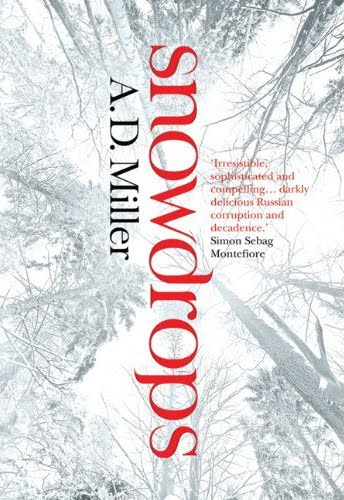
I know I just said that I'm not hard on fiction. I guess what I mean, is that it takes a lot for me to call something a "bad book" or to say that I've wasted my time reading a novel. I finish almost everything I start, and there have been only two exceptions in the past couple years. However, most of the things I'm about to say about Snowdrops are complaints. It's nominated for the Booker, so I don't have to be rhapsodic about its merits, of which there are many. It's a caper book, that's made clear from the start. There is a sense of fun when speeding through, knowing there's a scam, wondering how it will unfold. Snowdrops has a bit of a pulp thriller feel to it, though written in a more high-minded style, more thoughtful than throwing a cliff-hanger at the end of every chapter.

I enjoyed reading Snowdrops while I was reading it, but something nagged at me. About a week after I finished, I finally realised: I am sick of the honey-trap. I'm tired of the nebbishy guy seduced by the "bad" girl. I felt like I'd read Girl Crazy all over again, but set in Russia. Our protagonist, Nick, is a lawyer just moved to Moscow. He's a mediocre sort of fellow, without much in the way of personality, not much success with women, not much of a looker. Nick will be defined by the events around him, pulled along with the flow of cynical Russians, all on the take. Nick does not act, he reacts. Nick wants, but lets others take. Like Russell Smith's protagonist in Girl Crazy, Nick first encounters the conveniently slutty love interest while she's in distress. In this case, he foils a purse snatching. And Masha, after an accelerated courtship, gives him her body (and for extra kink, her “sister” watches). She continues to string Nick along for months, to ensure his help in the caper. (I'm not giving anything away here. Again, this is all foreshadowed in the telling.)
'In Russia,' Steve said, 'there are no business stories. And there are no politics stories. There are no love stories. There are only crime stories.'
Nick falls in love anyway. He thinks of marrying Masha, even though he knows nothing about her, and admits as much to himself in the narrative —constructed as a letter to his now fiancée (like in Girl Crazy there's a dull, dependable girl at the end, to act as foil to the wild girl of yore).
That's what I learned when my last Russian winter thawed. The lesson wasn't about Russia. It never is, I don't think, when a relationship ends. It isn't your lover that you learn about. You learn about yourself.
Caper accomplished, Masha conveniently disappears so that Nick can get onto being whatever it is he's learned to be. He can go back to England having had the Great Adventure, settle down with his predictable boring late-life wife.

One is supposed to separate the work from the writer. I understand that this is crucial in literary critique. But there are seriously unprofessional parts of me that wonder about A.D. Miller (and since I'm not getting paid for this, being unprofessional now and then is probably inevitable). A BBC piece on Miller says: "Miller's own experiences in Russia were 'slightly more uneventful' than those of his fictional creation". It makes me wonder if he wishes that all this had happened to him. If he saw all the strip clubs and easy sex, the women he writes about as desperate to find a non-Russian husband, and wanted so much to have them for himself. Would it have mattered if those women had ripped him off, had hurt him, if he'd gotten to fulfill that Mata Hari dream? In the end, this girl is always a fiction. It feels like Miller is writing a fantasy for himself, a Booker nominated Penthouse Forum letter. “I can’t believe it happened to me. I was working in Russia…” While it is well written, at times clever, Snowdrops winds up existing in sexual cliché territory, and for me that's a bit tired and not the least challenging.

ETA: In the comments, I just proposed the idea that the letter Nick writes to his fiancée is in itself a fiction. That he's the dullest dude ever, and so he makes up this elaborate story to tell his girlfriend, so she'll find him more interesting. And if that's the case, if the book is that self-aware? Then it's fucking brilliant. And I'm willing, totally willing, to believe that's the case, if there's any evidence for it. I'd prefer fiction be good, after all

Whatever You Say I Am

I was saying to a friend, recently, that I'm a lot harder on non-fiction than fiction. Even when I don't wholly enjoy a novel or short-story collection I don't tend to judge it too harshly. I like to talk fiction, move around inside it, make connections. With non-fiction, there's often a thesis in the setup (memoir isn't wholly excluded from this), and that invites critical inquisition of the text, even if the thesis as a whole is solid (see my unhappiness with Barbara Ehrenreich's Bright Sided). That's my theory on how I read, anyway.

The Psychopath Test danced right through all my argumentative tendencies, and stands as a solidly interesting read. Jon Ronson is an extremely talented writer and pure investigator. The Psychopath Test doesn't come from a single thesis, but rather the coalescing of several incidents and interviews that he'd done, which all seemed to make sense together in hindsight. For example, Ronson had interviewed "Tony" in Broadmoor psychiatric hospital for This American Life. Tony was living among serial killers and sex offenders as a consequence of claiming madness to get out of a jail sentence for aggravated assault. The psychiatrists at the time of his sentencing believed the quotes Tony had pulled from violent movies to be his own thoughts, and declared him insane. The NPR interview seemed pretty open and shut when I'd heard it years ago. Stupid kid does something stupid, and follows with stupid plot to Get Out of Jail Free. When he seems sane, the hospital thinks his treatment is working, and says they need to keep him. If he plays insane, he clearly needs to stay as well. Tony is stuck.

The Psychopath Test however, goes a bit further with Tony's story.
Seems Tony's doctors know very well that he faked his way into Broadmoor.
"Tony[...] did get here by faking mental illness because he thought it would be preferable to prison." [...]It was now the consensus. Tony's delusions --the ones he'd presented when he had been on remand in jail-- just, in retrospect, didn't ring true. [...]"Oh!" I thought, pleasantly surprised. "Good! That's great!" I had liked Tony when I met him but found myself feeling warier of him those past days so it was nice to have his story verified by an expert
However, the action of making up those stories in an attempt to escape prison, as well as many other indications have Tony diagnosed as a psychopath, according to the Hare Checklist.
But then I read Professor Maden's next line: "Most psychiatrists who have assessed him, and there have been a lot, have considered he is not mentally ill, but suffers from psychopathy."[...]Faking mental illness to get out of a prison sentence, he explained, is exactly the kind of deceitful and manipulative act you'd expect of a psychopath. Tony faking his brain going wrong was a sign that his brain had gone wrong.

The genesis and applications of the Hare Checklist, named after and created by pioneering psychologist Bob Hare, are ostensibly the main focus of the book. Ronson gives a thorough introduction to the history of the treatment and diagnosis of psychopaths, with pertinent peripheral information about psychiatry/psychology — and its opponents — in general (there's a very interesting chapter on the history of the DSM, which is going into its fifth edition). Ronson then takes the checklist on the road and investigates whether psychopaths are disproportionately represented in the top ranks of corporate executives. The Psychopath Test refuses to have a central thesis, rather Ronson simply and entertainingly reports the facts as he can find them, and the events as they happen. Both Scientologists and psychiatrists are treated with fairness, and neither escape scrutiny. Ronson gives enough of himself, though, to keep the book engaging and avoid being dry recantation of names and dates. This is simply an excellent, well-researched non-partisan look at a specific subset of psychiatric definitions.

When I was in University I took a first-year psychology course as an option. One of the things our professor told us was that we would wind up diagnosing ourselves with all sorts of mental disorders when reading the text book. We were told to ignore this phenomenon (is there a name for it? I never knew), and do our best not to be concerned when we checked off symptoms of depression, bipolar disorder, or food related disorders. We were asked to leave naming of our psychoses and neuroses to the professionals. An interesting subtext of The Psychopath Test is how Jon Ronson begins to do just this, as he becomes more knowledgeable. No, he doesn't think he's a psychopath, but he discovers — he thinks — that he's in whatever the exact opposite category is. He's too anxious, too interested in other people, he feels fear more physically*. At the same time, he begins diagnosing random people with psychopathy, after taking one class with Bob Hare. That, if anything, is one of the lingering and more important messages in The Psychopath Test: A little learning is a very dangerous thing.

*It's theorized that psychopaths had a low or non-functioning amygdala. Once Ronson hears about this, he feels his go in to overdrive rather too often.

Looking In

When Pigeon English was released early this year, we didn't know what would happen in London in August...

The narrative revolves around Harrison — Harri — an 11-year old boy, newly arrived to England from Ghana. He lives with his mother and older sister, while his father and baby sister have stayed behind. Harrison's family, like so many immigrant families, lives in a bad neighbourhood (in London), defined by crime and violence. Through the first-person narrative, Harrison retains an innocence and sense of wonder that seems to belong to someone several years younger. This is at times not exactly plausible, as when he seems to have absolutely no knowledge of human sexual activity. I remember being 11. I wasn't participating in anything, but I certainly knew some of the mechanics (and I can't just blame Jean M. Auel for that). Then again, perhaps the avenues which kids in Europe and North America learn about sex just didn't exist in Ghana; I can't claim to know anything about it. In other ways, the exaggerated innocence seems appropriate, as his class-mates are portrayed socially similar. The games and they way they play them sometimes seem, again, something younger kids would be interested in. (I should note, though, that by "innocent" I don't mean "simple.") The comparison has been made, favorably for Pigeon English, to Emma Donoghue's Room, with Harri judged an easier child narrator to read and accept. Readers often found Room's Jack both too precocious and annoying (I don't agree). Harri remains likeable and for the most part, age-appropriate (as above, if anything, he skews slightly young for his age). The Guardian review says
Kelman has already been much praised for his ability to write from an 11-year-old's perspective, but here, as often in the first half of the novel, Harri's voice feels laboured and faux-naïf.
I think most of this, aside from my issues with innocence, can be chalked up to Harri's difficulty using language in his new context. I think Stephen Kelman's writing is pretty clear on that.

While it's not explicit, one assumes that Harri's family is (in waves) moving to England for a "better life," but his flashbacks to time spent in his home country show that he is now much worse off. (Though this may be some of the troubling white framing of black experience as seen in The Help, or evoking a "noble savage" type.) Comparatively, London is dirty, violent, and crowded. People are selfish, preferring to harm rather than help others. The never-easing class divide in England cuts across colour and and country of origin, keeping a poisonous river between the have-nots and the have-too-much. The origins of the August 2011 London riots, it's been said, erupted from a feeling of absolute hopelessness, from the societal group of which Harri is now a member. Unlike the prevailing "You can be anything" message that American kids grow up with (erroneous or not), England likes to keep its classes separate. Given the historically abysmal record in the way England treats the poor, upward mobility isn't even considered; it's just assumed getting out is not possible. Near the end of the novel, the seniors in Harri's school write goodbye messages on each other's school shirts. Two pages are devoted just to these messages, and they illuminate the matter-of-fact acceptance of the fate of those without means. It doesn't even seem sad or angry, it just is. The messages read like any year-book: some are just names, some are jokes or bawdy quips. They begin*:
GOOD LUCK KEEP IT REAL     spud
NORTHWELL MANOR TILL I DIE        TYRONE
TAKE IT EASY GET RICH OR DIE TRYIN naomi
DFC [the initials of a local gang]FUCK SCHOOL LEWSEY HILL R. PUSSIES
Then others start, interspersed with the sort above, with a new theme:
JUST ENOUGH EDUCATION TO PERFORM
repeat after me: DO YOU WANT FRIES WITH THAT?
DON'T PAY TAX, SELL DRUGS INSTEAD
SEE YOU AT THE JOB CENTRE
Be warned: the future doesn't need you![emphasis mine]
It feels almost prescient that mere months before the London Riots this novel would be published, capturing the soon-to-be-violent malaise of a demographic group so strongly. Harri, while a newcomer, shares a lot with his peers, and neighbours. Like him, most of the people in Pigeon English are essentially, easily good. For example, Terry Takeaway is a thief and a drunk, owner of a pitbull (hallmark of a "bad guy" in many places), but he's also on the lookout for Harri, willing to defend him from older kids for no other reason than it's intrinsically right. (The pitbull, Asbo, is revealed to be a loveable pup, and Harri enjoys playing with him immensely.) There are only a couple essentially bad characters in Pigeon English, and Kelman is careful to make them different as possible, to show that the hard, evil criminals of legend aren't the majority. When things go bad on a large scale, as in the August riots, it's often not because people have substandard ethics or upbringing (fuck you very much, David Cameron), but because they're pulled along, never having been allowed to know another way to be.

There's a load of films being made where filmmakers go to a council estate and 90 percent of the people there are functional—getting their kids ready for school, paying their taxes, working. And 10 percent are dysfunctional—and they go, "That's what we're going to make a film about."*


*I've attempted to replicate the changes in type on these pages of the novel, which indicate that there are different people writing each message.
**Actor Eddie Marsan, interviewed by Jonathan Romney in The Independent, May 2, 2010. As quoted in Jon Ronson's The Pyschopath Test (210).
***Also, I think I've figured out — for myself anyway — the "talking" pigeon character that seems to have caused so many readers so much trouble. He's supposed to be for Harri, as Harri is for the neighbourhood; an outsider looking in, with a perspective that illuminates the situation. I agree, though, it doesn't really work.

Wild Abandon

My first experience with the work of Joe Dunthorne was watching the movie adaptation of Submarine. The movie is a bit off-kilter, slightly trippy, and seemingly coloured by remembrance. It’s also a bit uneven, and I was left not terrifically impressed. It was, then, with an open mind but a small amount of trepidation I began to read Dunthorne’s new novel, Wild Abandon. What I got was the usual outcome of the book vs movie duel: something much, much better on the page than on the screen.*

Wild Abandon follows the lives of commune, or their preferred term “community,” members in Wales. Don and Freya are a middle-aged married couple, and half of the creating force behind the community. Janet, their school chum, and Patrick, former landlord and provider of startup capital, round out the founders. The community is in decline, after a decade or so or humming along. New members are hard to find, there aren’t many children.

Don, with his degree in film studies, is ever the actor reciting lines. He’s described as often seeming to have rehearsed things is his head, many times, before speaking. “Don preferred himself in front of the lens. In the same way that a miserable holiday, when viewed through its photographs, becomes a stream of joyful moments.” In a flashback sequence, he is away from the community and gets the call his wife is giving birth to their first child, Kate. He relishes the role of the immediately expectant father, racing back, practicing what he’ll say, dramatically, to the cop that pulls him over for speeding (and is saddened when it doesn’t happen). That he doesn’t make it in time to see Kate born is representative of his character. Freya is responsible in birth, as well as in death; she’s been dubbed the community’s “abattoir,” because she’s the only one who can actually kill and butcher animals. The sexual politics between Freya and Don are interesting: it’s the woman who works hard, and gets down to what has to be done, because there’s little choice; the man lives in the mind, making speeches and directing, while doing very little himself. This relationship isn’t atypical in literature or life; I’m thinking of the Great Male Author trope, with his long-suffering wife behind him, making financial and household arrangements while the artist needs his think-time.

Kate has her sights set on going to University elsewhere in the next year, and 11-year old son Albert is too smart yet not socialized enough. Kate escapes the community to the home of her boyfriend’s parents. Like most teenagers, she wants only what she doesn’t have while living with her parents (and this is echoed by boyfriend Geraint moving to the community later on). She seeks what she thinks will be a more interesting sort of discord.
Considering that Kate had never spent any time in a suburban home before, she had a highly developed understanding of what to expect; during her upbringing, her father had encouraged her to make the most of his film collection, which had a lot to say on that subject, including The Graduate, Edward Scissorhands, American Beauty, and The Ice Storm. One of the community's well-told stories was of Kate, aged ten, setting an alarm for herself to wake at 3 a.m. so that she could come downstairs and watch Poltergiest, the definitive suburban horror film.
In fact, what she finds is that life is pretty much humdrum no matter where you run to.
The disappointing news from her time in Three Crosses was that, where she had hoped to find suburbia's dark and seething underbelly, she had found its potbelly of contented boredom.
( In this way, Dunthorne reads a bit like a gentler, less satirically-minded Tom Perrota.)

Everyone in Wild Abandon is a bit like Kate, moving and shifting, enjoying the new but eventually searching for a new place that might be just a bit better: Kate eventually gets into Cambridge; her parents leaving London squats for the wilds of Wales; Patrick leaves the commune to once again work a full-time job and have an apartment; Freya wanting to leave Don and get Albert into regular school; Geraint joining the community. It’s reminiscent of the constant ebb and flow of city/suburban populations. Albert, not having the possibility of self-determined mobility at his age, turns to an Apocalypse scenario centered on a black hole for comfort. It’s child’s logic; if he never leaves his known world, the only possible change is for the world to end. Kate is the embodiment of that black hole—as her sphere increases (going to school outside the community, then leaving for the Three Crosses suburb, then going to college) the more Albert feels his world is ending.


Dunthorne has just the right descriptive simile or metaphor handy at all times. This isn’t as easy to pull off as you might think; the descriptor has to be contextual, so much so that it gives the reader a perfect idea of the scene at hand, without distraction. Dunthorne has this down to an art, and it’s an integral part of his style. This might be annoying in the hands of a lesser writer, but I only noticed the comparatives so often because of how perfect they were. Early on in the novel, one of the founding members of the community, Patrick, has a paranoid episode after ingesting both marijuana and mushrooms. Fleeing the community on a cold night in just underwear, he tears through the brush, coming out into a suburban street in an empty new development. As he succumbs to hypothermia he falls onto the “road shaped like a thermometer -- a turning circle at one end.” Not only is this an accurate visual, it’s loaded with symbolism. The thermometer, of course, speaks of temperature and Patrick’s loss of body heat. The choice of a cul-de-sac, though, also represents an ending, the bottom of the bag, or in Intervention speak, rock bottom. Patrick quits the community, and gets clean (after a last hurrah of enjoying hospital sponsored morphine drips). Later, Kate takes her university qualifying exams:
There was something enjoyable about the tarot of turning over an exam paper: a whole gymnasium full of people reading their fortunes.
Again, this is perfect on a couple levels. Exam results do tell the future, but on a smaller and more physical level, the turning of the papers is indeed very like turning over tarot cards. It makes the moment slower than I remember when I took my exams, and more lovely. Wild Abandon is like that sometimes, making the reader stop sometimes, over the small moments, looking at the small parts of life in a new way. That’s what good literature does.

Kate’s first memory of cartoons is watching “Steamboat Willie.” She’s struck by the pile of potatoes Willie is tasked to peel, a pile that never seems to end or get any smaller. It gives her nightmares. The petite-bourgeois lives in Wild Abandon are similar in that, not getting ahead, just making lateral movements. (The commune, while at times hardscrabble and always ad-hoc still falls into this category, having been created by a property owner and three holders of liberal arts degrees). Comfortable survival is the same on the commune as in the suburbs. The novel’s title, perhaps, relates to those small moments which stand outside just-living, like the two rave parties depicted (an accidental one in the past, a party for Kate’s birthday that got out of hand, and the one that climaxes the book, which is engineered to generate interest in the community). Perhaps, though, the title is sarcastic, because no matter the location, being middle-class has conformity clauses.

Reviewed from advanced reading copy, courtesy Penguin Books Canada.
*Yeah, I get that they’re different works. **
** And I’m glad I haven’t read Submarine, actually. The Guardian review did that thing that The G&M review did with The O’Briens, talking about how the first book was much better. Sometimes, it’s good to start with the second book?